
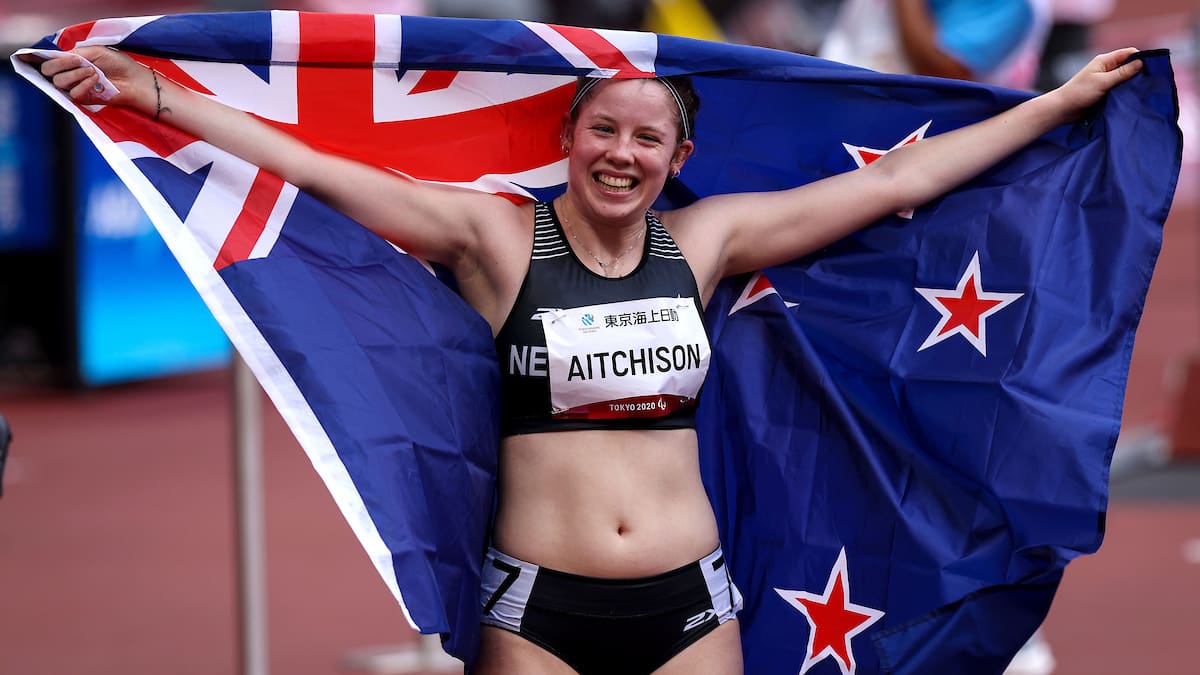
Since being properly fitted, Aitchison – named Para athlete of the year at last month’s Halberg Awards – has felt the difference immediately. Not just in comfort, but in performance. She’s running faster.
At last year’s world Para athletics championships in New Delhi, she set a T36 200m world record of 27.18s – shaving almost 0.3s off her previous best. She then won the 100m world title, just 0.02s outside her quickest time.
For an athlete constantly chasing the “one percenters” that drive performance gains, Aitchison has found proper breast support to be critical.
“Doctors have told me if you’re able to hold the breasts in place and have the right support, it actually does help me run faster,” the 24-year-old says. “Every point I can get to go faster, I’ll take it.
“I think if a bra is recognised as sports equipment, then women will feel more supported to talk about their breast health and their breast issues – and also understand what bras they need for the sport they’re doing.”
In-depth research into sports bras in recent years has revealed the benefits of proper breast support.
Organisations like England Football, the British Olympic Association and the British military have worked with the University of Portsmouth’s Breast Biomechanics Research Institute to look at the effect of sports bras on performance and women’s health.
The institute’s research shows poorly fitted bras can cause runners to shorten their stride by up to 4cm – the equivalent of running an extra 1.5km over a marathon. A runner’s breasts can move as much as 19cm without proper support. And 80% of women are wearing the wrong size sports bra, with wide-ranging consequences.
A 2019 survey with the English Institute of Sport found 75% of 70 elite athletes had never been fitted for a sports bra, while 26% said breast pain affected their performance, The Athletic reported.
Research shows poorly fitted bras can hinder athletic performance and cause various health issues. Photo / 123RF
Back at home, some elite sports teams include proper bra fittings as part of their uniforms. The Black Ferns are fitted with bras for their touring kit and receive bras of their choice, with a range of training gear, through sponsor Adidas.
But most high-performance athletes find, and fund, their own sports bras.
Dr Helen Fulcher is the athlete performance support lead at High Performance Sport New Zealand. She sees bras as an essential part of a female athlete’s equipment.
“As an athlete, your bra is part of your uniform … part of your sporting equipment. It does have an impact on your ability to perform as an athlete,” she says.
“For female athletes, being able to understand that something as simple as getting the right bra, getting the right fit can have a positive impact on their performance is a phenomenal thing. There’s complexity there we’re only really learning about now.”
The shape, style and fit of a bra can all impact a woman’s chest wall. A band around the bottom that’s too tight can restrict chest movement and “the ability to take a deep breath – and therefore your oxygen consumption, which is really important,” Fulcher says.
“There are also linkages between your foot strike and your posture in high impact or changing direction sports relative to how your breasts move on your chest wall.”
A poorly fitted bra can also create injuries, chafing and damage to breast tissue. It can even affect other parts of the body: research released in 2024 by the US National Institutes of Health showed the risk factors with ACL knee injuries decreased when women wore highly supportive bras.
Fulcher recommends women look at the sports bra app, created by Sport Medicine Australia with the support of the Australian Institute of Sport, for free guidance in choosing a bra that’s supportive, correctly fitted and comfortable.
Aitchison advocates for recognising bras as essential sports equipment and emphasises early education on breast health. Photo / Drew Chislett, www.photosport.nz
Aitchison, in speed training for next month’s Australian track and field champs, only realised the difference a well-fitted bra could make while recovering from surgery to remove breast lumps.
The three-time Paralympic medallist found multiple lumps in her breast, which raised concern with a family history of breast cancer. She was referred to a breast surgeon, and surgery confirmed they were benign fibroadenomas.
“If I didn’t have the surgery and didn’t have that whole journey, I think I would be still in the same place I was before. I didn’t really know much about sports bras, and having the right support for my breasts,” she says.
“I didn’t know about the importance of looking after your breasts and being aware of your body.”
Aitchison has also learned the importance of replacing bras regularly, as fabric loses its support and shape over time. And she’s also aware the cost of specialised bras can be a barrier to some athletes.
“It comes down to really emphasising the importance of, ‘This is expensive but the benefits of it actually outweigh the cost’,” she says.
While breasts remain something of a taboo in sport, Aitchison wants to see that change – starting with early education.
“If women aren’t realising how important breast health is to them, they’re not going to go and seek out information,” she says. “If it’s normalised, and everyone’s receiving a basic understanding of women’s health, they will be able to make the right decision for their body.”
This story was originally published at Newsroom.co.nz and is republished with permission.