

For decades, a bright star in the night sky quietly held onto a secret. Gamma Cassiopeiae, easy to spot in the familiar W-shaped Cassiopeia constellation, looked ordinary at first glance. But behind that steady glow, something strange was happening.
Astronomers kept seeing bursts of powerful X-rays that did not fit what they knew about stars like it. The question lingered for more than half a century: what was causing them?

Now, that long-running mystery finally has an answer. New observations reveal that gamma-Cas is not alone. An unseen partner has been feeding on it and, in the process, is creating the unusual X-rays that puzzled scientists for generations.
Strange past of gamma-Cas
Gamma-Cas has stood out since the 1800s. In 1866, astronomers noticed something odd in its light. Instead of showing dark hydrogen lines like the Sun, it displayed bright ones.
That discovery led to the classification of “Be” stars, a group known for spinning fast and shedding material into a surrounding disk.
Over time, scientists learned that these disks can grow and fade, causing changes in brightness. Gamma-Cas became a favorite target for skywatchers, both professional and amateur. Still, something deeper remained unexplained.
The X-ray puzzle
In the 1970s, things got even stranger. Observations showed that gamma-Cas was emitting strong X-rays.
Not just any X-rays, but ones coming from plasma heated to around 150 million degrees Fahrenheit. That is far hotter than astronomers expect from stars of this type. Even more surprising, the X-ray brightness was about 40 times higher than normal.
As technology improved, more stars like gamma-Cas were found. About two dozen showed similar behavior, forming a small but puzzling group.
Scientists narrowed the possibilities down to two ideas. Either magnetic activity near the star was heating the material, or matter was falling onto a hidden companion and releasing energy as X-rays.
gamma-Cas’ companion
The answer came from a newer space mission designed to study X-rays with sharp detail. Its instruments tracked how the hot plasma moved. What they found was clear. The X-ray signals shifted in sync with the orbit of an unseen object.
That object is a white dwarf. It is a dense stellar remnant, about as massive as the Sun but packed into a size similar to Earth.
The white dwarf pulls in material from gamma-Cas. As that material spirals in, it heats up and produces the intense X-rays observed.
“There has been an intense effort to solve the mystery of gamma-Cas across many research groups for many decades,” said lead researcher Yaël Nazé of the University of Liège, Belgium. “Now, thanks to the high-precision observations of XRISM, we have finally done it.”
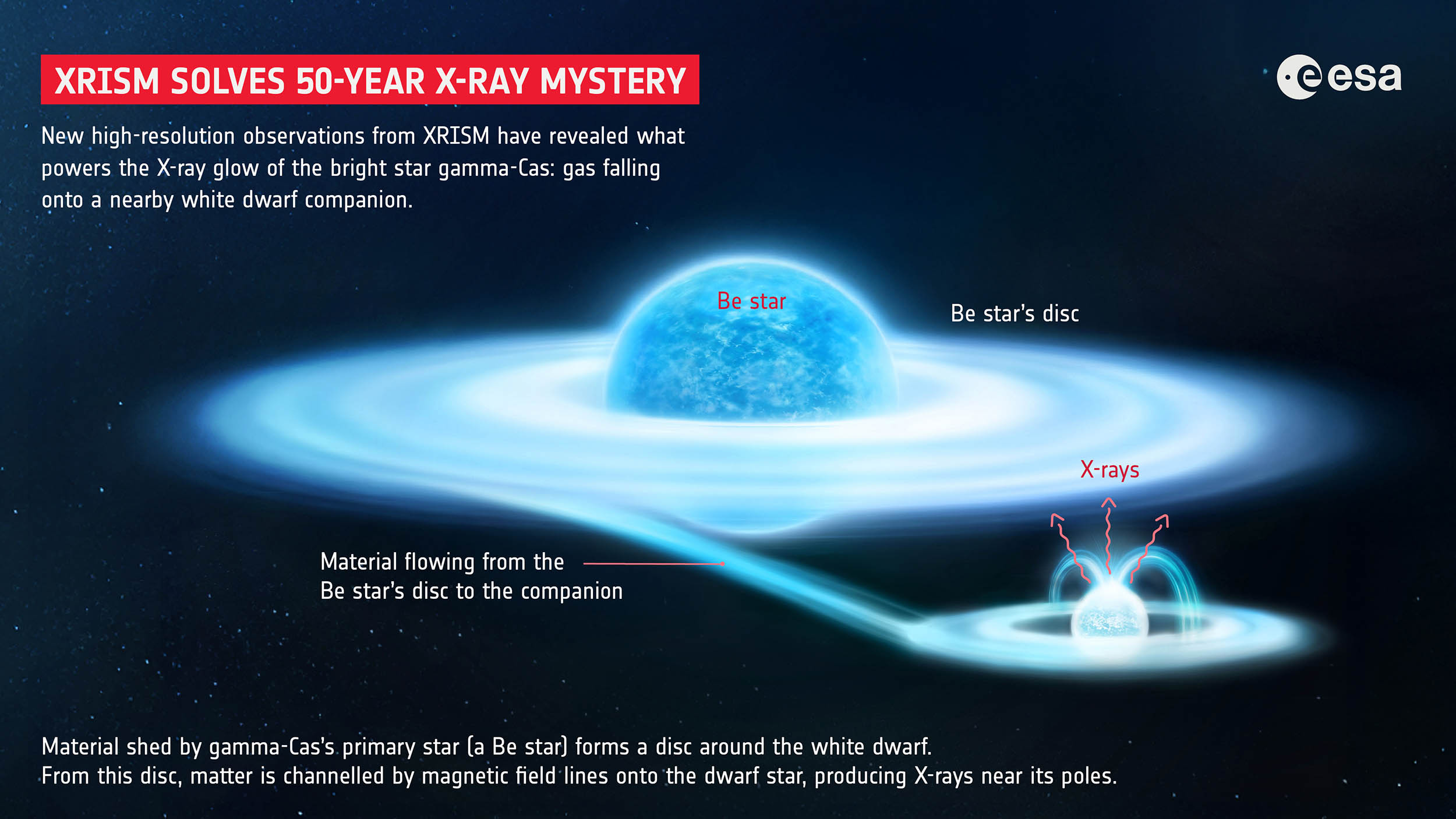 High-resolution observations made by XRISM have revealed the origin of the curious X-rays coming from naked-eye star gamma-Cas: matter falling onto its companion, a white dwarf star. Credit: ESA. Click image to enlarge.How the mystery was solved
The key to solving the puzzle was precision. Earlier missions helped narrow down the possibilities, but they could not fully track the motion of the X-ray source. The latest observations changed that.
“The previous work using XMM-Newton really cleared the way for XRISM, enabling us to eliminate numerous theories and prove which of the last two competing theories was correct,” said Yaël. “It’s extremely satisfying to have direct evidence to solve this mystery at long last!”
By linking the X-rays directly to the companion’s orbit, scientists could finally rule out magnetic interactions as the main cause.
What this means for astronomy
This discovery does more than explain one star. It changes how scientists think about a whole class of systems.
These pairs, where a Be star feeds a white dwarf, were expected to be common among lower-mass stars. Instead, they appear more often in higher-mass systems like gamma-Cas.
That raises new questions about how such pairs form and evolve. The interaction between the two stars plays a key role, but the details are still being worked out.
“We think the key is in understanding how exactly the interactions take place between the two stars,” said Yaël.
“Now that we know the true nature of gamma-Cas, we can create models specifically for this class of stellar systems, and update our understanding of binary evolution accordingly.”
Gamma-cas X-ray mystery solved
For many scientists, this result feels like closing a long chapter. Decades of observations, competing ideas, and gradual progress led to this point.
“It’s incredible to see how this mystery has slowly unfolded over the years,” says Alice Borghese, an ESA Research Fellow specializing in high-energy astrophysics.
“XMM-Newton did much of the groundwork in ruling out various theories about gamma-Cas. And now, with the next generation of advanced instrumentation, XRISM has brought us over the finish line.”
The effort also shows how science often works across borders. “This wonderful result underlines the strong collaboration between XRISM’s Japanese, European, and American teams,” said Matteo Guainazzi, ESA’s XRISM Project Scientist.
“This international team combines the technical and scientific expertise needed to solve the X-ray universe’s biggest mysteries and open new avenues for research.”
Gamma-Cas still shines in the night sky, just as it always has. But now its story is clearer. What once seemed like a simple point of light turns out to be a complex system shaped by a quiet but powerful interaction between two stars.
The full study was published in the journal Astronomy & Astrophysics.
—–
Like what you read? Subscribe to our newsletter for engaging articles, exclusive content, and the latest updates.
Check us out on EarthSnap, a free app brought to you by Eric Ralls and Earth.com.
—–