
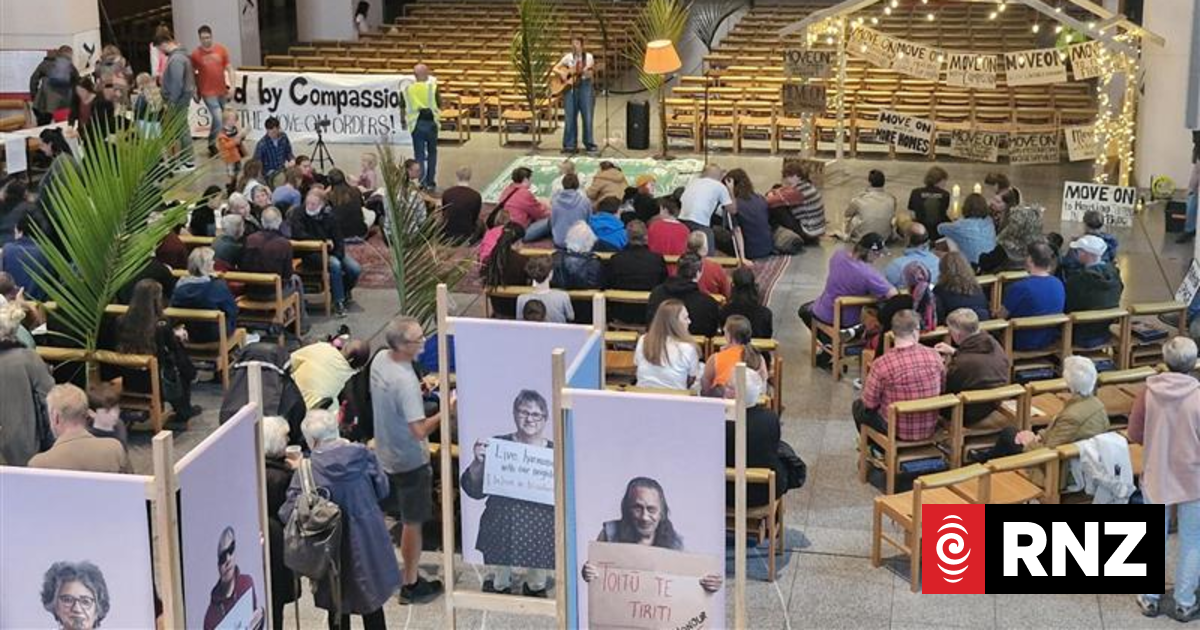
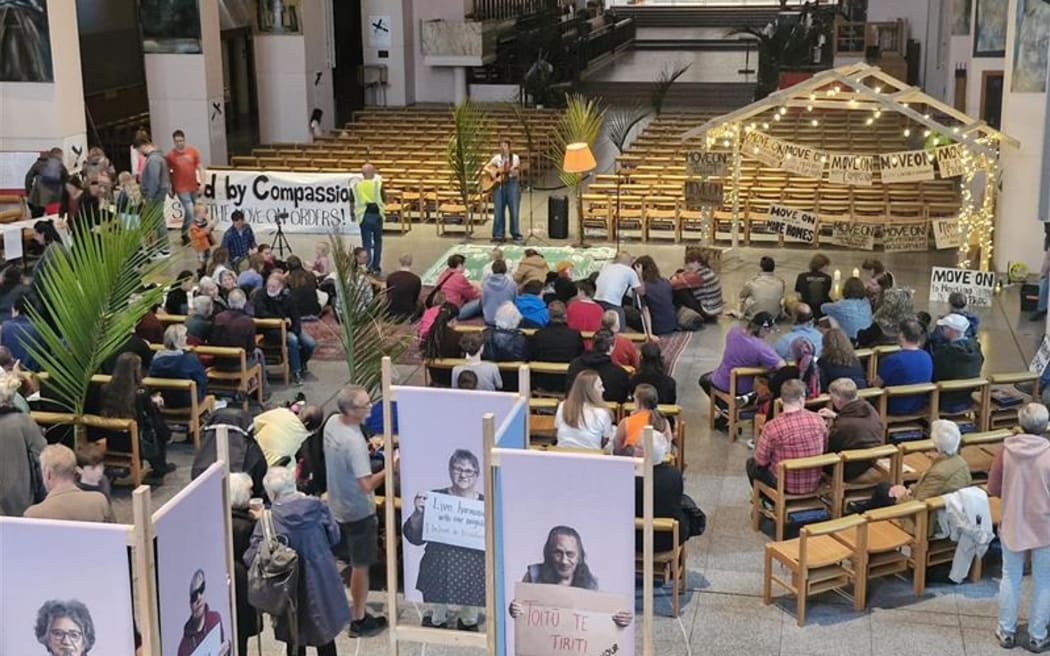
About 250 people are at an overnight vigil at Wellington’s St Paul Cathedral to protest the government’s plan to introduce move-on orders.
Photo: RNZ / Russell Palmer
Dozens of people are hunkering down overnight at Wellington’s St Paul Cathedral to protest move-on orders.
About 250 people and 50 volunteers are at the vigil, organised by 10 church groups and supported by other community groups.
Families with children were expected to head home after food, speeches and music tonight, while others were expecting to stay for the prayer vigil lasting until 6am.
Breakfast would then be served from 6.30am to 8am.
They oppose the move-on orders the government plans to introduce, which would allow police to issue notices to those sleeping rough requiring them to move to another location.
Those who refuse could face a $2000 fine or up to three months in prison.
Assistant Bishop Ana Fletcher told RNZ she wrote to Christopher Luxon and his Housing Minister Chris Bishop inviting them to attend, but got a message back saying they were unable to attend in person.
“I did write very nicely to the prime minister and the minister for housing and they said they were unable to attend in person, hopefully they send someone else.
“This is right next to the halls of power, it would be lovely if they could come, the opportunity is still open to anyone who would like to come if they’re available in town.”
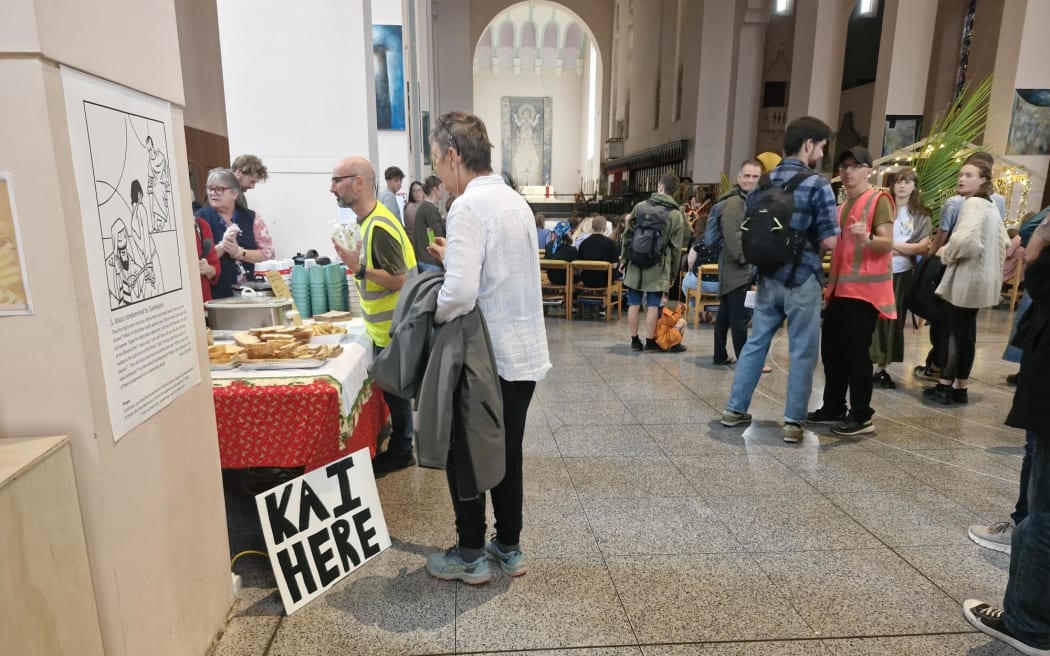
About 250 people are at an overnight vigil at Wellington’s St Paul Cathedral to protest the government’s plan to introduce move-on orders.
Photo: RNZ / Russell Palmer
A spokesperson for Luxon said he was invited to a lot of events, “all of which are carefully considered”.
“He has a full schedule in the mroning – including his weekly interview with Morning Report.”
Assistant Bishop Fletcher said they had three messages for the government.
“The first is that we believe that people are not problems to be kicked down the road, and that every person has dignity … the second is that the current response criminalises those who are in poverty that are experiencing distress and trauma.
“The third is that there’s actually evidence-based effective ways to address homelessness … we want to be pushing resource into those things that we know actually work.”
Ronson Grant works for support service DCM, which provides IDs, banking, and transitional housing to the homeless.
“Just [here] to support our whānau, building awareness especially. I mean, we could all end up in this situation one day, especially the way the world’s going,” he said.
“The more people that get behind this I suppose it would push it out there that we do need some more help with our whānau that are living on the fringes of society.”
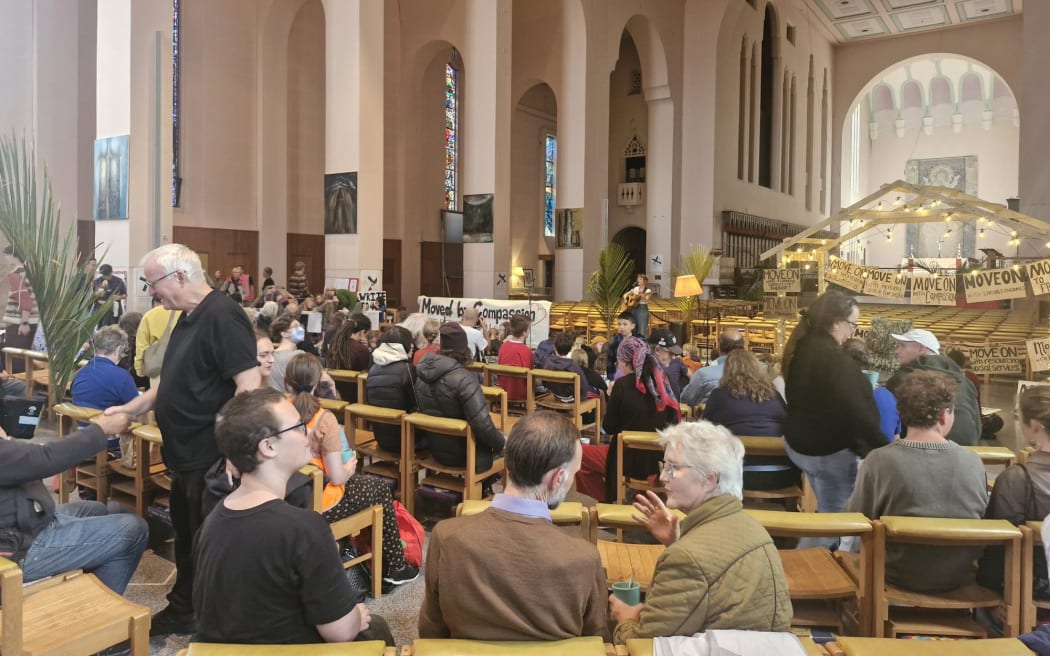
About 250 people are at an overnight vigil at Wellington’s St Paul Cathedral to protest the government’s plan to introduce move-on orders.
Photo: RNZ / Russell Palmer
He said he had written up some ideas for local councillors which would actually help with the problem.
“I think the message for our government is to come down and see how our whānau are living. There’s a little bit more to our whānau just wanting to live on the streets, there’s a lot of underlying issues … mental health or addiction or both, we sort of shifted away from institutionalised and it’s more of a community based solution to it all, so I think we should start backing that idea up.
“Don’t take their freedom away, they’re being ostracised enough as it is, just awhi our whānau.”
Reverend Amber Leonard Schoss – who has experienced homelessness – is community chaplain at Wellington’s Anglican Diocese and said the government had got it wrong.
“In our communities I think Kiwis have really responded to these orders so I think perhaps the government has misread Aotearoa on this one, because we’re people that when it’s hard, we turn up for each other.
“It’s pretty hard out there at the moment and people are worried about kai and about gas. But actually the most vulnerable people have been set up to being in a vulnerable position by predictable and preventable policies. I think New Zealand doesn’t want that.”
She said her message to the government was that they could change their mind.
“You can come and join us.”
Salvation Army NZ head of welfare Christina Taylor said the move-on orders were “horrendous”.
“I think it’s just really criminalising people … a really lazy, inhumane solution. We could do much better.
“It really impacts particularly women, really vulnerable people, young people, rainbow community and people with significant mental health and addictions.”
“Hit pause, come together, come up with something better.”
Sign up for Ngā Pitopito Kōrero, a daily newsletter curated by our editors and delivered straight to your inbox every weekday.