
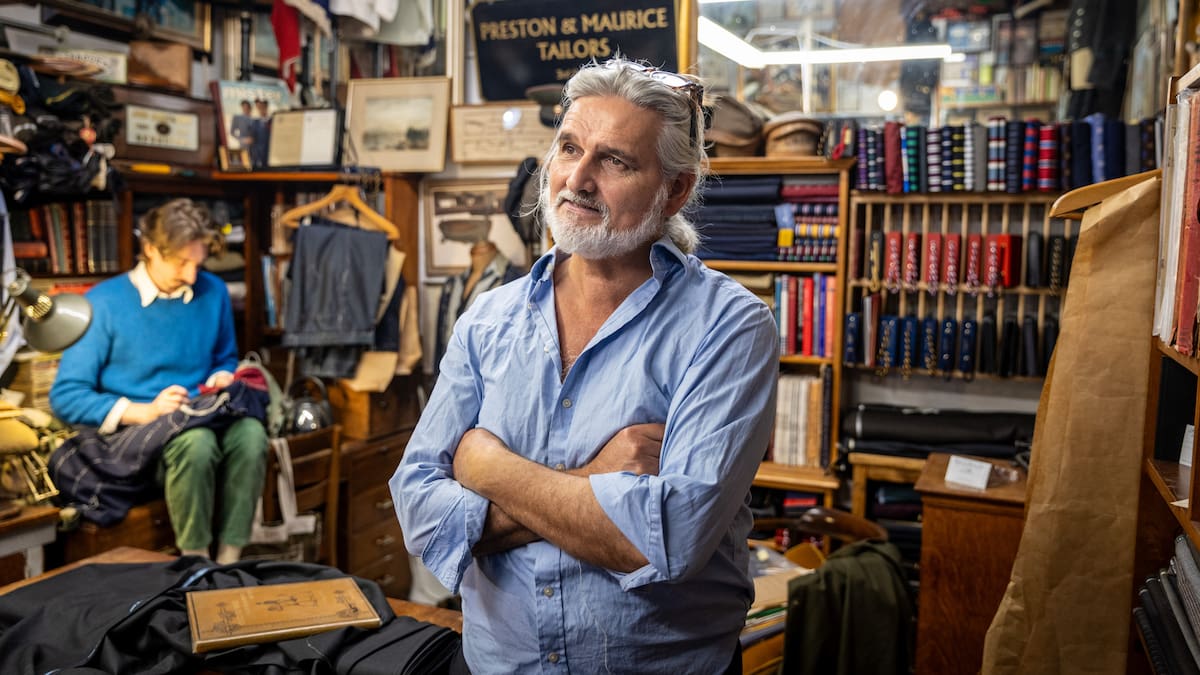
As with all consumer purchases costing life-altering quantities of money, the value of a bespoke suit is less about the product and more about the feeling. At Preston and Maurice at least, that feeling starts the moment you enter the store.
So much wood, cloth and clutter. So much tradition and nostalgia: bolts of fabric, boxes of tailor’s chalk, shears, paper patterns and a 100kg buttonhole machine that has done 615 million stitches. Antiques, century-old books, wage records, ancient magazines. It might cost $5000 or more for the incomparable feeling of a bespoke suit from Brendon de Silva, but it costs nothing for the incomparable feeling of spiritual connection to a grand tradition that comes from standing before his cutting table, surrounded by his personally-curated living museum.
Preston and Maurice is an aesthetically perfect, quite moving version of a past that probably never existed. Photo / Michael Craig
His shop is no less a work of art than one of his suits, but now it has been picked apart and must be remade in Parnell, where his partner, fashion designer Jane Daniels, has agreed to give him a room in her shop to operate out of.
There’s a good chance he will be the last in the long and illustrious line of tailors that have passed through the doors of Preston and Maurice, which, in its heyday in the 1950s, had 30 to 40 staff working across four floors in its premises on High St.
For as long as he can remember, the business has claimed to date back to 1897, but his own investigations have only managed to find records dating to 1909. This detail is not trivial. This is a man who values a line’s precision as much as its beauty.
At one point more than 30 people worked for the company. Photo / Michael Craig
With his voluminous grey mane and two pairs of glasses to hold it out of his eyes, beautifully cut untucked shirt unbuttoned to expose his decolletage, eclectic conversational tastes, salesmanship and jandals with socks, he’s less a throwback and more a one of a kind: someone who cherishes and celebrates the line of tradition from which he comes, but also exists entirely outside it.
He didn’t start working as a tailor until he was 28, which, he says, is too late by Savile Row standards. Before that he had worked as a salesman in a place called the Suit Centre when he bought some cloth from Malcolm Heard of Preston and Maurice. They struck up a friendship and he began visiting the shop in High St. Heard became his teacher and mentor and, after Heard’s death, de Silva took over the business.
From one of his mannequins, he pulled an under-construction jacket that was covered with hundreds of stitches, known as “basting stitches”, which would later be removed. The suit was comprised of a shocking number of layers of fabric: cotton, horsehair, silk and so on. He opened it out and showed me the enormous amount of work that had already gone into it, and outlined the enormous amount still to come. He would conduct up to five fittings throughout the construction: reshaping and refining and developing until it was less a suit and more a delivery device for self-improvement.
Although it was not made for him, nor remotely his size, he put it on and asked me to shake his hand. “Look at the shoulders,” he said. “See how they stay still?” He takes pride in his shoulders and even more pride in his sleeves. To produce a good sleeve, he says, is the pinnacle of the craft.
Brendon de Silva became a tailor at age 28. Photo / Michael Craig
He says the production of a bespoke suit is akin to sculpture and to watch him thread and use a needle is to understand the truth of that claim. I watched him work on a phenomenally fine sliver of cashmere, laying down stitches that barely touched the surface, so as not to show through the other side. He plunged the needle down towards the fabric, then, at the last moment, levelled out, skimming only microns beneath the surface and coming straight up again, before plunging back down. When he’d finished, he turned the cloth over to show the invisibility of the stitches. It was literally surgical precision, closer to a magic trick than an act of craft.
Unbidden, he started assessing my body and talking about how he would design for it. He said I had strong shoulder blades, like a tennis player. He made me feel good and told me – contra my children – that I wasn’t fat. He put an under-construction jacket on me and told me to notice how it made me look “healthy”, especially in the chest, where carefully cut curves and layering of premium hydroscopic fabrics created what he called “a wonder bra for men”.
Greg Bruce is fitted for a suit. Photo / Michael Craig
A properly made bespoke suit, he says, will make a man look fit, healthy and slim: broader in the shoulders and narrower in the hips. From five, 10, 15, or even 20 yards away, he says, people will notice how fantastic you look.
Limited by his dedication to handmaking such beauty from start to finish, de Silva can only make 20 suits per year, much of which he does while sitting on the cutting table in his shop with cloth draped over his legs. After his considerable costs, he’s making what he describes as supermarket shelf-stacker wages.
On Savile Row, he would be called a journeyman, which is the name they give to someone who does everything from start to finish. Ironically, you don’t find journeymen on Savile Row, where division of labour and specialisation rule.
It takes de Silva 120 hours to make a suit. On Savile Row, he says, they can do it in 65. It takes him 27 minutes to make a buttonhole. He says there is a woman on Savile Row who can do it in five. That is all she does: producing buttonholes in a basement for bespoke tailors.
Buying a beautiful suit is a little about the way it makes you look and a lot about the way it makes you feel. There might be money in buttonholes made in basements, but when you’re paying $5000 or more for a piece of clothing you don’t want efficiency – you want magic. At Queens Arcade, the magic just left the building.