
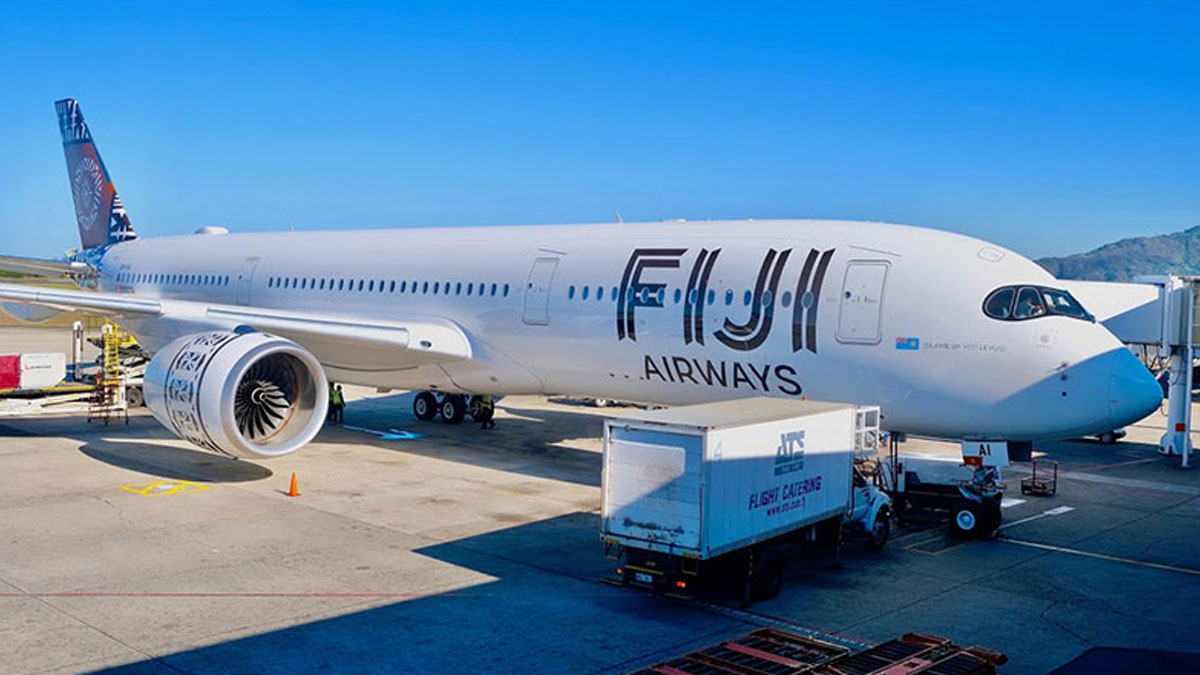
Fiji Airways reports a loss of $25M in 2024, primarily due to unrealised foreign exchange losses
The Fiji Airways Group
reported a loss after income tax of $25 million in 2024, primarily
due to unrealised foreign exchange losses of $83.5 million on
USD-denominated lease obligations following the strengthening of the
US Dollar.
The
adjustments are non-cash and required under international accounting
standards.
They
say the overall profitability was affected by significant global
currency movements.
Fiji
Airways says despite these impacts, as at 31st December 2024, the
company maintained a strong cash position of $375.2 million,
supported by $2.1 billion in operating receipts.
They
add cash reserves, liquidity, and fleet strength continue to provide
a solid foundation for the airline’s future financial resilience.
The
airline further reduced its debt portfolio, strengthening balance
sheet resilience and liquidity, with more than 95 percent of
borrowings sourced from local financial institutions as at the end of
2024.
For
the period, Fiji Airways says it produced another year of strong
network performance, fleet investments, and continued global
recognition.
The
airline reported record operating revenue of $1.85 billion and
carried 2.3 million passengers, the highest in its history.
Despite
intense trans-Pacific competition, rising operating costs, and
foreign exchange pressures, Fiji Airways maintained strong liquidity,
expanded its global footprint, and continued major investments in
fleet, training, and local talent development.
The
company says the 2024 performance has
helped strengthen a more resilient Fiji Airways.
The
year was marked by challenges such as cost of living pressures,
limited growth in hotel room stock, strong competition from
alternative destinations and, more recently, a fuel cost and supply
crisis.
In
2024, the airline launched its Dallas-Fort Worth route, Fiji’s
longest service and third gateway to the U.S., while also introducing
new services and increased flight frequencies across Australia.
The
company says operational performance remained strong, with
improvements in on-time performance and expanded digital service
options for customers.
Fiji
Airways adds it completed its full transition to the oneworld
alliance in April 2025 and strengthened partnerships with key airline
partners, including American Airlines, Qantas, and Cathay Pacific.
The
airline further expanded its global reach through new interline
agreements with China Airlines and Porter Airlines, enhancing travel
options for passengers.
Fiji
Airways says it now operates 23 aircraft, including additional ATR
72-600s to support domestic and regional reliability.
Major
upgrades to the Fiji Airways Aviation Academy were also completed,
including the installation of new A350 and ATR full-flight
simulators, reducing the need for overseas training and expanding
pilot and engineer development pathways.
The
airline has reported a workforce of 2,228 employees, with 90 percent
local Fijian representation and women comprising 43 percent of the
workforce.
Fiji
Airways continued to receive top-tier global awards, including Best
Airline in Australia and the Pacific – Skytrax World Airline Awards
2024, Best Economy Class in Australia and the Pacific – Skytrax 2024,
Best Business Class Onboard Catering in Australia and the Pacific –
Skytrax 2024, Best Airline Staff Service in Australia and the Pacific
– Skytrax 2024, APEX Five-Star Major Airline Rating 2024, APEX
Passenger Choice Award 2024 for Best Entertainment in the South
Pacific, and Oceania’s Leading Airline Lounge – World Travel Awards
2024.
Board
Chair, Nalin Patel says these awards reaffirm the dedication of their
people, who consistently go above and beyond to deliver the warm
hospitality that Fiji is known for.
The
airline also highlighted several sustainability initiatives,
emphasizing that transformation does not happen overnight but is
achieved through steady, meaningful progress, initiative by
initiative, under its sustainability framework: Maroroya.
The
key initiatives include the introduction of electric ground power
units and tugs, onboard recycling of plastic bottles, the “Every
Takeoff, One Tree” program, and the expansion of low-waste inflight
practices, all reflecting Fiji Airways’ commitment to reducing its
environmental impact.
Looking ahead Fiji Airways expects global market conditions to remain dynamic
in 2025, with ongoing competition and cost volatility across the
aviation sector.
Given
the recent spike in jet fuel prices driven by the conflict in the
Middle East, the airline will continue to closely monitor
developments and take a prudent approach to capacity deployment, cost
management, and network planning, while maintaining a strong focus on
service quality and operational resilience.
Patel
says their team continues to demonstrate resilience and
professionalism in a highly competitive global aviation environment.
The
Fiji Airways Annual Report for the year ended 31 December 2024 has
been tabled in Parliament and the results are now publicly available.
The
company also acknowledges the delay and they understand their results
of great interest to the people of Fiji.
The
2025 results are currently under audit and these results will be made
publicly available in a timely manner.