

Press Release – Horizon Research
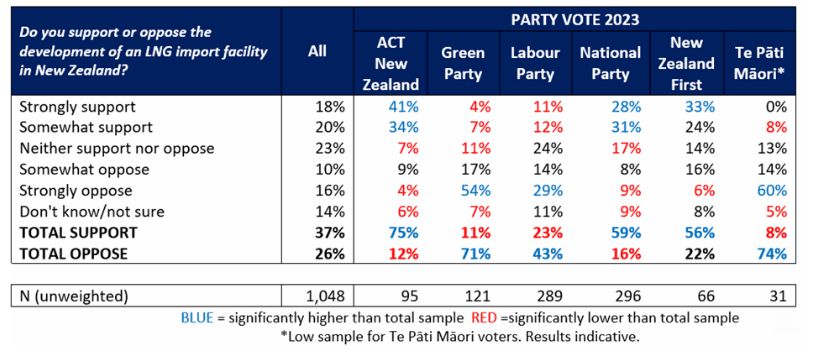
Highest support for an LNG facility comes from voters for coalition government parties. 75% of ACTs 2023 general election voters support the development. Highest opposition comes from Green Party and Labour Party voters.
While New Zealanders want energy security – they strongly oppose a Government proposal to levy a tax on electricity users to fund the project.
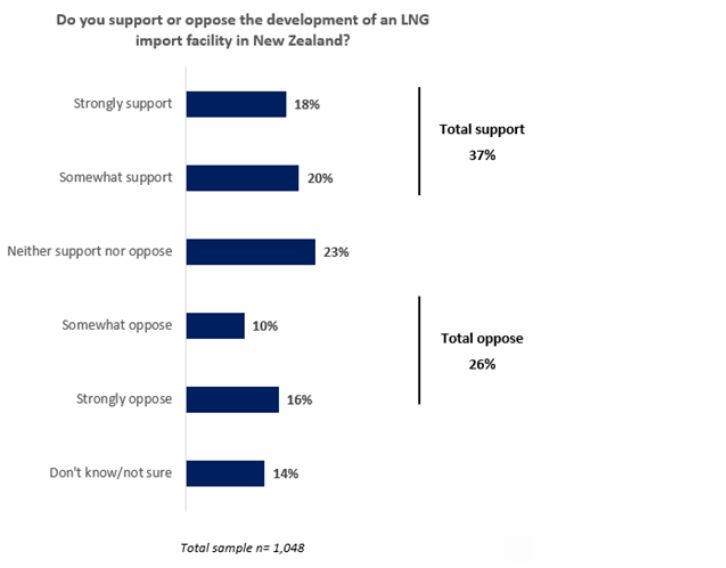
37% support the development of an LNG import facility in New Zealand. This is the equivalent of around 1,442,000 adults.
18% (676,000 adults) strongly support the development.
26% (1,020,000 adults) oppose the development.
16% (626,000 adults) strongly oppose it.
Many are unsure with 23% (874,000 adults) saying they neither support nor oppose.14% (533,000 adults) don’t know.
32% of under 35s neither support nor oppose and 22% are unsure, which are both significantly higher than total sample.
Highest support for an LNG facility comes from voters for coalition government parties. 75% of ACT’s 2023 general election voters support the development.
Highest opposition comes from Green Party and Labour Party voters.
Just over half oppose funding an LNG facility through a levy on electricity users
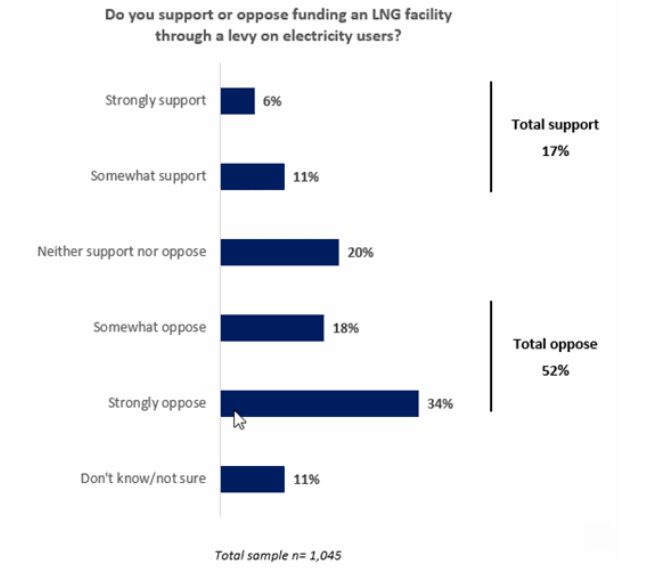
52% (1,998,000 adults) oppose funding an LNG facility through a levy on electricity users.
34% (1,310,000 adults) strongly oppose funding through a levy.
17% (653,000 adults) support funding an LNG facility through a levy on electricity users
6% (228,000 adults) strongly support a levy.
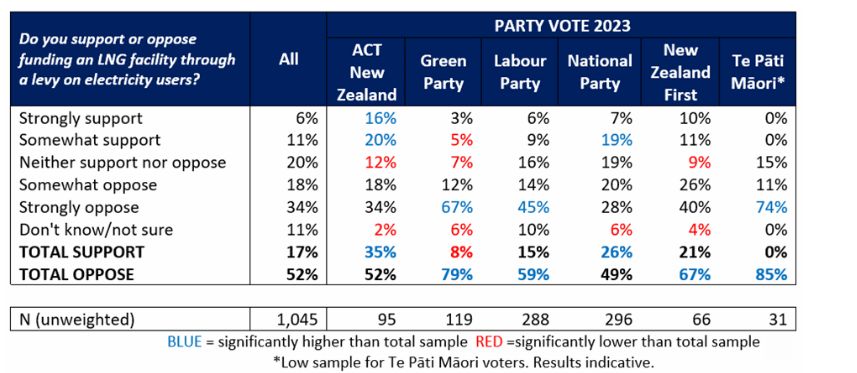
Highest support for funding an LNG facility through a levy on electricity users comes from ACT and National voters. However, opposition from ACT and National voters is higher than support.
Who should pay?
People think households should not be charged a levy and it should be funded by large users and the Government.
35% (1,368,000 adults) believe a levy is unfair to households.
29% (1,133,000 adults) think large users should pay most of the cost.
28% (1,082,000 adults) say the Government should fund it instead.
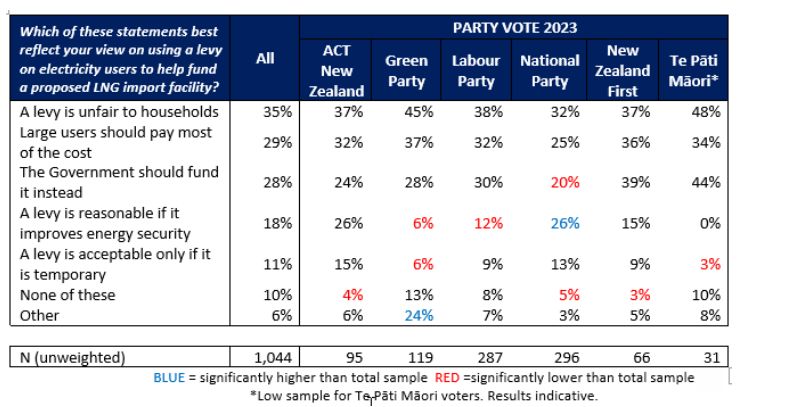
Highest support for funding an LNG facility through a levy on electricity users comes from ACT and National voters. However, opposition from ACT and National voters is higher than support.
Research method
An online survey of adults living in New Zealand aged 18 and older, undertaken by Horizon as part of its public interest research programme. This aims to make New Zealanders heard.
Sample sources
Members of two nationwide Horizon Research panels and a third-party panel (used for source diversity).
Fieldwork dates
20 to 27 February 2026, before the US-Israel attacks on Iran and the folllow-on impacts on world oil supplies.
Sample size
1,048 adults.
Weighting
The total sample is weighted on age, ethnicity, gender, region, personal income and Party vote 2023 to match the New Zealand adult population.
Maximum predicted margin of error
±3% at the 95% confidence level.
Population estimates in the report
These are based on the Stats NZ Census 2023 population of 3,865,235 people aged 18 or more. All population numbers are to the nearest thousand.
Information on project provided to respondents
Before answering questions about LNG, respondents were shown the following information:
The New Zealand government plans to build its first Liquefied Natural Gas (LNG) import facility in Taranaki by 2027–2028.
The Government says that this will secure energy supply, stabilise electricity prices and support economic growth. The infrastructure costs would be paid for through a levy on electricity.
Supporters also say that the LNG terminal complements New Zealand’s renewable energy boom, providing a reliable backup without replacing renewable generation. It supports long-term planning for gas-dependent industries, reducing the risk of supply disruptions and extreme price volatility. The facility is expected to create construction jobs and long-term skilled roles.
Some have raised concerns about public funding, long-term costs, and potential lock-in to higher gas prices. Also, that LNG may not be the most cost-effective solution for dry-year risk and urged alternatives. Some argue the levy is a “gas tax” and could result in electricity price rises for households.
Environmental concerns include greenhouse gas emissions across the LNG supply chain.
Content Sourced from scoop.co.nz
Original url