
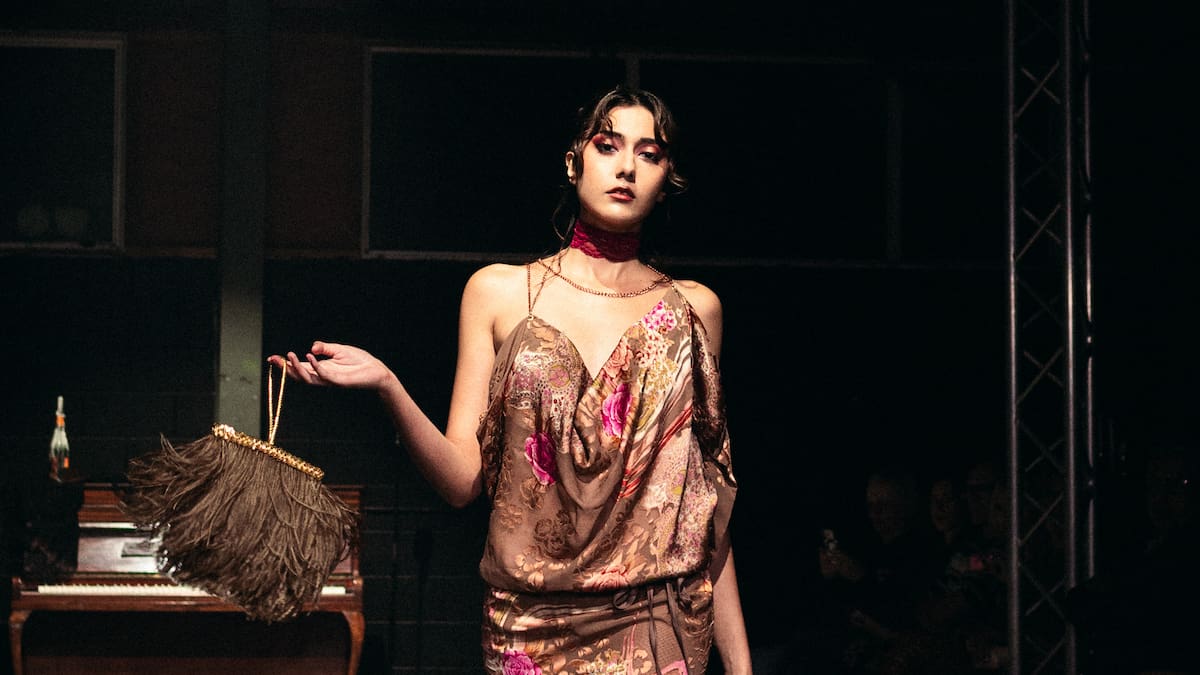
Fresh perspectives from designers worth watching on the runways at Te Wiki Āhua o Aotearoa.
A really, really good look can take your breath away.
The setting was an echoing industrial garage hidden in central Auckland. Claps and woos ensued, as the first collection of night five of
Te Wiki Āhua o Aotearoa wrapped. The final model drew audience eyes as she trailed off the runway. The lights dropped.
Then, a sudden gust ripped through the pitch-black room. Heads whipped to meet it. Gasps. Invisible doors cracked open on the other side of the runway. Behind it, a neon-green garden was aglow. Jojo Ross’ first model wandered through and crossed the threshold – the embossed, mossy dress seemed to breathe with her.
The opening of Jojo Ross’ runway show. Photos / Sarah Doss and Fergus Mark
It was one of many moments of high drama that audiences witnessed at the fourth iteration of Te Wiki Āhua o Aotearoa last week.
The fashion event, first established on Karangahape Rd in 2024, hosted more than 60 designers over nine days. Audiences stumbled down the back alleys of Newmarket to find runways staged within new venues. Emergent fashion was in residence in a dilapidated garage, industrial-style church and a skate park (usually reserved for Olympic hopefuls to ollie and kick-flip).
Attitudes were reliably spiky – pre-show announcements lamented the growing use of AI and championed the hands-on work of local designers and makers.
“Our designers aren’t just making clothes,” the voice-over speakers said. “They are poets of the tactile. Their craftsmanship shines through an art that has a thumbprint, a heart, a soul … To our guests, our invitation to you this evening is to step out of the digital noise and into the tactile renaissance.”
The creatives wanted everything to be tangible. Tech and media nostalgia were notable (though of course, social media pages remained busy).
For opening night, the programme zine was extra (extra!) – printed to resemble a newspaper. Before shows, scribes were perched scribbling letters for designers using ink and quill, as audiences socialised atop skate ramps. Wired headphones were a pivotal prop to open a group runway. At one show, attendees plucked wax-sealed letters from their seats to read gossipy and political thoughts from the “Lady Whistleblower Society Papers”. At another, glossy magazines were used as set dressing.
A scribe ahead of runway shows. Photo / Sarah Doss
However, this version of Āhua was certainly bigger and slicker. Designers with a pre-existing and strong local presence, like Jojo Ross, Oosterom, Mitchell Vincent and Adrion Atelier, debuted new collections. Ponsonby’s luxury retail boutique The Shelter worked in collaboration with Āhua to retail pieces from designers.
A growing capacity for influence blurs the definition of “underground” for this fashion event. So, how do these insistent emerging designers want us to dress in 2026?
With sensuality
A collaborative showing by Manawa, Lu’lette and Sleeping Profit called The Cat’s Meow conjured the mood of a smoky bar, assisted by the opener who sang sweetly into a ribbon microphone.
Playing into a sense of drama at The Cat’s Meow. Photo / Max Beach
The runway celebrated performance and sensuality, with styles reminiscent of the 1920s, 1970s and 2000s. Materials were sheer, lacy and lush with velvet, emphasising the movement of each model. The cuts dropped low on both hips and backs (bare skin was punctuated with charms and stones). One particularly excellent dress included a belted cut-out, while a suit exposed a torso dripping with crystals.
Looks from The Cat’s Meow runway. Photos / Max Beach
Models swayed, swaggered and picked at each other’s clothes on the runway. Assuredness was amplified by a playful smattering of hats (think newsboys, trilbies, bowlers and wide brim).
Daf Nimkovsky showcased dresses with sheen that similarly emphasised choreography of the body. Aera The Label revelled in little lace skirts and bold cut-outs. Mitchell Vincent’s showing leaned in too – impeccably cut, silky occasionwear was paired with kākahu and raranga by Natura Aura.
Sleek designs were punctuated powerfully at Mitchell Vincent. Photo / Max Beach
With plenty of presence
Winnie Catherine presented a sharp, assertive collection of workwear, with commanding silhouettes.
A big, big coat by Winnie Catherine. Photo / Jeri
Sleeves were pleasantly puffed, skirts were broad and full, and one wonderful collar was sharp and rich in size (cobalt blue touches for the muted clothing were used to amplify its quiet power).
Power was present for Oosterom too, whose autumn/winter debut opened with a skirt printed with Vermeer’s Girl With A Pearl Earring (the audience watched her, but she was watching back). A lush wool-blend coat also had a sharp shape, while the sway of hand-cut tassels demanded attention.
Oosterom’s autumn/winter collection. Photo / Jenna Chapman
Colour (and an absolute lack of it) also pulled focus.
Manzil’s bubbly weaving, hand-stitched colour squares and vibrant plaid were brilliant in the Lungiwala collection presented for Frayed Opulence. Fringes Garments was consistent in its grungy, monochromatic showing, cutting black garments sharply to create real stature.
Plaid by Manzil and a grid by Fringes. Photos / Vivienne Tam and Max Beach
With rebellion in mind
Ella Rhodes presented disobedience at Work Till We Drop. The collection, titled Confiscated Property, reimagines a St Trinian’s makeover for 2026. School uniform is pulled apart and parodied with polka dots, asymmetric cuts and frayed edges. It courted trouble with badges that read Headmaster’s Office and Uniform Violation.
School cheek by Ella Rhodes. Photo / Yuki Wada
A T-shirt screen-printed repeatedly with “Resist” was tacked to the stage and worn by a model for the Frayed Opulence showcase – just one of the designer suggestions to dress more politically this election year.
The most overt message came during the A Lot Of A Little Is A Lottle runway show (an unserious title that becomes more serious every time you read it).
Looks from Sherbert Lemons (left) and Stang (right). Photos / Jenna Chapman
It included joyous, knick-knack embellished pieces by Sherbert Lemons, who built an alternate hyper-feminine world free of shame in neon pink. The most literal swing came from Stang, whose knitwear carried messages like “Toitū te Tiriti”, “Unionise”, “Tax the Rich” and “Vote!”.
The clearest provocation from this iteration of Āhua was to summon dignity in the way you dress. Drawing on personal identity, familial histories or subcultural stylings, designers delivered looks that were entirely sure of themselves – a genuine surprise for uncertain times.
More local fashion
From city-centric style to slow fashion practices.