
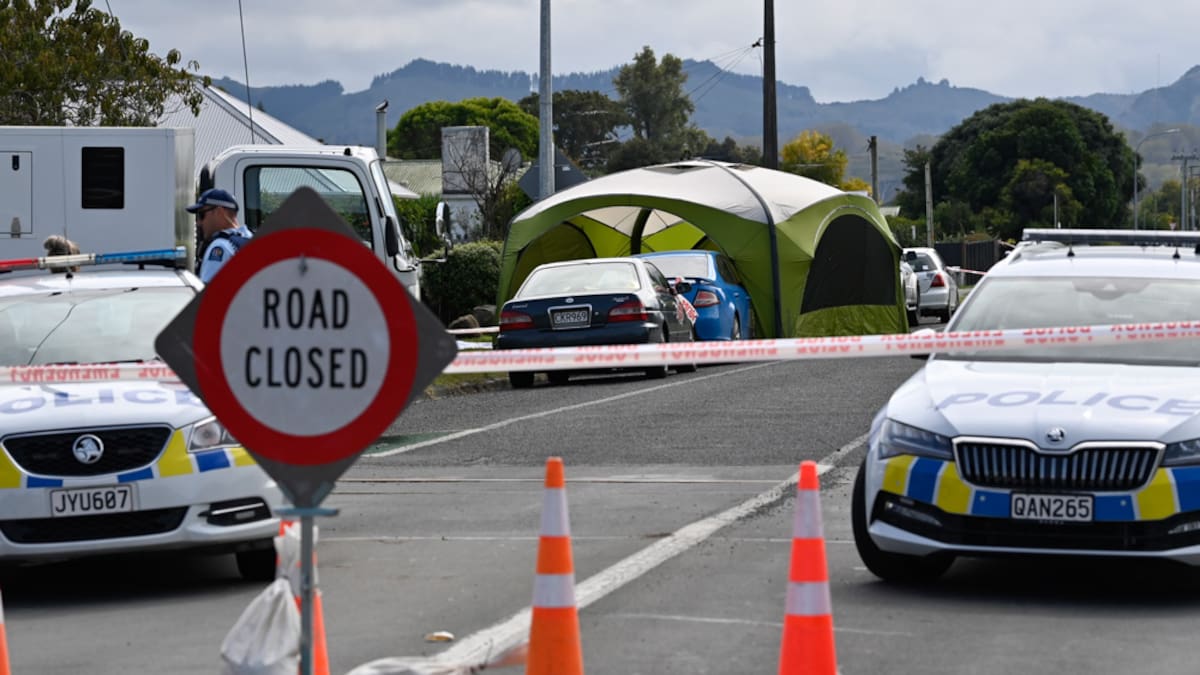
Tamihere had pleaded not guilty to the fatal stabbings of Chrysler Stevens-Mark and Kane Wiremu Te Paa at Stevens-Mark’s 21st birthday celebrations in Lytton Rd on March 23, 2024.
He also pleaded not guilty to wounding two other men with intent to cause grievous bodily harm.
An aunt of Stevens-Mark, through tears, told the court how she grieved daily.
“He was bold and outgoing, and truly fearless with the way he loved with his whole heart.”
“Libya, you don’t get to take any more from my family. No words will ever be enough and no sentence will ever be enough,” she said.
“I want you to know you didn’t win; all you did was bring shame on yourself and your family. We don’t fear you.”
One of the two stabbing victims who survived spoke about how his son, the other surviving victim, was in a coma for three days and was flown to Waikato for surgeries.
“That night our family were ripped to pieces,” he told Tamihere.
“I hate you with a passion for what you did.”
Uninvited guests
Tamihere and another man, who was also charged in relation to the incident but died last year, were told that rival Mongrel Mob members were at Stevens-Mark’s 21st birthday on March 23, 2024.
A jury found that the men, members of a local Mangu Kaha (Black Power) chapter, went to the party to commit serious violence on people they believed were related to a rival gang.
The other man brought a large Westinghouse knife, and it was not proven that Tamihere stabbed anyone.
However, the jury found Tamihere was aware of the knife, that it could be used and that people could die.
It was considered highly likely the knife belonged to Tamihere as it matched one missing from a block in his kitchen.
Photos taken at the party before the two men arrived showed “clearly a joyous occasion”, Justice Boldt said.
The pair arrived uninvited and Stevens-Mark’s family members repeatedly asked them to leave. They refused.
They asked to see Te Paa, a Black Power member, whom they claimed they knew. Te Paa was polite but also asked the two to leave, telling them it was a family gathering.
While still being told to leave, the two men saw a youth wearing a red T-shirt and cap. Tamihere aggressively asked people to bring the youth to them.
A violent altercation ensued and resulted in the two deaths and injuries to others.
The jury found that while Tamihere and his accomplice did not set out to kill Stevens-Mark and Te Paa, they started the confrontation that led to the stabbings and knew full well it was a probable consequence.
‘Our family were ripped to pieces’
Whānau victim impact statements were read out in court.
One whānau member described Stevens-Mark as “bold and outgoing and truly fearless with the way he loved with his whole heart”.
Te Paa was a “kind, gentle man who thought of others before himself”. Family “was everything to him” and he was a true “gentleman”.
Both men were young fathers, Te Paa with an infant daughter and Stevens-Mark with a baby son.
Libya Tamihere was today sentenced in the High Court at Gisborne to a minimum of 20 years in prison. Photo / Gisborne Herald
“Our grandchildren are the biggest victims in this whole tragedy,” Te Paa’s whangai father, who is also Stevens-Mark’s uncle, told Tamihere in a victim impact statement read on his behalf.
“The joy and light that my son and nephew brought into our lives is now gone.”
He said his son was a hero, referring to his attempt to peacefully resolve the situation before he was tragically murdered.
“He would move heaven and earth to protect [his family], and that is what happened that night. My son was a hero.”
‘Haven’t seen any responsibility for anything’
Tamihere faced an automatic life sentence. Justice Boldt had to decide the minimum non-parole period.
Prosecution lawyer Riki Donnelly submitted a minimum term of 21 to 22 years.
He said the minimum should not be below 17 years.
Defence lawyer Tiana Epati said the minimum term should be lower at potentially 14 to 15 years.
This submission was based on comparing the case with precedents set in other double murder sentencings. It also took into consideration that Tamihere was not found to have carried out the stabbings himself.
Justice Boldt said the intent to go to the address and commit serious violence against people he believed were in an opposing gang was a serious aggravating factor, potentially the most serious.
Tamihere acknowledged the harm, but “I haven’t seen any responsibility for anything”.
Justice Boldt noted it was not in dispute that Tamihere aggressively demanded the youth in red be brought to him. It was also not in dispute that he did not leave when asked to.
“[There was] no expression of saying I shouldn’t have done that. You’ve never taken real responsibility for what you did or had any insight, even for things not in dispute,” the judge told Tamihere.
It was not the first time Tamihere had attacked someone for wearing red.
He was convicted after a 2013 incident where he and an associate approached someone wearing red in a restaurant, kicked him in the head and continued even when a member of the public intervened.
Justice Boldt set a starting point of 21 years.
He noted Tamihere “had a good upbringing” with a caring family, did well in school until he got involved with drinking and drugs, and was in a stable relationship at the time of the offending.
His decision to join a gang was a “gradual life progression” with his friend group.
The offending was not caused by underlying mental health, addiction or an inability to fit into the community.
Tamihere’s culpability was reduced because the Crown did not prove he had stabbed anybody, but Justice Boldt said he did not think that it was reduced by much.
He gave “max credit” for “very slim mitigating factors” to reach a 20-year minimum jail term.
This was to be served concurrently with a 9-year sentence for the two counts of wounding with intent to cause grievous bodily harm.