
A report looks at three groups of health-care workers, nurse practitioners, pharmacists and paramedics to examine how they could help provide more primary care.
When Dechen Palmo found out about a dual-degree nursing program between Canada and India, she said it felt like God had given her a second opportunity.
The Tibetan lives in India, where her status makes it complicated to travel or even find work. She thought the best way to accomplish both was through her studies.
“My mom said, ‘Go for it, go for it! I’m there for you!’” Palmo said in an interview with CTV News.
Fast-forward nearly four years and Palmo is in Fredericton, N.B. about to start her six-week practicum at the Dr. Everett Chalmers Regional Hospital and a Shannex long-term care home.
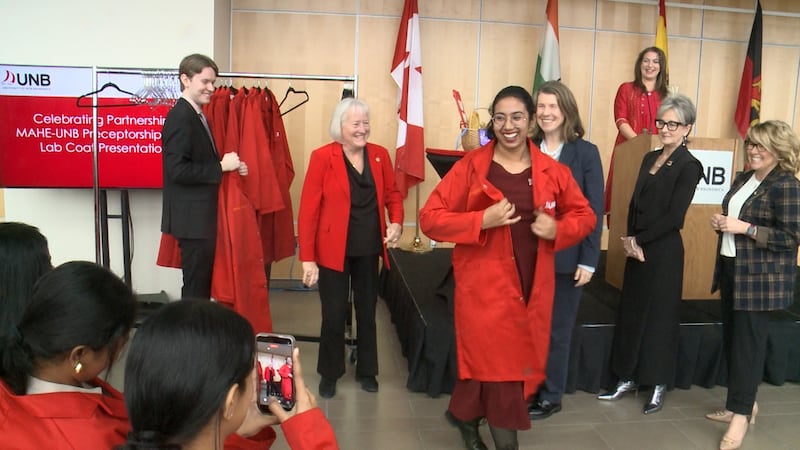 Jennifer Joseph receives her red coat. Jennifer Joseph receives her red coat. The nursing student from India will begin a six-week practicum in N.B. before returning to India to complete her nursing degree. She hopes to return to Canada once she graduates (Laura Brown/CTV News).
She’ll be part of the first graduating class of 25 students, from the dual-degree program in the fall. Upon graduating she will earn both a nursing degree from Manipal College of Nurses and the University of New Brunswick.
The program was created, in part, because of an ongoing nursing shortage in N.B.
“If we look at our own province, there’s ten more clinics that are going to need nurses. So there’s always going to be a need,” said Dr. Lorna Butler, UNB’s Dean of Nursing and one of the founder’s of the program.
She said it’s considered ethical too, because the 25 students are on top of already existing nursing seats in India.
Administrators went through the curriculum at Manipal line-for-line, to verify it included everything necessary to work as a registered nurse in Canada.
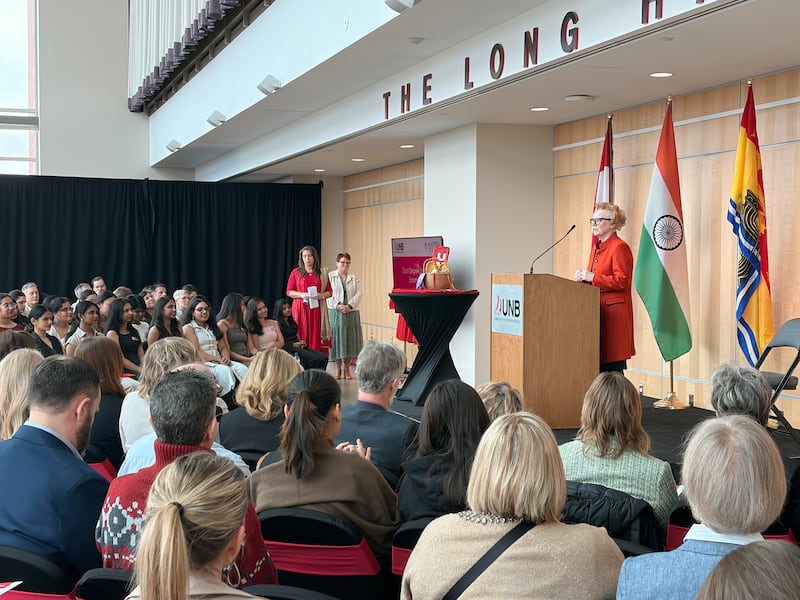 Red coat ceremony in Fredericton, N.B. Dr. Lorna Butler, Dean of Nursing at UNB speaks at the red coat ceremony in Fredericton, N.B. Butler founded the dual-degree nursing program between India and Canada four years ago (Laura Brown/CTV News).
After the students complete their Canadian practicum, they’ll also write the National Council Licensure Examination for Registered Nurses – to earn their Canadian license. Butler said she wanted to ensure the graduates could seamlessly enter Canada’s healthcare system without waiting for credentials.
But students won’t be expected to return to Canada and work if they don’t want to.
Butler is hoping at least 19 of the 25 students do consider coming back. She says she has been talking to government and consulate representatives to make sure the graduates do not come across any obstacles navigating Canada’s new immigration policies.
“The government here is working on our behalf to mitigate what might be happening in the world,” she said. “I mean, we can’t predict what will happen, but we’ve just come through some relationship issues with India and we’ve been able to, I think, have those repaired based on Prime Minister (Mark) Carney’s last visit…”
Butler says she has not been concerned about Ottawa’s international student cap, because the 25 are receiving most of their education in India and are not full-time international students.
But for students looking to transition into full-time work within the province, challenges could arise due to Canada’s 2026 immigration plan.
The 2026 target of 380,000 new permanent residents, is a slight drop from the 395,000 accepted in 2025 and a major shift from 2024, when more than 483,000 were welcomed. The number of new permanent residents is set to remain at 380,000 through 2028.
Butler reiterated the province of N.B. is in constant communication with her and has been working with immigration officials so that the graduates can quickly accept positions in the province.
Students say, ‘that is my greatest opportunity’
Palmo and her classmate, Jennifer Joseph, reiterated how thankful they are to be a part of the program, during an interview with CTV News.
They described the differences between the two country’s healthcare systems, explaining that there’s more students in India than Canada and little one-on-one or on-the-job training.
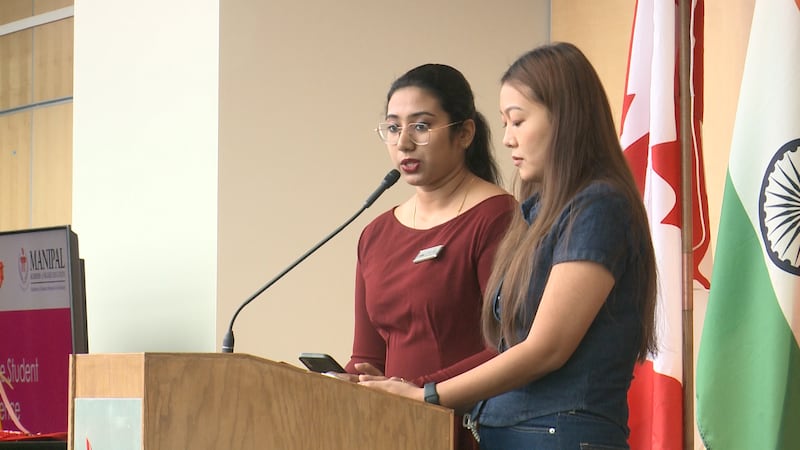 Jennifer Joseph and Dechen Palmo Jennifer Joseph and Dechen Palmo speak at the red coat ceremony in Fredericton, N.B. The nursing students are about to enter the last phase of their joint Canada-India degree program before graduating in the fall (Laura Brown/CTV News).
“Back in India, only about 50 per cent of the hospitals are doing all the documentation stuff through a computer. All the other documentations are by written notes,” said Joseph. “So I guess here, all the documentation is done through a computer. So that’s also a very different thing for us.”
Dr. Butler said Horizon Health Network is ready to give graduates offer letters the moment they complete their licensing exam.
Joseph and Palmo say once they have those letters in hand, they want to return to Canada and begin their nursing careers.
“I said as soon as possible, even if it’s the day after the (graduation) ceremony, I’ll come,” said Palmo. “I really want to be here because that is my greatest opportunity.”
19 students begin their on-the-job training Monday, after receiving their red coats at a ceremony at UNB.
They have spent the last few days exploring what could be their new home, of Fredericton, saying so far, they feel very welcome.
“We were traveling back to the college and the taxi driver, he was asking like, ‘You are nursing student, right?’ and I was like, ‘Yeah!’ and they said, ‘We really need of you. Thank you for coming,’” Joseph said.
“So it was a really surprising moment… people encouraging us to work here and seeing us as their own people, as their own community.”