
“Ahab’s Head: American Vengeance,” Heidi Whitman’s hair-raising installation at the New Bedford Whaling Museum, invites that question. and more broadly asks how society reflects the psyches of its leaders.
Like the book, the exhibit is a hall of mirrors. Whitman elucidates how characters and symbols reflect each other in the intricate, twisting tale. In Melville’s psychological epic, Ahab’s belief that Moby-Dick is purposefully malicious may say more about the captain than the whale, for example. And the descent into chaos of his ship’s crew reflects Ahab’s perilous mental decline.
The exhibit’s most terrifying mirror is this: Ahab, erratic and driven by his own impetuous emotional needs regardless of those around him, reflects American leadership now.
The artist doesn’t make that explicit, but the show’s subtitle, “American Vengeance,” implies a certain national DNA. There’s a dictionary definition on the wall: “ven´geance, n. The infliction of pain on another, in return for injury or offense.”
I spoke with Whitman as she was installing “Ahab’s Head” in November. In March, I returned to see the completed show. It’s aptly housed in the museum’s Herman Melville Room and a corridor leading to it. She originally started crafting “Ahab’s Head” in 2020, during Trump’s first term. She was thinking about the government. In this term, she said, she sees “a whole new level of vengefulness and retribution.”
Much of Trump’s ethos appears to revolve around his perceived enemies. He has followed through on his 2024 promise for a campaign of retribution, taking legal action against perceived enemies such as former FBI Director James Comey and New York Attorney General Letitia James, among others.
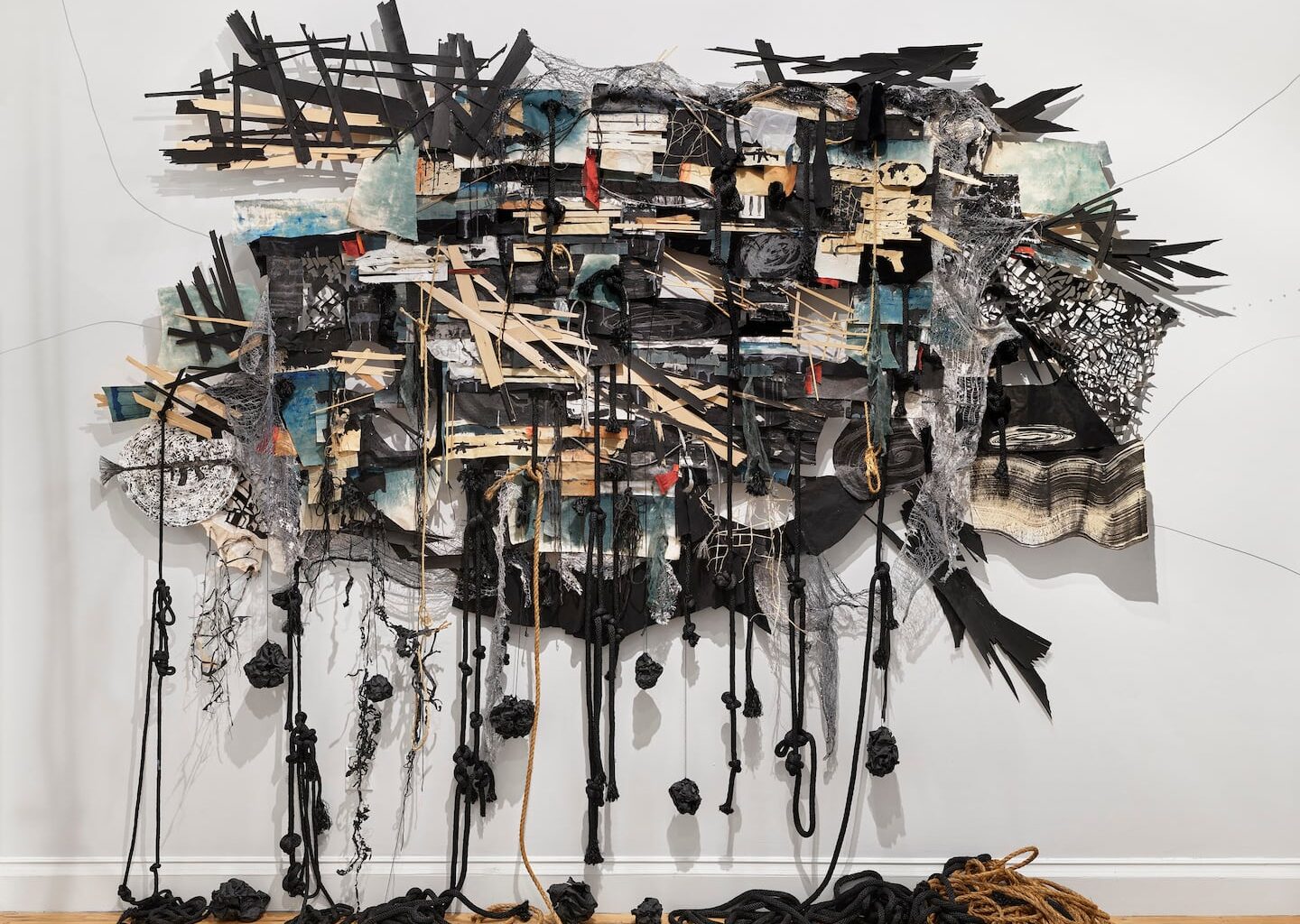
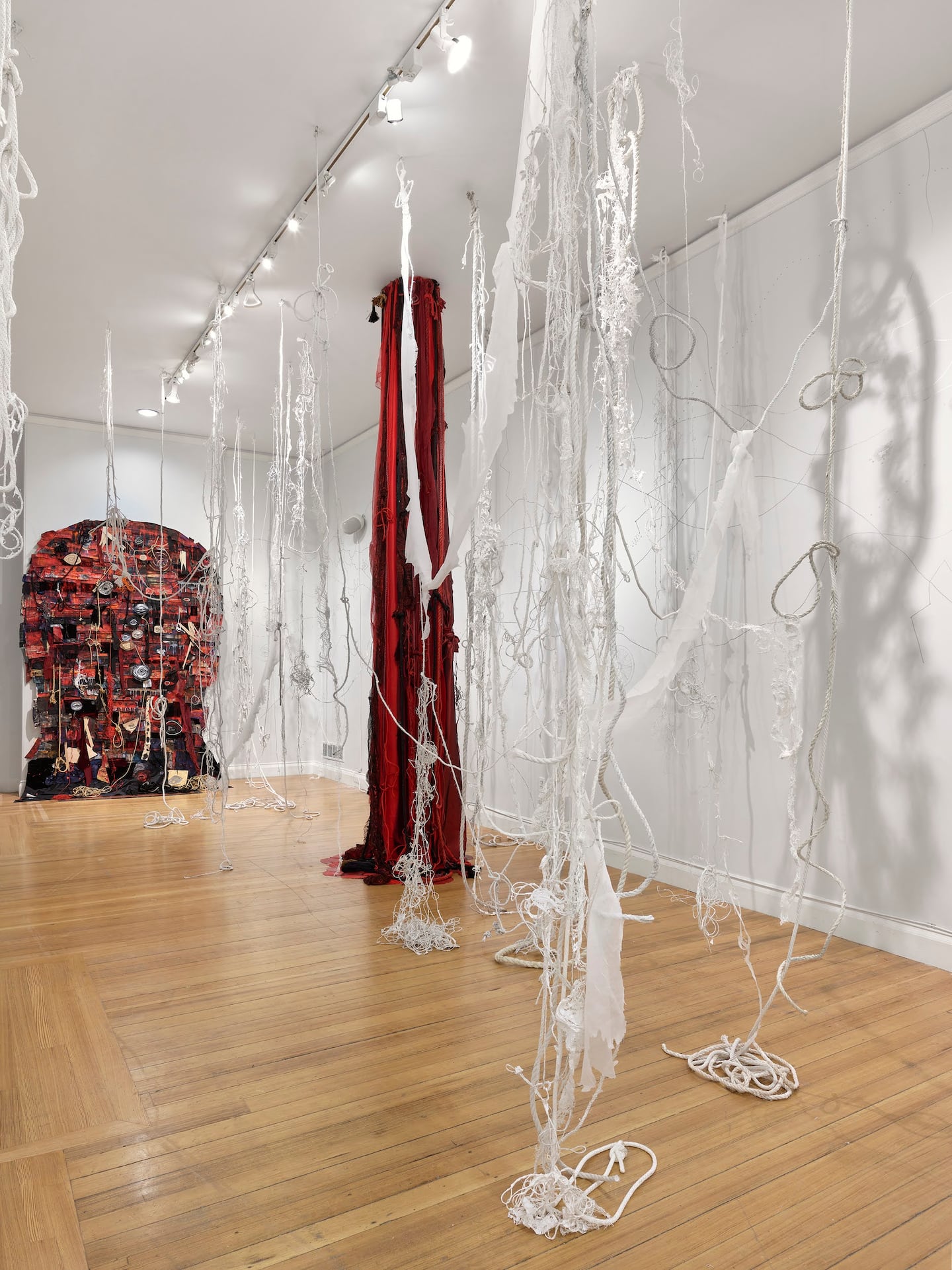 Heidi Whitman (b. 1949) Ahab’s Head: American Vengeance (installation), 2020-2025. Ink, gouache, acrylic, paper, canvas, cloth, string, rope, wood, Cinefoil, sound, and cast shadows. Dimensions variable.Julia Featheringill
Whitman, a Boston artist, has made increasingly nuanced, ambitious, and politically pointed art in recent years. “New World,” her COVID-era installation in “Wayfinding” at the Addison Gallery of American Art, was an eviscerating reimagining of colonial history that reckoned with American violence and greed up to the present day.
She has long worked to chart the mysteries of the mind. In an artist’s statement, she calls “Mental Maps,” her series of deeply layered and tangled drawings, “cartographies of the subconscious.” They make space for hidden motivations and shadows, obsessions and quirks we cannot discern ourselves. Here, she funnels that approach through “Moby-Dick” and Ahab. The knotty shadows the installation casts on the walls hold as much power as the objects themselves.
Whitman read a chapter of “Moby-Dick” each day during the pandemic. It’s a beauty and a terror of a book — I read it in college and recently picked it up again. “Ahab’s Head” packs the novel’s operatic scope into a single gallery that resembles the aftermath of a shipwreck.
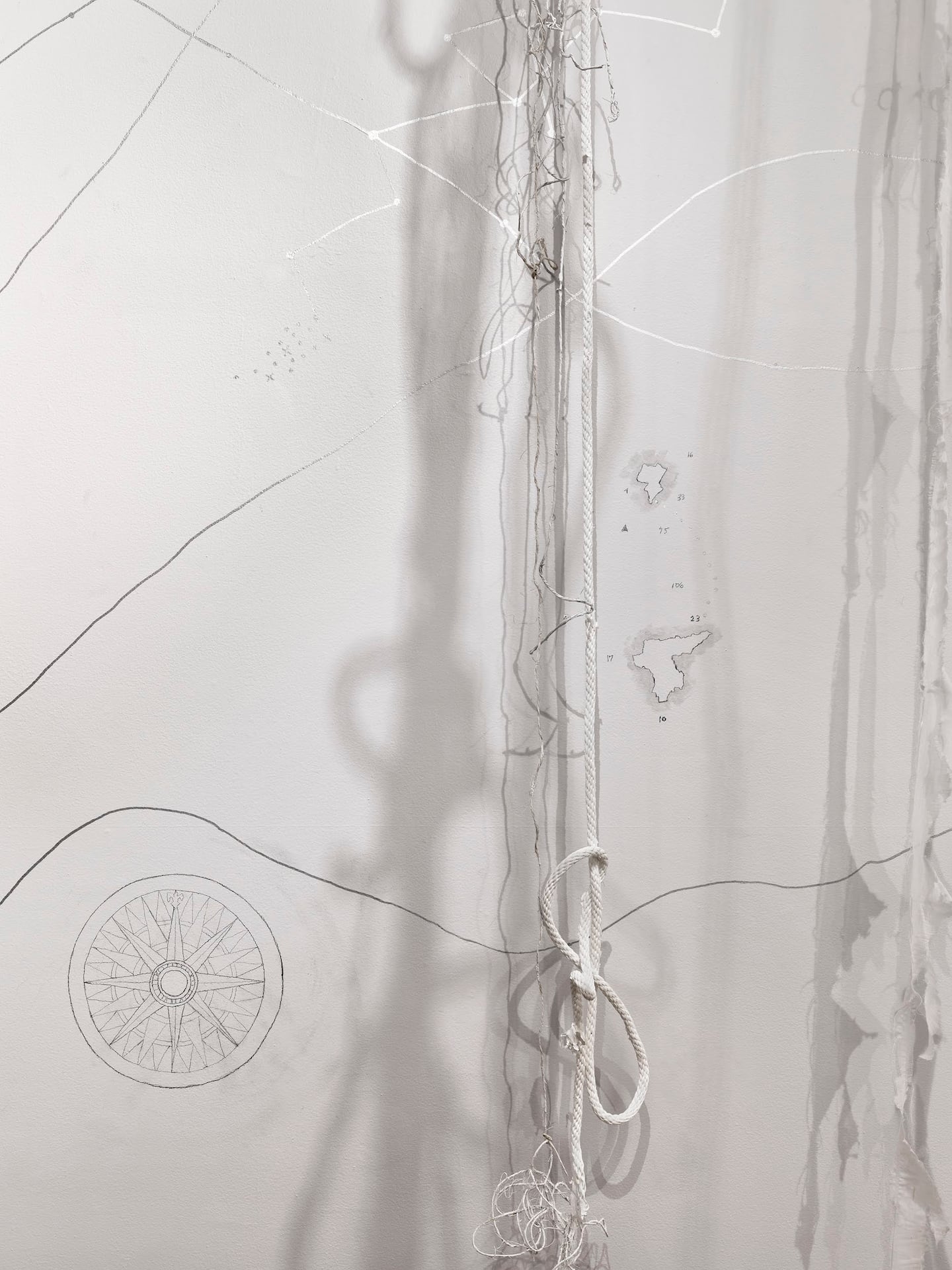 Heidi Whitman (b. 1949) Ahab’s Head: American Vengeance (wall detail), 2020-2025. Ink, gouache, acrylic, paper, canvas, cloth, string, rope, wood, Cinefoil, sound, and cast shadows. Dimensions variable.Julia Featheringill
Even before you get inside, stark, gritty, mostly black-and-white abstract drawings lead forebodingly to the entrance. Weapons from the museum’s collection hang above the door, marking it as a portal to violence. Ominous music by Boston-area musician David Raposo plays on a loop daring us to enter. In it, we perceive the low pulse and rush of the whale against increasingly dissonant higher tones that might be Ahab’s own consciousness.
Inside, giant paper constructions face off on opposite walls, one shaped like a devastated Pequod (or perhaps it’s the whale, or both) dripping with ropes, cobweb-like netting, and dotted with pictures of harpoons and guns – including present-day automatic weapons, suggesting another national genetic strand. Across the gallery looms Ahab’s head, blood red, scarred with black, pitted with eyes gazing accusingly at us: whale eyes, human eyes, and eyes that might be either. Throughout the gallery, white tangles of rope hang ceiling to floor along with twists of white fabric like torn sails or hastily ripped bandages.
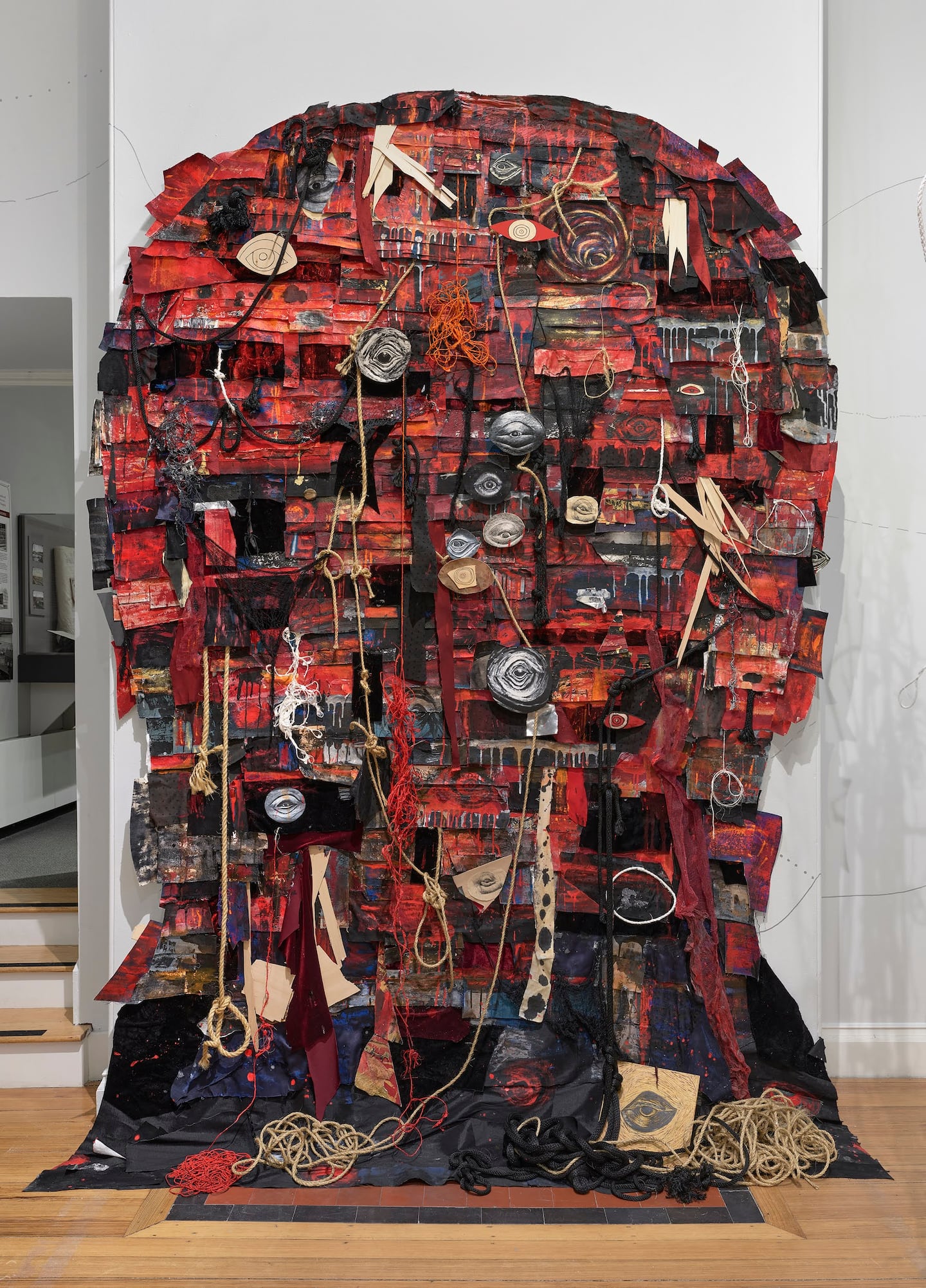 Heidi Whitman (b. 1949) Ahab’s Head: American Vengeance (head detail), 2020-2025. Ink, gouache, acrylic, paper, canvas, cloth, string, rope, wood, Cinefoil, sound, and cast shadows. Dimensions variable.Julia Featheringill
Amid the ropes, a single column of red and black fabric cascades between floor and ceiling like the spout of a dying whale. I thought, too, of an oil geyser. Whaling, driven by the Industrial Revolution’s ravening hunger for whale oil, blubber and baleen, was an early extractive industry. That’s another piece of the American DNA Whitman references.
Maps on the walls, flights of fancy based on charts made by a 19th-century whaling captain named Eber, are marked with Xes, as if we have equated the earth’s resources with some mythical booty indicated on a treasure map. For many, finding such treasure is never enough, or never truly achieved (maybe the 2020 election is Trump’s white whale). Such a hunger can lead to darkness. Melville writes of Ahab, “And he piled upon the whale’s white hump the sum of all the rage and hate felt by his whole race.” Trump’s social media feed evinces similar ire.
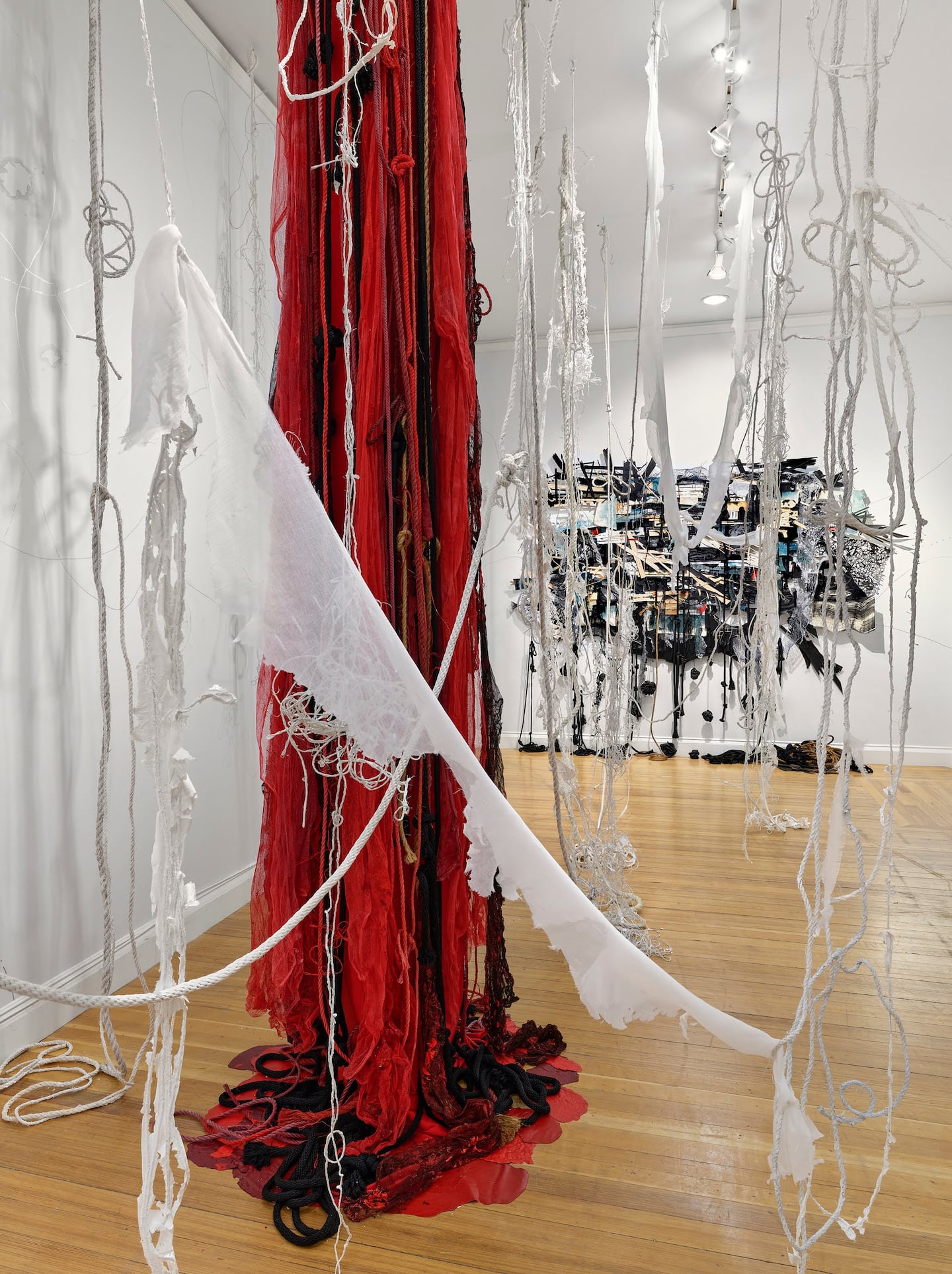 Heidi Whitman (b. 1949) Ahab’s Head: American Vengeance (installation), 2020-2025. Ink, gouache, acrylic, paper, canvas, cloth, string, rope, wood, Cinefoil, sound, and cast shadows. Dimensions variable.Julia Featheringill
A treasure, a win, a whale is just a momentary satisfaction; the need for more always comes clawing back. The plunder continues, the resentment, the vengeance. The hollowness inside. Melville, and now Whitman, invite us into the wreckage of that hollowness.
It’s a mirror, not an argument, but the stark vision of “Ahab’s Head” will amplify some viewers’ convictions that we must change direction. We must put down our obsessions and our petty resentments, go home without that treasure and instead make peace with our neighbors and families. After all, that’s where the treasure really lies.
AHAB’S HEAD: American Vengeance, an Installation by Heidi Whitman
At New Bedford Whaling Museum, 18 Johnny Cake Hill, New Bedford, through May 3. www.whalingmuseum.org/exhibition/ahabs-head-american-vengeance/