
But couldn’t we always? Time immemorial underpins the idyll here; it’s a jaunt through millenia represented in the MFA’s remarkable collection, from the ancient world to the here and now. Marble statues from Ancient Rome, medieval tapestries from Europe and the Middle East, Mayan ceramics from centuries before European contact — they all help knit together a reverence for the natural world across epoch and culture. People have always looked to nature for inspiration, for solace, for something reliable, unwavering, firm amid constant, often devastating change. It may be the only thing we, as a species, can come close to agreeing on.
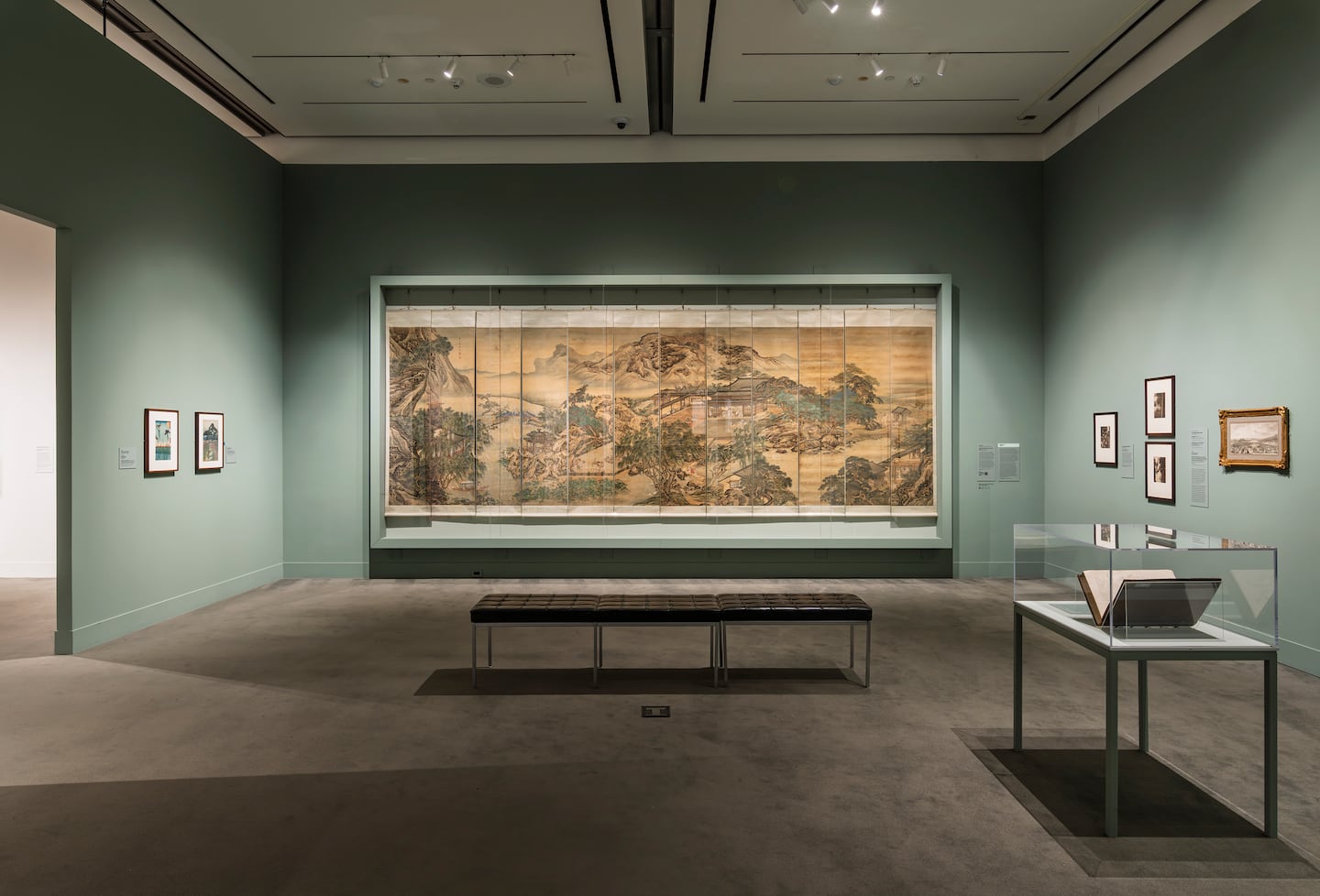 Framing Nature: Gardens and Imagination exhibition at the Museum of Fine Arts, Boston.
March 15, 2026 to June 28, 2026
* Ann and Graham Gund Gallery
* Photograph © Museum of Fine Arts, BostonJohn Woolf
Framing Nature: Gardens and Imagination exhibition at the Museum of Fine Arts, Boston.
March 15, 2026 to June 28, 2026
* Ann and Graham Gund Gallery
* Photograph © Museum of Fine Arts, BostonJohn Woolf
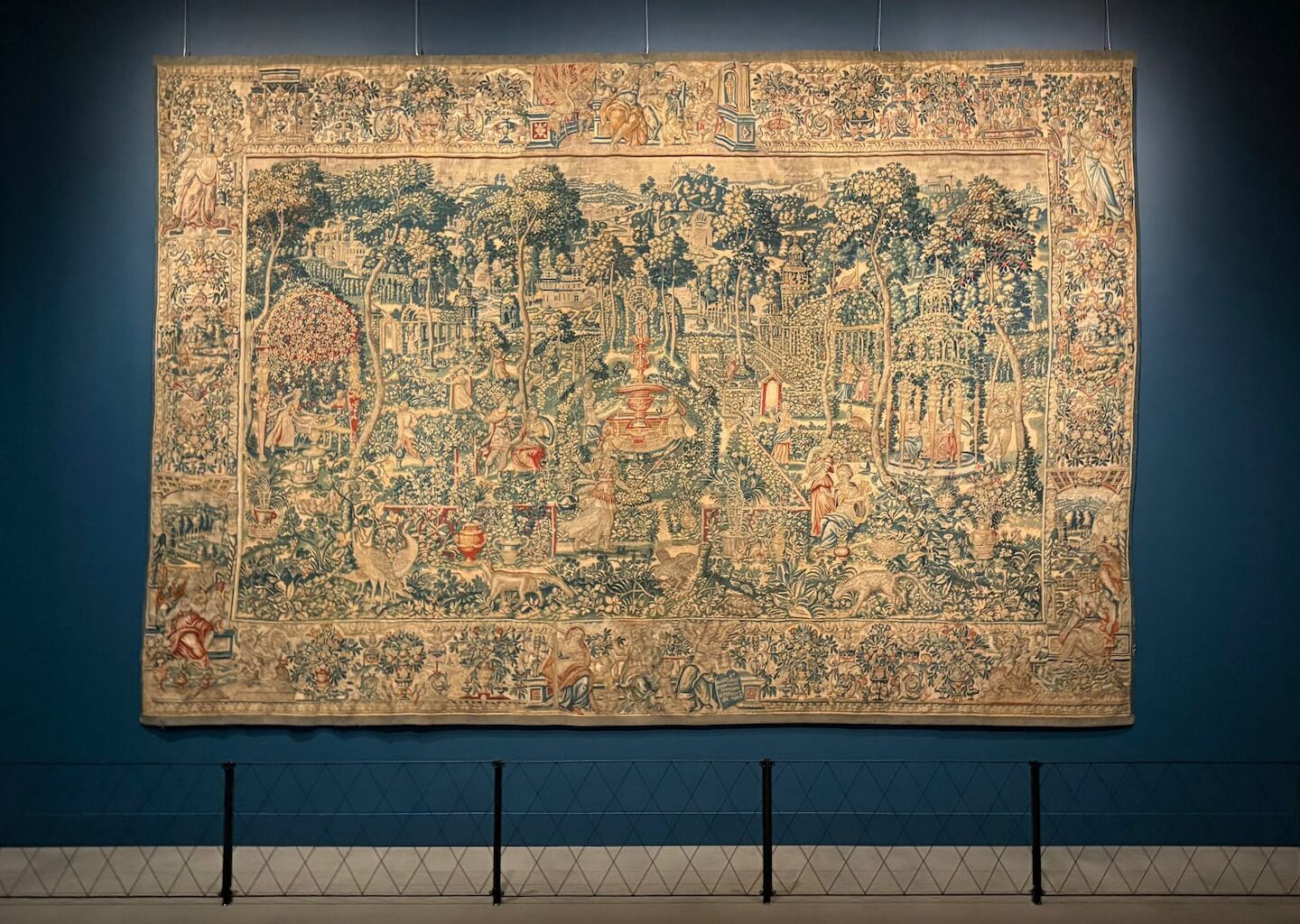
And there is indeed much harmony: In that first room, the source of that birdsong and babbling brook, is a massive 16th century Flemish tapestry that hangs spot-lit in darkness, an intricately woven scene of a vast, stately garden. It echoes an array of huge mid-18th century Chinese scroll paintings in the next room that captures an expanse of tended trees and shrubs in the nook of a mountain valley. The tapestry and scrolls are each populated with figures of both labor and leisure, held in a pastoral embrace. There’s no mistaking the succor nature provides in either, or its evocation of the sublime.
But don’t mistake harmony for simplicity. “Framing Nature,” the show’s title, is a clue. Nature may be sublime, but subjectivity is a very human flaw. That’s what frames the ideal here, and the complexity — of perspective, of the very personal — infuses the show in its best moments with subtle and compelling tensions. There’s friction amid the splendour, a subtle infusion of discord that makes the idyll something more.
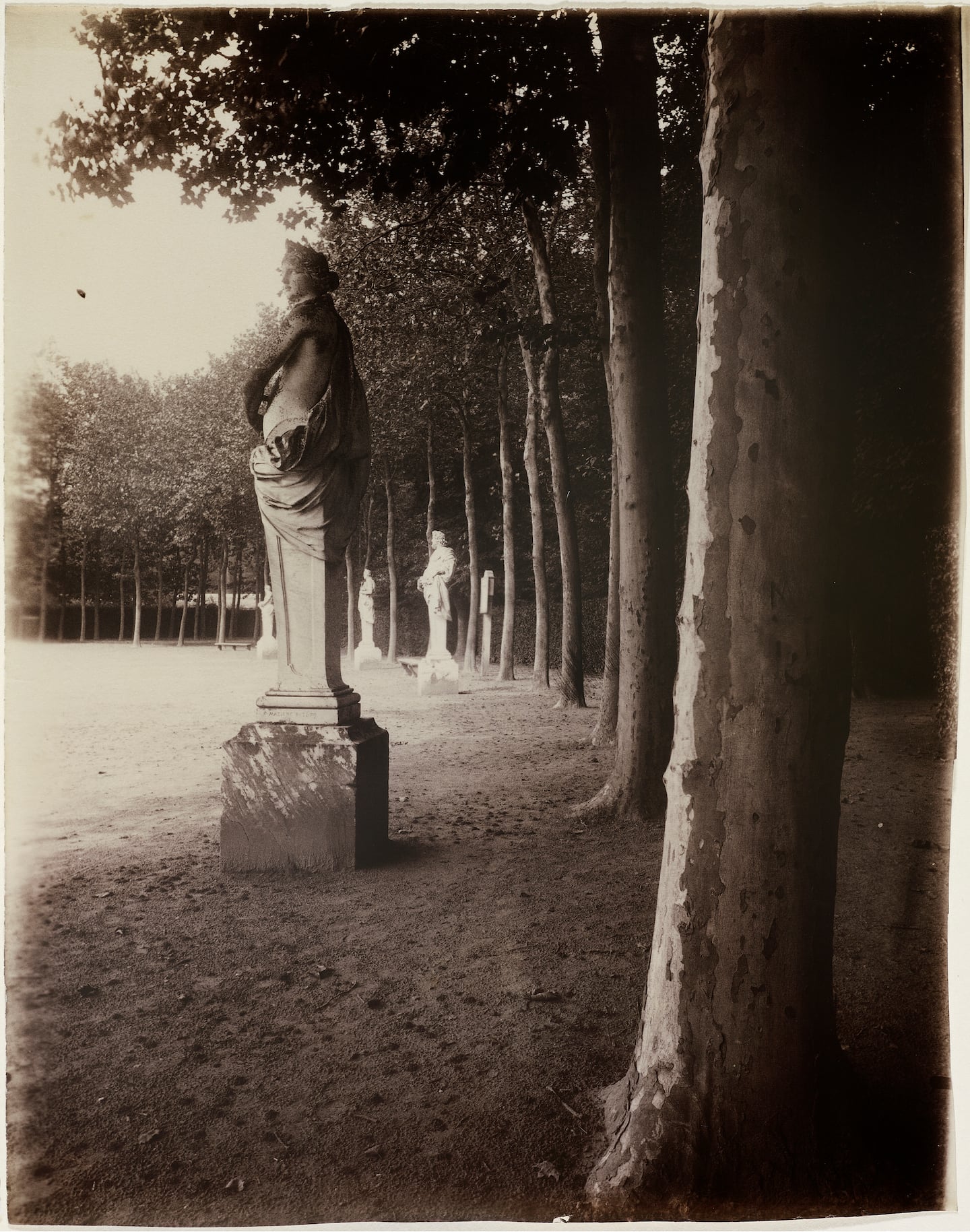 Jean‑Eugène Auguste Atget, “Versailles, Corner of the Park, Statue by Mazière,” about 1902. Photograph © Museum of Fine Arts, BostonMuseum of Fine Arts, Boston
Between those two grand paeans to the sublime are a handful of little photos by the French photographer Eugène Atget, of the gardens of Versaille. They’re beautiful, surely, but also symbols of the decadence of a fallen monarchy, and, in Atget’s time in the late 19th century, a retreat from encroaching industrialization that was swallowing the French countryside by the day. Ashen and mournful, they offer a counterweight that belies their small scale. Nature, he seems to say, is under multiple threats: From the voracious consumption of industry, and from the wealth that generates is. Only a century before, Versailles was the exclusive domain of the elite; with expanding industrial wealth, his images feel like a caution: It might be again.
It has company here in its dour concern. Nearby, small-scale marble statues from first century CE Pompeii depict the deity Hermaphrodite, and a river god, poised in a fountain. Accoutrements of a garden of a well-to-do Roman era villa, it would have been enclosed by frescoed walls.
All, of course, is not so fraught. There’s a remarkable 16th century Mughal carpet from India, its earthy tones woven into a vision of paradise. Resplendent as ever, a pair of dreamy 1910 watercolors by John Singer Sargent seem to bleed sunshinefrom his luminous scenes of potted lemons perched on classical balustrades of the late-Renaissance Florentine palazza, Villa Marlia.
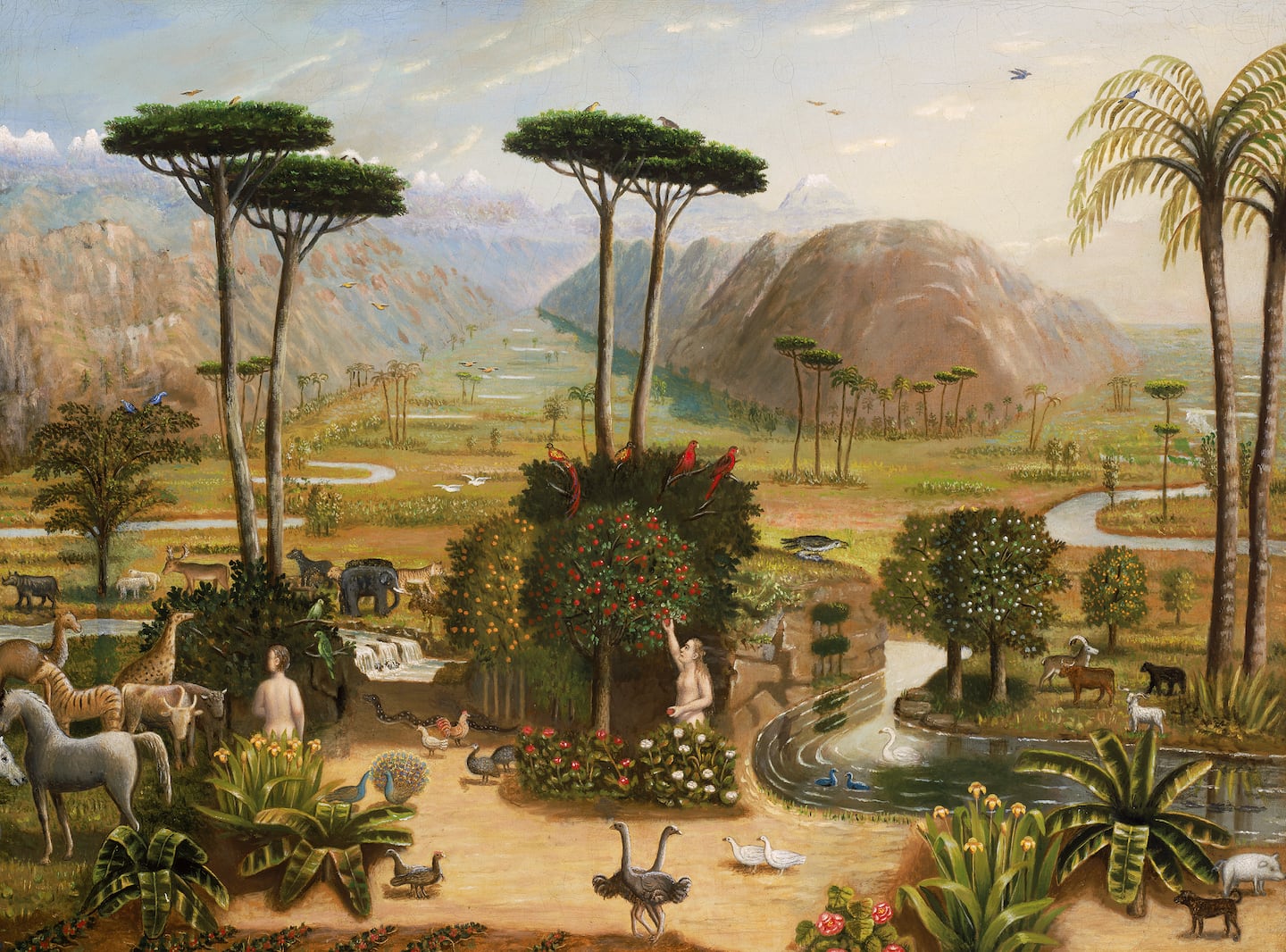 The Garden of Eden
Erastus Salisbury Field (American, 1805–1900)
about 1860
Oil on canvas
* Gift of Maxim Karolik for the M. and M. Karolik Collection of American Paintings, 1815–1865
* Photograph © Museum of Fine Arts, BostonMFA Boston
The Garden of Eden
Erastus Salisbury Field (American, 1805–1900)
about 1860
Oil on canvas
* Gift of Maxim Karolik for the M. and M. Karolik Collection of American Paintings, 1815–1865
* Photograph © Museum of Fine Arts, BostonMFA Boston
Even so, there’s a visual rhythm to the otherwise dreamy melody that’s hard to deny. I loved “The Garden of Eden,” an extraction from the museum’s Folk Art collection, making a stand across from the classical wonders of Pompeii and the masterful brushwork of Sargent, no stranger to privilege himself. Painted in 1860 by Erastus Salisbury Field, it’s an ungainly riot of compressed perspective, glaring light, and stubby beasts and bodies — Adam and Eve, picking the apple, of course — that would have prompted in Sargent a body-shuddering cringe. He’s sharing space with it, for now, like it or not. And I like it. No one holds deed on this Eden, it seems to say. It’s a delight of a democratizing moment; it feels deliberate, a pushback against posh romanticism, blithe and self-satisfied. I can get with that.
 Resting
Jay Lynn Gomez (American, born in 1986)
2019
Acrylic and house paint on canvas
* James N. Krebs Purchase Fund for 21st Century Paintings
* © Ramiro Gomez
* Photograph © Museum of Fine Arts, BostonSaravuth Neou
Resting
Jay Lynn Gomez (American, born in 1986)
2019
Acrylic and house paint on canvas
* James N. Krebs Purchase Fund for 21st Century Paintings
* © Ramiro Gomez
* Photograph © Museum of Fine Arts, BostonSaravuth Neou
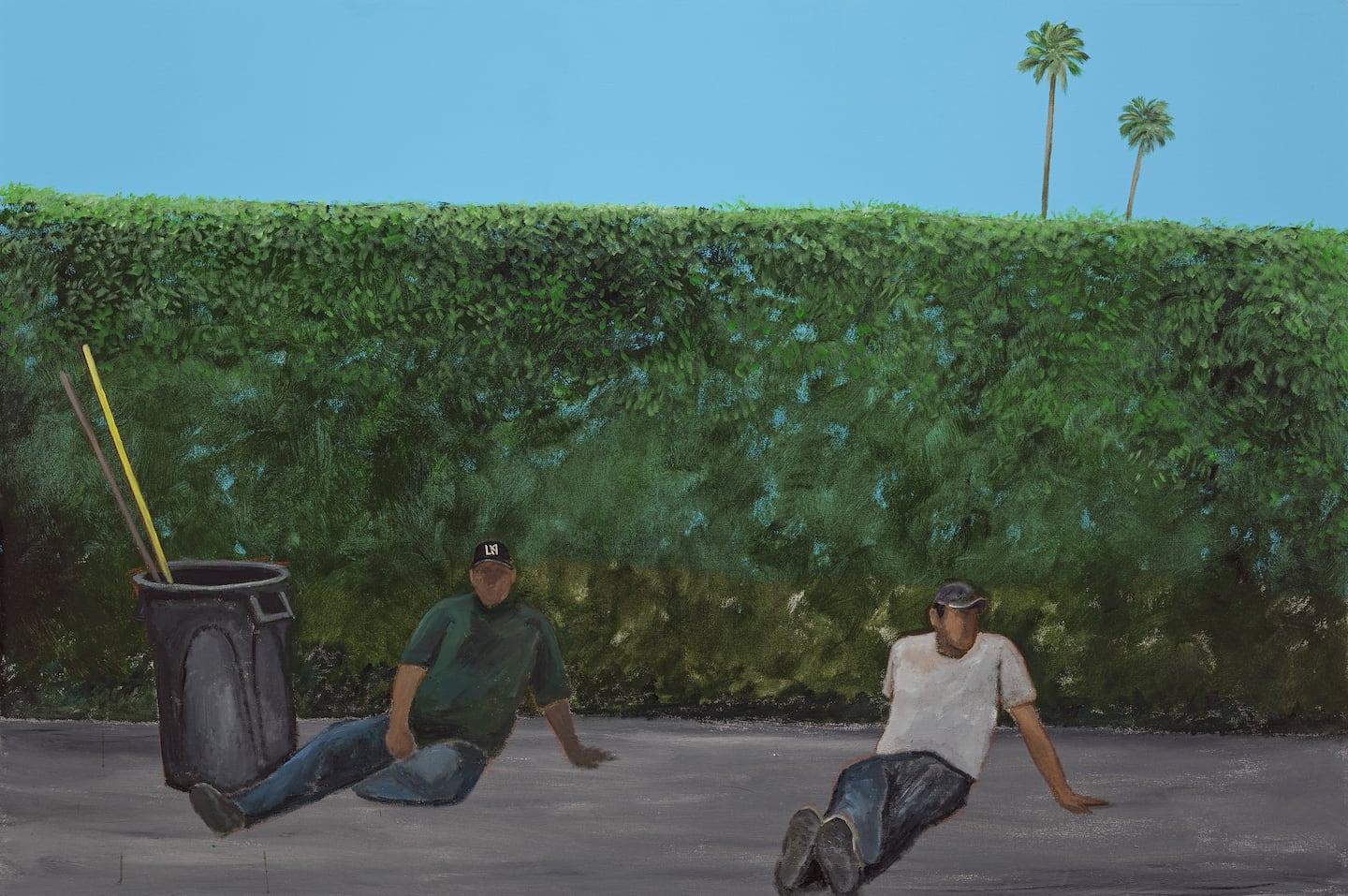
In the next gallery, the beat goes on. Hanging near another opulent Flemish tapestry from 17th century — “Vertumnus Throwing off His Disguise,” a depiction of a scene from Ovid’s ”Metamorphoses” — is Jay Lynn Gomez’s “Resting,” 2019, a big, plainspoken painting of have and have not. In the foreground, two men slouch on a sidewalk in front of a towering wall of green hedge, tools and trash bin to one side. They are faceless; Gomez has made it clear that breaktime is on the outside of the garden, on the hot concrete, not amid the cool manicured lawn and shrubbery that may lie within.
It’s sobering, a prompt to consider the consumption and possession of land that has always been a feature of humankind’s relationship with the land. These days, it’s the acre-gobbling industries of resource extraction and private property development, whether for gated communities, golf courses, or any other walled refuge for those who can afford it. Dakota Mace, a Diné artist whose photographic piece hangs in a portion of the show called “Gardens and Power,” deepens the concern with a reminder of how long this has been going on. In her “Sacred Places” series, Mace references the Long Walk of 1864-68, in which the U.S. government displaced some 10,000 Diné people from their ancestral lands. Her work here is a photograph of the hands of Helen Nez, a Diné elder, paired with silhouetted images of native plants from Nez’s Arizona reserve. It points out another grim reality about that land: No longer a refuge, it’s been contaminated by uranium mining.
 L: Claude Monet, “Water Lilies,” 1905; R: Gustave Caillebotte, “Les dahlias, jardin du Petit Gennevilliers,” 1893. Installed in “Framing Nature: Gardens and the Imagination” at the MFA. (Murray Whyte/Globe Staff)
Murray Whyte/Globe Staff
L: Claude Monet, “Water Lilies,” 1905; R: Gustave Caillebotte, “Les dahlias, jardin du Petit Gennevilliers,” 1893. Installed in “Framing Nature: Gardens and the Imagination” at the MFA. (Murray Whyte/Globe Staff)
Murray Whyte/Globe Staff
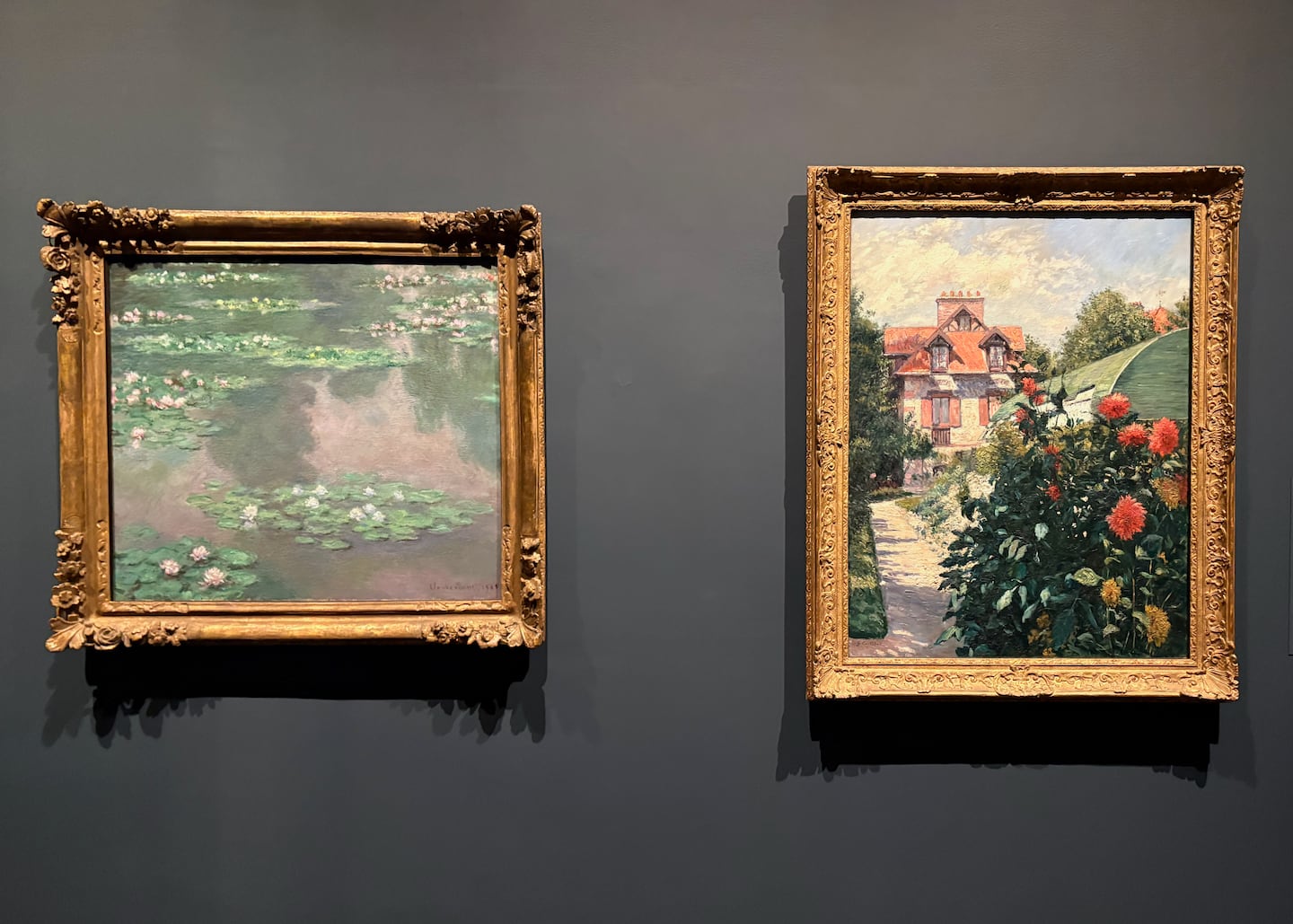
This is stern stuff for a spring bloom, and you can snap out of it, if you like, with Claude Monet’s “Water Lilies,” 1905, with its blots of flowering green and white adrift in the mirror sheen of a pond. It hangs next to Gustave Caillebotte’s “Les dahlias, jardin du Petit Gennevilliers,” 1893, with its fiery floral bursts erupting in the foreground of a prim country home. Their magic is undimmable, together or alone; they shine like beacons here, blithe anomalies that exist to just to be beautiful, and only that.
They read, to me, like a breather – a simple moment amid the complexities here. I’ll allow it. In this garden, as frequently rosy as it is, there’s ample notice of the thorns.
FRAMING NATURE: GARDENS AND THE IMAGINATION
Through June 28. Museum of Fine Arts, 465 Huntington Ave. 617-267-9300, www.mfa.org.
Murray Whyte can be reached at murray.whyte@globe.com. Follow him @TheMurrayWhyte.