
Less than two days from now, NASA’s Artemis II mission is scheduled to lift off for its historic 10-day journey around the Moon, marking the first time humans have ventured beyond Low Earth Orbit for the first time since Apollo 17 in 1972, and possibly even set new distance records for traveling beyond Earth. However, Artemis II is only scheduled as a flyby mission and will not be landing humans on the lunar surface, with this endeavor being scheduled for later missions.
Now, a team of researchers from NASA and industry might be one step closer to landing humans on the lunar surface, as they recently presented findings at the 57th Lunar and Planetary Science Conference (LPSC) discussing how they narrowed down the landing site selection for future Artemis missions. While the study mentions site selection for Artemis III, NASA changed the landing mission to Artemis IV before this year’s LPSC meeting, with Artemis III now being used as a testing mission for an Earth orbit docking test in mid-2027 for the Starship or Blue Origin landers. Nonetheless, the research presented in this study is paramount for future human landings on the lunar surface.
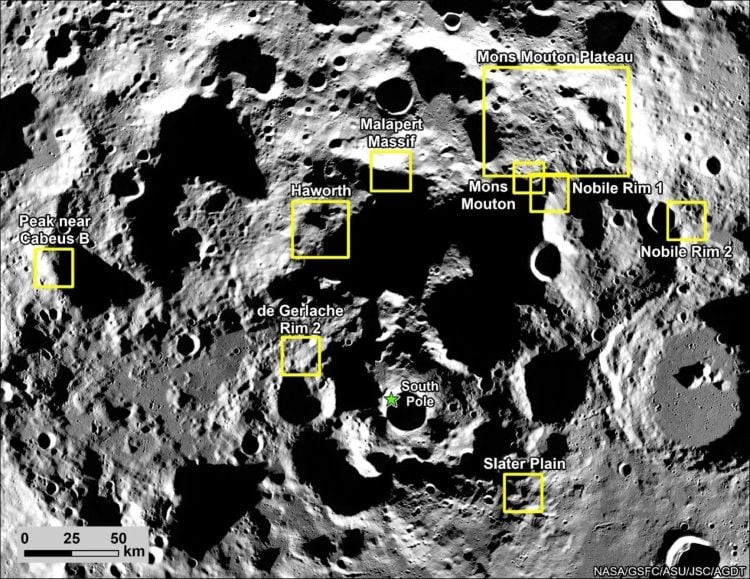
For the study, the researchers provided an updated list of 9 candidate landing sites that was also announced in October 2024. Both the October 2024 and LPSC announcements build off the initial NASA announcement in 2022 regarding 13 candidate landing sites with the goal of narrowing down the most plausible landing sites to maximize mission success.
The team notes that between the 2022 and 2024 announcements, numerous assessments and mission updates were conducted and made for narrowing landing site candidates based on several mission needs, including crewed lander and vehicle design, communications, surface lighting, safety, and surface mission duration, the last of which the researchers estimate will be 5.75 to 6.25 days.
The study notes, “The resulting down selection from thirteen to 9 regions reflects prioritization under current Artemis III constraints and does not imply that removed regions are unsuitable for future exploration. Rather, the 9 regions represent those that continue to balance operational feasibility, terrain safety, and science potential most effectively for the architecture envisioned for the first crewed mission.” Once again, Artemis III has been re-designated as a test mission, so the landing sites in this study will likely get pushed back to Artemis IV or later.
With all landing sites located at the lunar south pole, communications become crucial for staying in constant contact with Earth. While the Earth is tilted approximately 23.5 degrees relative to the Sun, the Moon is only tilted approximately 5 degrees. This much smaller angle means some regions of the lunar poles are not directly in line with Earth, meaning communications can be intermittent.
This issue became apparent during the IM-2 mission for Intuitive Machines that attempted to land near the south pole but ended up landing sideways in a crater. This is because during the descent, the spacecraft’s telemetry and altitude experienced large changes, meaning the spacecraft didn’t know where it was due to intermittent communications with Earth. This occurs if a spacecraft passes behind a crater rim or small hill, temporarily cutting communications with ground controllers on Earth. While a robotic mission might end in failure, or in the case of IM-2, sideways in a crater, future human missions will require constant and uninterrupted communication relay with Earth to ensure maximum safety and mission success.
A primary reason NASA is targeting the lunar south pole is due to the large deposits of water ice present in deep craters that scientists estimate that haven’t seen sunlight in billions of years, resulting in slow buildup of water ice from the frigid temperatures. Known as the permanently shadowed regions of the Moon, these exist due to the aforementioned small axial tilt of the Moon, whereas Earth’s tilt allows sunlight to bathe our entire surface over the course of one Earth year. For context, one “day” on the Moon lasts approximately 29.5 days, with half that time in sunlight and the other half in shade, which is also experienced on the lunar polar regions.
What landing site will ultimately be selected for the first human lunar landing since 1972? Only time will tell, and this is why we science!
As always, keep doing science & keep looking up!