
I admit it: I have a guilty pleasure.
Don’t worry. It’s nothing dangerous, nothing illegal, nothing that would make national headlines. But I’m still not going to tell you what it is. Not here, and probably not ever.
You have a guilty pleasure, too. You know exactly what I’m talking about—that thing you do on a consistent rhythm, maybe daily, maybe weekly, that you would never bring up at a work dinner. The thing you’d only tell a close friend after lowering your voice, glancing around, and prefacing it with don’t judge me, but…
Most of us have one. And the psychology behind why we have them, why we hide them, and why we might desperately need them is far more interesting than I ever expected.
Sharon’s Kitchen
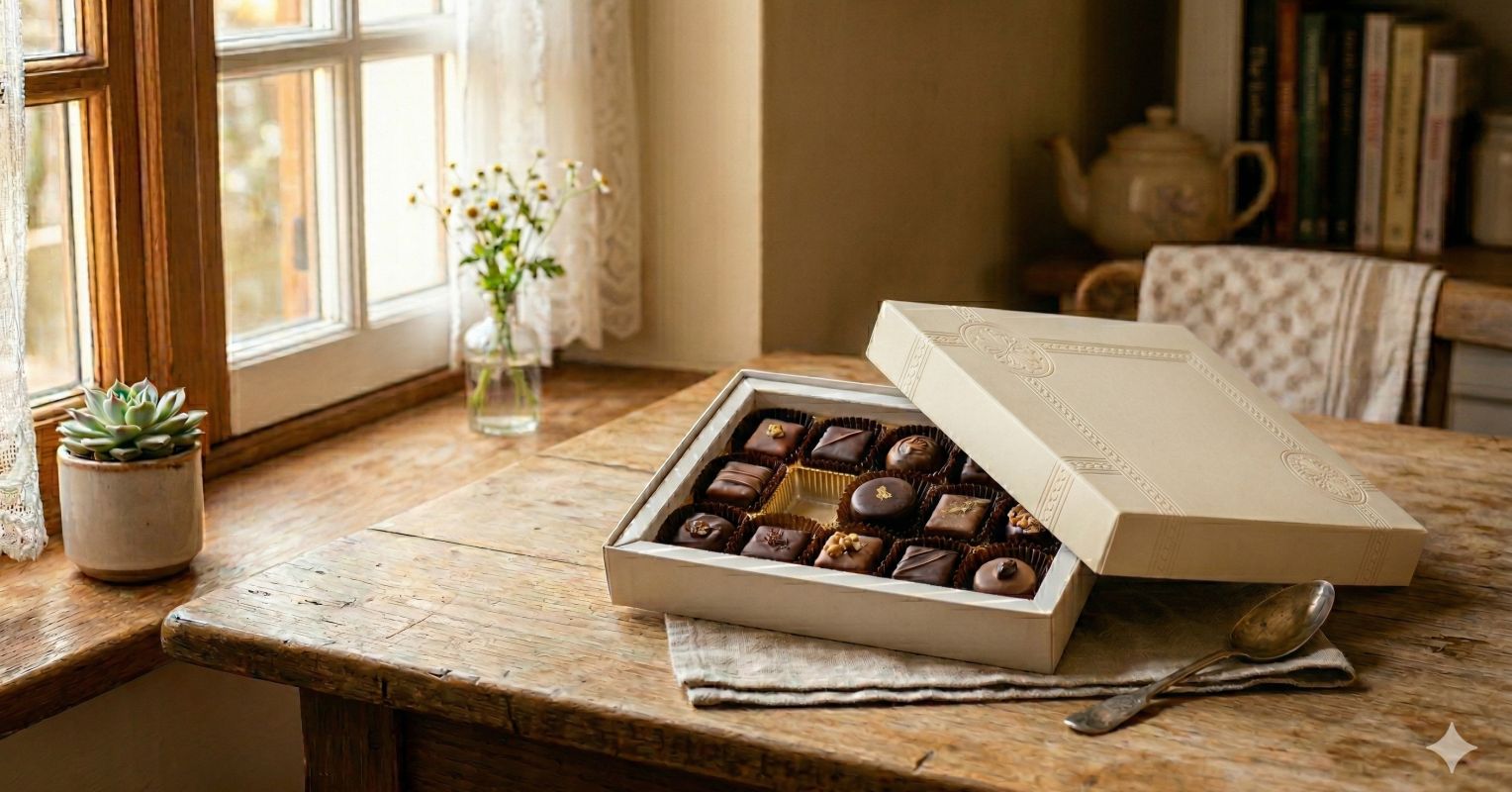
I first heard the phrase “guilty pleasure” when I was 10 years old. My friend Bryan and I walked home from school early to play video games. Bryan’s mom, Sharon, was like a second mom to me. Her kitchen was an open headquarters for every stray kid in the neighborhood. That afternoon we opened the front door and found Sharon sitting alone at the kitchen table, a See’s Candy bon-bon halfway to her mouth.
She looked up at us. And she blushed bright pink.
A grown, responsible woman in her kitchen, eating a piece of candy she’d bought with her own money on a perfectly ordinary afternoon. She shrugged and said, “You caught me. It’s my little guilty pleasure.”
I didn’t understand it then, but something about the moment stuck with me for decades. Why did Sharon feel caught? What was she guilty of doing? Why did she feel like she owed two kids an explanation for enjoying a treat in her own home?
The Theory I Never Saw Coming
These questions came rushing back recently, over drinks after a guest lecture I gave at Columbia Business School. I was talking with Michel Tuan Pham, one of the most cited consumer psychologists in the world, and the founder of Columbia’s Research on Emotions and Decisions (RED) lab. He told me that he and doctoral researcher Jingxuan Liu were building a formal theory of guilty pleasures.
I almost spit out my drink. Seriously? Then he started explaining what they’d found, and the conversation went somewhere I wasn’t prepared for.
A guilty pleasure, Pham explained, occupies a psychological space that almost nothing else does. It’s different from addiction, which is defined by loss of control. It’s distinct from regular indulgence, which doesn’t carry emotional conflict. A guilty pleasure is something more nuanced: it’s an experience in which you’re enjoying something and, at the same time, judging yourself for enjoying it.
I immediately thought about Sharon. The See’s Candy, the blush. But now it started to make sense: Pham and Liu’s research shows that guilty pleasures are marked by a kind of compartmentalization. They almost always happen at specific times, in specific places, usually alone. They involve hiding, selective sharing, and some internal negotiation: I earned this, just today, I want it. Even though it’s never just today; it’s every Tuesday, every night at nine, every Friday when the week is finally over.
That rhythm matters. It’s part of what separates a guilty pleasure from a real problem. Pham’s and Liu’s framework draws the line clearly: Guilty pleasures are intentional violations. They’re fairly innocuous, and they’re under your control. You can stop, but you choose not to—for now. Addiction is when that choice disappears. Sharon could put that bon-bon down, but an addiction wouldn’t let her.
And the emotion she felt when we walked through that door? It probably wasn’t guilt at all. In fact, the dominant feeling in guilty pleasure is closer to embarrassment, the fear of being seen. Sharon wasn’t morally tortured over that bon-bon. She blushed because she suddenly had an audience.
And her embarrassment wasn’t about the candy itself, but about what it represented: a moment that didn’t match the identity she’d built as mother, caretaker, giving person who puts everyone else first. The guilty pleasure was in Sharon getting to be just a person who wanted something for no reason at all.
Turns out, in guilty pleasures, your identity is tied to the values being violated, not to the source of pleasure. You’re never ashamed about the thing itself. You’re embarrassed because enjoying it contradicts the story you’ve been telling yourself about who you are.
Is Guilt The Point?
After the conversation with Pham, I went home and started reading more widely. The research got weirder. A research team led by behavioral scientist Kelly Goldsmith discovered that guilt amplifies pleasure instead of diminishing it. That’s right: Feeling guilty is part of the enjoyment!
Across their experiments, people primed to feel guilty reported greater enjoyment of indulgent experiences—from chocolate to videos to romantic escapades. Priming them to feel disgust or sadness did nothing. The effect was unique to guilt. The explanation? We’ve heard “guilty pleasures” so many times that our brains have fused the two into one circuit. Activate guilt, and pleasure lights up alongside it. They travel together.
Which means the self-help mantra to “stop feeling guilty about your guilty pleasures” might have it totally backwards. Strip that guilt away and you might lose the mojo that makes the whole thing work.
Why We Need Them
Guilty pleasures ask something strange of us psychologically. They require us to hold two contradictory feelings at once—enjoyment and self-judgment—and not resolve the tension. Psychologists call this ambivalence, and we’re generally pretty terrible at it. We crave clarity. We want to know whether something is good or bad, worth our time or a waste of it.
A guilty pleasure refuses to be one or the other. And staying in that discomfort, enjoying something without being able to justify it, is actually a marker of psychological flexibility. It means your identity isn’t so rigid that it shatters the moment you do something off-brand.
That matters in a culture obsessed with self-curation, where every choice is supposed to cohere into some polished narrative about who we are. Your guilty pleasure is where that narrative cracks. And nobody is forcing the crack open, because we police these things entirely from within. The constraint is self-imposed. We are both the indulger and the warden. The permission we grant ourselves, the boundaries we set, the rituals we build—these are some of the more sophisticated acts of self-regulation we perform as human beings.
We just refuse to give ourselves credit for it because it looks like stuffing chocolate in our faces at the kitchen table.
The Most Human Thing We Do
I think about guilty pleasures differently now. Especially in this moment, when the world seems to be accelerating past our ability to keep up with it. When AI drafts our emails and when productivity culture has colonized every waking hour.
Our guilty pleasures can’t be optimized, automated, hacked, delegated, or for god’s sake, scaled. That’s the whole point. Guilty pleasures feel like the last corners of our lives that belong entirely to us, and they exist for no other reason than we are human beings who simply like something.
I work with AI every day, and I teach my own MBA class on it. I can tell you: AI will never have a guilty pleasure. It will never blush over a bon-bon. It will never feel that private, ridiculous thrill of doing something completely pointless and loving every second of it.
The experience of being tangled up with enjoyment, embarrassment, and ritual belongs to us—and only to us.
Where to Start
Say it out loud. Why not tell someone your guilty pleasure without softening it first? Offer no disclaimers. Just pay attention to the slight wince, because that’s your identity telling you where the performance ends and the real human begins.
Stop apologizing. Your guilty pleasure probably has a rhythm to it—the same time, same place, same trigger. While we beat ourselves up over a lack of discipline, that’s just your psychology doing exactly what it’s supposed to do.
Protect it. Be selective about who gets to know and who doesn’t. Part of what makes a guilty pleasure work is that it belongs to you. You certainly don’t owe it to anyone as content, as conversation, or as a confession. But that means you can’t let anyone, including yourself, talk you out of it, either. The things that can’t be justified are often the things that hold us together.
Now if you’ll excuse me, I have an appointment that I can’t explain.