
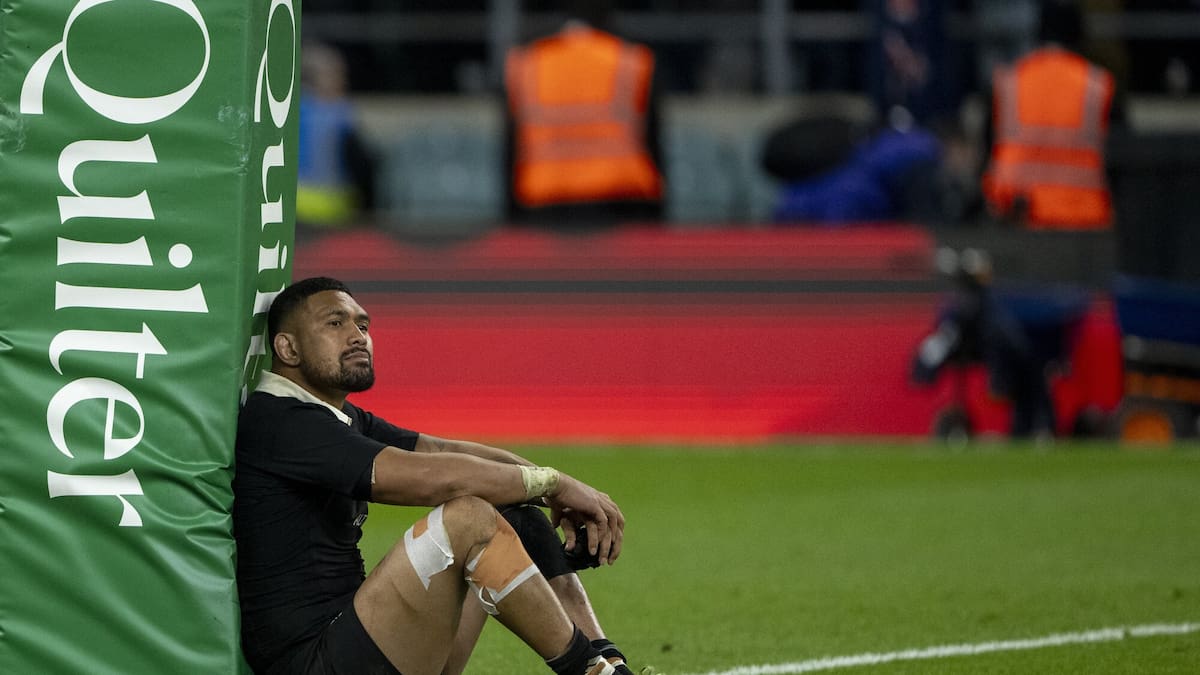
The fading renditions of Swing Low, Sweet Chariot could be heard as the last of England’s jubilant fans exited Twickenham, and all that could be seen were thousands of empty seats and the scale of the clean-up job awaiting the ground staff.
On the field, Ardie Savea had not yet
retreated to the changing room. He was sitting against a goalpost in deep contemplation.
He stared out, which was understandable as the All Blacks had endured a painful 33-19 loss to England – their third defeat of 2025 – and it had killed their hope of securing a coveted Grand Slam.
Yet more painful was the nature of the defeat – following as it had a well-worn formula of a third-quarter meltdown in which the All Blacks lost their shape and England took control.
No doubt Savea reflected on the specifics, but he might also have been contemplating that he could have played his last test for the All Blacks.
Savea wasn’t reflecting on one game, but his 106-test career that had just ended.
Ardie Savea celebrates for the All Blacks against Ireland, in Chicago last year. Photo / Photosport
He was out. Done. Finished. His test career was over, because a week earlier, Savea had told New Zealand Rugby (NZR) chair David Kirk that he wanted out of the remaining two years of his contract.
It was shocking for Kirk to hear the country’s best player – the world’s best player – say he wanted to terminate his $1 million-plus a year contract.
Savea was not only the All Blacks’ best player, but the spiritual leader of the team and the face of many of NZR’s commercial projects and partnerships.
Kirk and Savea spoke a week after the All Blacks had been in the USA to play Ireland, collect a near $6m payday from the gate receipts, schmooze new sponsors and sell the team and the sport to a strategically vital market.
Savea, as the team’s bona fide superstar, was an integral part of the sales pitch, but here he was wanting to get out ahead of the commercially critical Greatest Rivalry Tour with South Africa, ahead of the launch of the Nations Championship, but most damagingly, ahead of the 2027 World Cup.
Edinburgh is a city with a dark history and many secrets and – not far from where former Romanian lock Cristian Raducanu escaped the clutches of Nicolae Ceaușescu’s secret police after a test against Scotland in 1989 and defected – Savea was explaining to Kirk why he too wanted to escape, in his case, from the last two years of his contract.
He’d chosen to speak to Kirk as he knew he was delivering bombshell news and he felt the chair was the best first port of call.
Chief executive Mark Robinson had resigned and was leaving NZR in December and Savea felt a contract issue was more in the executive wheelhouse than that of head coach Scott Robertson’s. (Kirk was also returning to New Zealand after the match against Scotland on November 8).
Savea was explicit – he was struggling with what was effectively a nomadic lifestyle of being away from his home and family for long spells.
In the past two years, travelling for rugby meant he had missed a great deal of time with his wife Saskia Savea and three children, and his wider close-knight family.
In 2024, he’d missed the Super Rugby Pacific season to play with Kobe in Japan between December (2023) and May (his family stayed in Wellington), before heading on the road with the All Blacks between July and November, which included a trip to the USA, two weeks in South Africa and five weeks in Europe.
Ardie Savea switched to Moana Pasifika in 2025. Photo / SmartFrame
He then switched his Super Rugby allegiances to Moana Pasifika, so he was based in Auckland between January and June, while the family again stayed in Wellington. He was then back on the road between July and November with the All Blacks.
He was contracted to play for Kobe again between December 2025 and May 2026, meaning more time away from family.
Family is Savea’s everything and he felt that to be true to himself and his presiding core value, he had to prioritise his wife and children.
A source with knowledge of the situation says Savea’s children had reached an age where it was harder to be away from them – his absence coinciding with milestone events.
The source said that while Savea would love to have a fairy-tale ending to his career at next year’s World Cup, he also thought that by the time he’s 80 and looking back on his life, he’d feel that being a good, mostly present father and husband would mean more to him.
“Ardie is his own man and does everything with a true heart,” the source said. “He felt the way he did because that’s what matters most to him.”
Savea also, it is believed, told Kirk that he was both physically and mentally tired – that his season with Moana, in which he played 12 of 13 games and delivered the greatest individual campaign in history, had taken a lot out of him.
He’d also played virtually every minute of every All Blacks test so far that year.
The Herald has been told that he felt his only way out was to pull the plug on his NZR contract.
New Zealand Rugby chair dealt directly with Ardie Savea. Photo / Sylvie Whinray
Kirk is understood to have told Savea – in what is thought to have ended up being a wide-ranging conversation – that NZR valued him highly, did not want to lose him (and would not agree to an early termination) and that it would work with him to find ways to help him get through the next two years.
It is understood that Robertson was not told about the conversation between Kirk and Savea before the test against Scotland.
The Herald has been told that Savea met Robertson in London a few days later, ahead of the game against England on November 15, and the former said precisely the same thing he had to Kirk – that he missed being away from his family, was physically and mentally tired, and wanted out of his contract.
That same week, Robinson met with Savea’s representative Jay Maka in London and the messaging was again consistent, as it was when the chief executive discussed the issue face-to-face with the All Blacks back-rower during the last week of the tour in Cardiff.
Robertson and Robinson both reiterated that NZR would work with him to find a solution to keep him, and that the All Blacks didn’t want to lose him.
But Savea kept saying he was done, that his All Blacks career was over.
While the prospect of Savea walking out on the All Blacks was a major concern for NZR, other significant problems came to a head in the week after the defeat to England.
Two well-placed sources have confirmed that NZR’s executive became aware in the week after the tour had finished that All Blacks – of all levels of experience and ages – had started to talk openly amongst themselves in both private and public settings about their lack of confidence in the coaching set-up.
One source said that All Blacks management started to become aware of the problem when the team were in Cardiff to play their last Grand Slam test.
The Herald has been told that some All Blacks management (non-coaching staff) also became aware during the Grand Slam tour that players were leaving the team hotel in small groups to congregate in nearby cafes.
Management believed this was happening because players deemed these were safer areas to talk more openly with one another about their coaching gripes.
The All Blacks perform the haka ahead of their test against Wales in 2026. Photo / SmartFrame
After the 52-26 victory against Wales, there were few players drinking in the team room at the hotel as there typically would have been at the culmination of a long tour.
Management suspected that most of the squad had gone elsewhere to avoid any potentially awkward conversations with coaching staff, who may have wanted to informally chat about how things were going over a beer.
Immediately after the tour, various groups of players were sent around the world to engage in commercial activity with sponsors, and it is understood that it was on these trips that players began talking with little inhibition.
There was genuine concern, one source says, “that players were going to talk negatively in front of sponsors and commercial partners”.
One senior player, who the Herald has chosen not to name, was understood to have been particularly vocal and critical about the coaching set-up in spaces where he could potentially have been overheard, but there were no adverse reports from sponsors about player behaviour or conduct.
But still, the message had been relayed back to NZR’s executive team that there was an unprecedented volume of unrest within the squad, and a sense that the internal self-policing dynamic had collapsed, as this sort of open dissent was not considered the All Blacks way.
The nature of the loss to England, where there was a major disconnect between the on-field leaders and coaching team following a yellow card to Codie Taylor, widened what was an undeniable sense of there being a divide between the players and coaching group whenever the team were under pressure.
It is understood that the corrosive element in eroding the team fabric was the growing number of times players felt they had endured poor and confused communication from Robertson and were left uncertain about the game plan, their role and where they stood in the selection hierarchy.
The feedback from players was so uniform and so widespread that there were regular third-party interventions throughout 2024 and 2025 to try to improve things.
The Herald has been told that in 2024, Robinson came under pressure from figures within rugby to talk with Robertson about toning down his public narrative to persuade former All Black Richie Mo’unga to return from Japan.
Richie Mo’unga and Beauden Barrett at the 2023 Rugby World Cup. Photo / Photosport
It was the Blues, though, who felt most affected – with many of their players reporting back to the club after international duty uncertain about what they were being asked to do to stay or get into the team.
It reached the point where Blues coach Vern Cotter rang Robertson – in a call that the Herald has been told was collegial and constructive – to get answers on behalf of players in the squad and to ascertain what others, not being picked, could do to change that.
Robertson was happy to have the dialogue and retain open lines of communication with Cotter.
There were also incidents and decisions that players didn’t feel aligned with the All Blacks’ culture and which, it is said, they didn’t feel were dealt with consistently or appropriately.
Robertson had styled himself as “the culture coach”, taking responsibility for ensuring the team were cohesive and aligned behind a simple theme.
But as the Herald has previously reported, sources with direct connections to the team say several players were disappointed in July 2024 when Damian McKenzie was not disciplined for missing the bus the All Blacks took from San Diego to Los Angeles International Airport after the test against Fiji.
McKenzie ended up having to take an Uber to the airport (at a likely cost of around US$400, about $700), and for those older All Blacks who had lived through previous regimes, what happened in the US was seen by them to be at the more serious end of indiscretions.
Damian McKenzie faced no further punishment after missing a team bus in San Diego. Photo / Photosport
Many people spoken to by the Herald have said that the punishment – McKenzie being asked to apologise to the team – was felt by some senior players to be both weak and inconsistent with All Blacks standards, while others are said to have been conscious that it was inconsistent with the punishment given to wing Mark Tele’a the year before – albeit under a different coaching regime – when he was dropped for the World Cup quarter-final after missing a curfew.
It was never clear at the time when the Herald investigated this story whether responsibility for disciplining McKenzie lay with the leadership group or coaches, but several sources said it was a misdemeanour of such magnitude that the latter, regardless of any pre-agreed jurisdiction, needed to ensure the response to the incident sent the right message.
“I’m happy to, actually,” Robertson said at the time, after the Herald had broken the story and he was asked to clarify what had happened.
“He [McKenzie] missed the bus because he missed the transport to the bus. It’s that simple. He apologised to the group. I can’t say any more. The back seat of the bus did a great job. I step in if there is a curfew broken … but it was just a bus.”
On the end-of-year tour, TJ Perenara performed his politicised haka without the permission of his teammates – an incident that is understood to have left captain Scott Barrett feeling he wasn’t offered enough support to shut it down or deal with its ramifications.
Earlier on the same tour, Ethan de Groot was stood down for the game against England at Twickenham, and while the reasons were not revealed, it was believed to be because he missed a curfew.
Notwithstanding that Robertson could draw a distinction between missing a bus and missing a curfew, the inconsistency of fate was again noted.
For a team with a famed “no dickheads” culture and peer management system where teammates held teammates accountable, there was a distinct sense among the players that standards were neither consistent nor high enough.
But the Herald has been told that it was the plight of Blues captain Dalton Papali’i that became something of a cause celebre among teammates, and the totem for their collective gripes.
Papali’i began the Robertson era as the first-choice openside but was relegated from the match-day 23 midway through the Rugby Championship.
Well-placed sources say Papali’i clashed often with Robertson throughout 2024, and when the former was picked for the end-of-the-year tour, but unable to travel because of a hamstring injury, he was confused by the head coach’s public messaging.
Robertson said several times that he expected Papali’i to join the tour, but the call-up never came and the relationship soured.
Dalton Papali’i in action for the All Blacks in 2024. Photo / Photosport
But Robertson threw an olive branch in July last year when he called up Papali’i for the final game of the series against France.
Papali’i came off the bench, was told after the game that he played well and Robertson and the other coaches had liked his attitude and positivity in camp.
It’s at this point that Robertson’s and Papali’i’s perspectives appear to diverge. The Herald has been told by NZR that Robertson felt he was clear about the circumstances under which Papali’i was told he’d remain with the All Blacks and travel to Argentina for the Rugby Championship tests.
It was a call-up contingent on whether other players recovered from injury. The Herald understands that Papali’i, though, came away from the conversation 99% certain he was going to Argentina and was, therefore, disappointed when the squad was named and he wasn’t in it.
He received no communication about the matter, at which point he instructed his agent to tell NZR that he would be invoking a clause in his contract to quit early if he was not selected by the All Blacks.
In November, Papali’i was named captain of the All Blacks XV and after leading the side in two games against Uruguay and the Barbarians, he was called up to join the All Blacks for their test against Wales.
He rejected the invitation, telling NZR that he was committed to leaving (he will join French club Castres later this year) and that the opportunity would be better used by somebody else.
In 2019, Papali’i was being touted as a future All Blacks captain and here he was now giving up on that dream at just 27. The whole business reeked of sadness and needlessness.
He was a well-liked and respected All Black and his story resonated with teammates.
It was, it is believed, a seminal moment inside the All Blacks – viewed by many of the players as emblematic of the confusion that reigned.
The normally measured and brilliantly astute former England and British and Irish Lions first five-eighth Stuart Barnes was forthright in saying what, or rather who, was responsible for Robertson’s termination in January this year.
His column in the Times was titled: “Scott Robertson sacking is victory for Ardie Savea and player power.”
He was far from alone. The notion that Savea led a player revolt with an ultimatum to NZR that he would walk out on his contract unless the All Blacks head coach was removed is hard-baked into the narrative of Robertson’s demise.
It has been referenced by papers such as the Times and Telegraph in London, as well as the Irish Independent, and a source says that Savea, having seen how this narrative has also exploded on social media, feels he is perceived to be the international poster boy of player entitlement.
It’s a position that a source says Savea vehemently refutes. The source also said that Savea feels he was wrongly and unfairly singled out by initial media reporting about Robertson’s axing.
All Blacks teammates have also publicly denied Savea led any revolt, while Kirk has said: “There was definitely no revolt. The players were very measured and thoughtful in their responses. It’s very unfair to say that Ardie somehow led something, not at all.”
The Herald has made exhaustive inquiries and spoken to more than 20 people to piece this story together and there is no evidence Savea made an ultimatum about Robertson having to go for him to stay.
The Herald has confirmation that Savea indicated he wanted to stay a full month before the head coach was let go.
Different threads have been wrongly tied together and the two most obvious elements that have been conflated are Savea’s desire to quit his contract and the decision by NZR to sack Robertson.
Everyone spoken to says that Savea was consistent and genuine with his reasons for wanting to leave the New Zealand team.
But two things can both be true at the same time and the Herald has been told that Savea wasn’t enjoying the All Blacks environment in 2024 and 2025, and that it is believed that he felt he never developed a strong relationship with Robertson the way he did with previous All Blacks coach Ian Foster.
Well-placed sources say difficulties between the two began before the first All Blacks tests of the year over Savea’s decision to sign with Moana Pasifika.
The chance to play for Moana was the perfect opportunity for him to have a playing experience that was aligned with his identity and family.
It was, to Savea, a meeting place of his faith, family and footy and on the day he was unveiled, he said: “To have this team show the love and support they have for me and my family is special.
“Knowing that, regardless of anything that might happen, they will look after me and my family – I think that means a lot.”
But there had been a lot of angst getting to that point. Savea, who represented himself in the negotiations, had initially been talking to the Hurricanes – the club he had played for between 2013-2023.
One source familiar with negotiations says that when it became apparent that Savea had pre-agreed another sabbatical with Kobe in 2026, talks with the Hurricanes broke down. They didn’t want to have him available in 2025 and 2027, but not have him in 2026.
It is also believed that Savea had pay demands that were beyond the Hurricanes’ budget, but Moana, through a third-party deal, were believed to have boosted their offer by around $250,000 to get him the package he was after.
But several sources with knowledge of how things played out say that Robertson and NZR general manager of professional rugby Chris Lendrum initially positioned themselves against the move.
They are understood to have held concerns, which they expressed to Savea, about Moana’s high-performance culture, facilities and coaching.
These were fair, given the club had finished last in 2023 and second-last in 2024, but the pitch against Savea going was deemed by those who were aware of what was said to be too strong and, at times, tone deaf.
It contained concerns about Savea being overplayed by a club that didn’t have rest and rotation agreements in place with the All Blacks, and it was even put to him that his form would suffer.
On that last point, agreement was reached that a portion of his salary – thought to be around 20% (circa $200,000) – was contingent on him being selected for 70% of the All Blacks tests in a calendar year.
Such clauses are not uncommon, but Savea is thought to have seen it as a way of punishing him for going to Moana.
More significantly, it is believed that he felt that his reasons for going to Moana were never understood – that family and faith are everything to him.
In announcing that he had signed with Moana, Savea insisted the press conference be exclusive to Pasifika media and Pasifika journalists.
While there was tension between Savea and Robertson during the Moana negotiations, to say they never got on is not true.
There are ample reports from people connected to the team that Savea and Robertson had a functioning, professional relationship and that the two had the same sort of informal, personal interactions as the coach did with other players.
But one well-placed source says that Savea, who had captained the All Blacks in 2023 for more minutes than the appointed skipper Sam Cane, felt he was marginalised at leadership meetings when it came to on-field strategy and devising game plans.
Ardie Savea (left) with Scott Robertson at a captain’s run in 2024. Photo / Photosport
Robertson had appointed him off-field captain with specific responsibility for managing the team’s commercial activities each week, and Savea, one source with specific knowledge says, never felt that he was valued as a strategic, on-field leader.
According to many people familiar with how meetings typically ran, captain Scott Barrett, vice-captain Jordie Barrett and chief playmaker Beauden Barrett would lead the strategic planning each week.
However, Robertson never had any hesitation or qualms about promoting Savea to the captaincy whenever Scott Barrett was injured.
Savea stepped in as captain in the home series against Argentina in 2024, and against France twice in 2025, as well as in tests against Australia and Scotland.
Robertson also publicly spoke glowingly about Savea’s performances and leadership.
What potentially accentuated an unacknowledged awkwardness between the two was Savea’s outrageously good form for Moana in 2025, which demonstrated that shifting to the club had been a brilliant career move.
But while Robertson may have been wrong about how the shift could potentially affect Savea’s form, he was right about the heightened physical and mental impact it could have.
Robertson has legitimate reason to have felt blindsided by Savea’s revelation in November and the coach may wonder why nothing was said earlier.
Savea, a source aware of how he was feeling says, is not inclined to seek conflict and his instinct in 2025 was to mentally withdraw and not engage.
There was, by early December 2025, a diverse range of evidence to trigger concerns that the All Blacks had deep and possibly systemic issues.
There were, most importantly, the inconsistent performances and comparatively underwhelming results – the best judge of the team’s overall health.
The record of 20 wins from 27 tests was at the low end when measured against previous regimes in the professional age but was not the lowest.
However, Robertson had not banked any titles and the one win in four attempts against South Africa suggested the All Blacks (No 2 in the World Rugby rankings) were further behind the Boks (No 1) than the rankings appeared.
Then there was the Savea situation – not of itself a red flag as problems with the environment were not driving his desire to leave – but it was naïve to think he would want out if he was loving being part of the team.
There was the intel Kirk had picked up being close to the team in Chicago and Edinburgh and talking informally to players as he had, and there was the knowledge about player dissent escalating.
Former captain and New Zealand Rugby Commercial board member Richie McCaw had spent time with the team at Robertson’s request, and he’s thought to have made poignant observations that were fed back to Kirk.
Richie McCaw and Scott Robertson look on at an All Blacks training session last year. Photo / SmartFrame
There was the feedback from the 2024 review which, it is understood, had highlighted many of the issues that intensified in 2025.
None of this meant that NZR’s exec or board reached a pre-determined conclusion, but it did mean they felt they needed an action plan to investigate.
After Savea had talked with Kirk in Edinburgh, the chair contacted NZR board member and former All Black Keven Mealamu – one of the most respected figures in the game.
Mealamu’s brief was to work with Savea – effectively persuade him to stay. The former hooker contacted people who he knew Savea trusted, to help talk him down, as it were.
At about the same time, NZR head of high performance Mike Anthony was beginning his usual end-of-season review of the All Blacks.
That involved him spending time with the team in London and Cardiff and asking questions of coaches, players and management.
But by early December, there was a groundswell building for a more detailed investigation.
The New Zealand Players Association (NZRPA) was aware of the discontent among the rank and file, and while it was common for All Blacks teams to have a small number of disaffected players, the perceived level of disillusionment was on a scale never seen before.
The NZRPA and some influential personnel with strong links to the playing group are believed to have lobbied Kirk and Mealamu to carry out a deeper review with an element of independence.
In the first two weeks of December, the NZRPA, Kirk, interim CEO Steve Lancaster and NZR’s professional rugby team devised a strategy to get to the bottom of what was going on with the All Blacks’ culture and coaching set-up.
This collective group picked 25 players to interview, as well as the coaching group and the management leaders of the All Blacks’ individual units, such as performance, commercial and business.
The Herald has learned that Papali’i was one of the 25 players interviewed – this despite not having been selected (he was an injury call-up in July and again in November when he declined) in any of the three squads in 2025 (July, Rugby Championship and Grand Slam tour).
Papali’i only spent a week with the All Blacks in 2025 and played less than 20 minutes. NZR wouldn’t comment on which players were selected, but the Herald understands that Papali’i (as well as Crusaders captain David Havili, who also wasn’t an All Black in 2025) were interviewed as their observations about how they had transitioned in and out of the team were deemed to be of value.
On December 15, former NZR head of high performance Don Tricker agreed to serve as an adviser to the review and provide independent oversight.
It was agreed that Kirk, because of his background, expertise and standing, and Mealamu, because of his ability to draw the truth out of players, particularly those of Pacific Island descent, as well as his knowledge of the All Blacks, should do the interviews.
They completed the interviews before Christmas, correlated the data in early 2026 and announced on January 15 that Robertson was leaving the All Blacks.
The last thread to tie up is the fate of Savea. He’d told Kirk he wanted out of his contract, but no one spoken to by the Herald knows what, if any, alternative plan Savea had in mind for his career.
Media reports had previously linked him with the rebel entity R360, but in late November, it postponed its launch until 2028, and no evidence has been unearthed to believe Savea shopped himself around to Japanese or European clubs.
If he had an alternative plan, he kept it well secret and a source says that by mid-December, Savea was happy for his representative, Maka, to meet with NZR to begin talks to stay.
Several factors are believed to have triggered Savea’s change of heart. It is understood he had talked to some trusted confidantes and that he also decided to bring his family to Japan for the duration of the school holidays.
But arguably the biggest driver was the messaging from NZR. The national body held a firm and consistent line after Savea’s discussion with Kirk.
NZR is believed to have told Savea that he was a hugely important player to the All Blacks, which was reflected in the value of his contract, and that the expectation remained that he would fulfil his obligation.
NZR had already given Savea two sabbaticals. These agreements afford long-serving players such as Savea the right to take extended time off – typically up to six months – or to play offshore.
Savea had opted to use his sabbatical options to play in Japan and bank an estimated $4m – but the national body is understood to have said that it would work with him to accommodate his desire to spend more time with his family and create a playing schedule over the next two years that worked for both parties.
NZR says it was by no means certain when discussions first began that Savea would walk back his desire to leave, but it was significantly more hopeful of getting a positive outcome than it had been two weeks earlier.
Since mid-December, Maka has been working with Lendrum and the professional rugby team to build a workload management plan for Savea through this year and into the next to ensure he is in peak form come the World Cup, and that more family time is built into the arrangement.
The specifics are still to be agreed, but Savea has given NZR an assurance that he will see out his contract. Savea has come in from the cold.
NZR said in a statement: “Ardie is contracted through to the 2027 Rugby World Cup and remains an important player for the All Blacks.
“Discussions with players about their contracts within their term are not uncommon but we don’t share the details of those publicly.”
Numerous options are on the table about how to manage his workload and the one under most scrutiny is Savea returning from Japan in late May – it will depend how far Kobe reach in the Japanese competition – and not being available for the July tests against France, Italy and Ireland.
In this scenario, he would return for the Greatest Rivalry tour to South Africa and travel to the UK at the end of the year for the November tests.
The complication in this is whether missing tests in July would preclude him from being a viable option to be named All Blacks captain, but NZR is just glad to have the certainty that Savea will be here through to next year’s World Cup.
SaveShare this article
Reminder, this is a Premium article and requires a subscription to read.
Copy LinkEmailFacebookTwitter/XLinkedInReddit