

Comment: Power isn’t a luxury; it’s essential to modern life, and every dollar on a bill matters. So why does the next bill always seem higher than the last one?
Well, we need to think about electricity not as a single product, but as a system made up of many connected parts – like a house. That ‘electricity house’ now needs upgrading.
Electricity isn’t one cost – it’s a system
When you own a house, the purchase price is just the start. You also pay for the wiring, plumbing, driveway, insurance, and the maintenance that keeps it safe and liveable.
Electricity works the same way. Your power bill reflects the cost of generating electricity, transmitting it around the country, delivering it safely through local lines companies, and retailing it to customers.
As chief executive of Electricity Networks Aotearoa, I represent the local lines companies – the poles, wires and substations that deliver power to homes and businesses across the country. They are one part of the system, alongside generators, Transpower, retailers and regulators and each one plays a different role.
That matters because public frustration is often directed at the final bill, while the causes of that bill sit in different parts of the system. It also means no single part of the industry can fully explain rising prices on its own.
Generation: the house itself, or the foundations
First, we need electricity to be generated. New Zealand has benefited for decades from relatively low-cost electricity from hydro dams and other types of power stations that were built long ago. The power stations on the Waikato River for example, were built between the 1920s and 1970.
Today, building new generation is more expensive. Construction and financing costs have risen, dry years reduce hydro output, and gas – which has long backed up the system when hydro dams are low – is becoming scarcer and more costly.
Like buying a house today compared with 20 years ago, the purchase price has gone up.
Generation accounts for the largest share of the average power bill – about 38.5 percent.

Start your day informed. Make room for newsroom’s top stories. Direct to your inbox daily.
Transmission: the street outside your house
Electricity must then be moved around the country using Transpower’s high-voltage grid.
Much of this infrastructure was built in the 1950s and 60s and now needs major upgrading to support population growth, more parts of the economy switching to electricity, renewable generation in new locations, and resilience to severe weather.
You don’t think much about your street until it needs rebuilding.
Transmission accounts for about 8 percent of the bill.
Lines companies: the wiring and plumbing
This is where lines companies come in.
Local lines companies own and maintain the poles, wires and transformers in your community. Much of this infrastructure is old, some of it more than 50 years old.
In the past, networks were often expanded on a just-in-time basis. That helped limit costs in the short term, but it also left less room for flexibility as assets aged, demand patterns changed, and resilience expectations rose. A fair question now is whether some of this investment should have happened earlier and more gradually.
Today, lines companies face multiple challenges, including assets that must be replaced as they reach the end of their service life, more frequent storms and climate-related damage, growing uptake of electric vehicles, heat pumps and solar, and higher expectations of reliability.
Homeowners know you can’t postpone replacing old wiring forever. Over time, it needs to be renewed – and doing that early and in a planned way is safer and often more affordable than leaving it to the last minute.
That said, electricity users are entitled to ask why they should pay more now for infrastructure that, in some cases, has aged over decades. One explanation is that deferring replacement helped keep costs lower for earlier consumers – but it has also meant that more investment is now needed over a shorter period.
Local distribution charges make up about 24.5 percent of the bill.
Retailers: the property managers
Retailers don’t generate electricity or own the networks. They buy electricity on wholesale markets, manage price volatility, and handle billing and customer service.
When wholesale and network costs rise for sustained periods, retailers eventually must pass those costs through. That is how the market is structured, though consumers do not necessarily experience those distinctions neatly when the bill arrives.
The retail component is about 11 percent. A further roughly 18 percent is made up of metering, levies and GST.
Why is this happening now?
Multiple long-deferred investments are landing at once. New generation is needed, transmission and local lines infrastructure require renewal, and climate resilience must be built into the system.
At the same time, gas supplies are declining, and more homes, businesses and vehicles are switching from fossil fuels to electricity to reduce emissions, which means the system must safely supply more power in more places.
On top of this, labour, materials, insurance and financing all cost more – just as they do for households maintaining a home.
The system is being asked to do more, in more places, with infrastructure mostly built for an earlier era.
That we now have more demand, more weather risk, older assets and higher input costs is becoming more obvious. The harder debate is about pace, timing and who should bear the cost.
Why this spending cannot be deferred
The lines companies I represent argue this investment is not about gold plating the system, but about maintaining safety, reliability and capacity as demand changes. That claim should be tested, not simply accepted, which is why regulatory scrutiny matters.
Delaying maintenance does not make electricity cheaper. It simply shifts the cost into the future, where it becomes larger, more disruptive, and harder for households to absorb.
The challenge for the industry, regulators and government is to carefully sequence investment as the system evolves – managing the pace of change, avoiding unnecessary price shocks, and being clear with the public about the trade-offs involved.
Like a well-maintained home, a well-maintained electricity network helps keep costs more stable over time, reducing the need for more significant investment all at once.
What lines companies are doing to control costs
Local lines companies know that every dollar invested ultimately shows up on a consumer’s power bill. That’s why controlling costs is a core part of how we operate.
Over the past decade, lines company charges have risen more slowly than inflation (CPI – the Consumer Price Index). They have increased even more slowly than the Capital Goods Price Index (CGPI), which tracks the cost of things like equipment and infrastructure. That is an important part of the picture, but not the whole one. Consumers do not pay network charges in isolation; they pay the full bill. So while distribution charges may have risen more slowly than inflation in the past, that will not blunt frustration from households whose total electricity costs have still climbed sharply.
Distribution lines charges 2012 – 2030, indexed to 2012 dollars
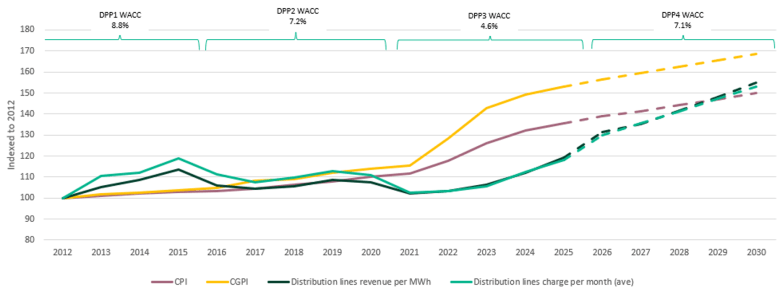 Source: Electricity Networks Aotearoa analysis, based on Commerce Commission published ID data to 2025, Stats NZ CPI and CGPI, and forecast data from the DPP4 modelling suite and asset management plans
Across the country, lines companies are trying to keep prices down by prioritising maintenance and replacement so the most critical assets are fixed first, avoiding costly emergency failures, smoothing investment over time to prevent sudden spikes in prices, and using technology such as smarter monitoring and automation to extend asset life and reduce manual work. In practice, that means spreading spending more evenly, intervening earlier where failures are most likely, and using better data to avoid replacing assets before it is necessary.
Importantly, lines companies are working within strict regulatory settings, where investment plans and returns are closely scrutinised by the Commerce Commission to ensure customers only pay for what is needed.
That does not remove the underlying tension. Regulators are asked to allow enough investment to avoid deterioration, while consumers want protection from becoming the shock absorbers for every overdue upgrade.
Lines companies are not insulated from rising costs. They face the same increases in labour, materials and financing as households and businesses. But every investment decision is made with a simple goal in mind: to maintain safety and reliability while keeping long-term costs as low as possible.
Getting that balance right matters, because fixing problems early and methodically is almost always cheaper than reacting after something fails.