
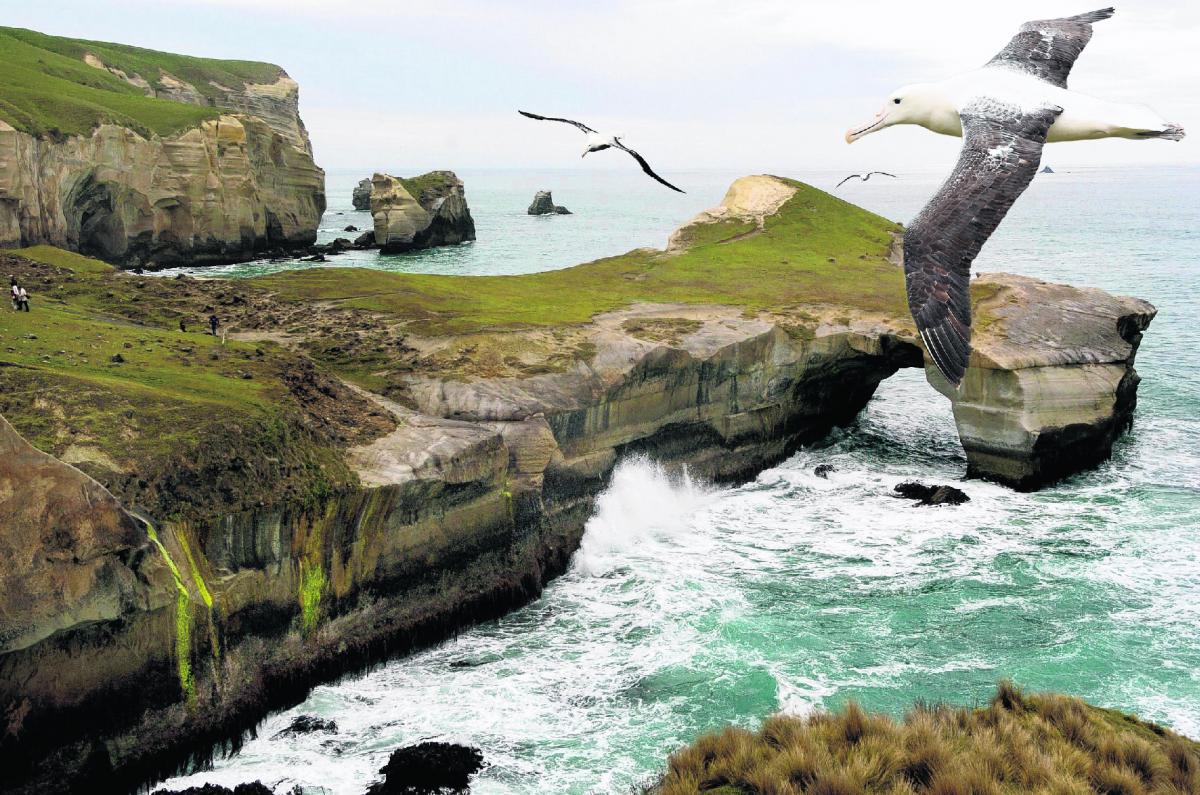
Dunedin’s world-renowned albatross colony could be relocated after the discovery under Taiaroa Head of a mineral from which several rare earth elements are derived.
Fergusonite was discovered when maintenance work was carried out on the foundations of the disappearing gun, another of the tourist attractions on the Otago Peninsula site.
Fergusonite is a source ore for several rare minerals valued by industry for a range of high-tech manufacturing processes.
It contains yttrium (used to manufacture lasers) and cerium (high-specification glass) as well as neodymium — central to making the strong magnets used in electric vehicle motors.
Initial estimates of the ore discovery suggest the Fergusonite could be present in sufficient quantities to be mined commercially, a welcome, potentially multibillion-dollar windfall for Dunedin’s economy during the ongoing global economic crisis.
However, plans will first have to be hatched to move the royal albatross colony, which sits atop the Fergusonite strike.
The colony, the only mainland royal albatross colony in the world, is regarded as the jewel in Dunedin’s tourism crown and is itself worth millions a year to the city in terms of visitor income.
A spokesman for mining company Diggett and Delve — the firm hoping to exploit the Fergusonite lode — said the colony could be successfully relocated, and suggested the move would be a win-win for the city.
‘‘We are proposing to move the birds to Tunnel Beach. It is similarly windy and exposed to the elements, so the birds should feel right at home and be able to take off from up there. Also, it is much closer to the city, making it more accessible for visitors.’’
Given the colony was established relatively recently — the first egg was laid there in 1919 and the first live fledging was not observed until 1938 — the birds should be able to manage their nesting sites being moved the 36km to Tunnel Beach, he said.
In February, the government ring-fenced $80million in the Regional Infrastructure Fund to develop and process domestic critical minerals resources.
The Diggett and Delve spokesman said the firm would be applying for government investment from that fund to confirm the commercial potential of the Fergusonite lode, and the feasibility of relocating the feathered occupants of Taiaroa Head. It would then seek fast-track approval for the new mine.
Other animals, notably skinks and snails, had been successfully relocated to accommodate mining ventures elsewhere, so there was a track record of success in transferring wildlife, he said.
Further details of the Fergusonite discovery will be announced at a press conference at noon today.