
The coronal mass ejection now racing toward Earth at roughly 1,100 miles per second has two stories attached to it. For skywatchers across the US, it means a possible northern lights display. For NASA, it spent the past 48 hours as a live threat to the most significant crewed space mission in more than 50 years.
The X1.4 solar flare erupted late on 29 March from a cluster of sunspots designated active region AR 4405. It was powerful enough to cause high-frequency radio blackouts across Southeast Asia and northern Australia. Behind it came the CME: a violent eruption of magnetised plasma now expected to deliver a glancing blow to Earth tonight, triggering G1 to G2 geomagnetic storm conditions, with stronger G3 activity possible.
 Credit: NOAA SWPC
 Credit: NOAA SWPCWhy NASA Was Watching Closely
Artemis II launches tomorrow. The mission will carry four astronauts — commander Reid Wiseman, pilot Victor Glover, and mission specialists Christina Koch and Canadian Space Agency astronaut Jeremy Hansen — on a ten-day lunar flyby. It is the first crewed mission beyond low Earth orbit since Apollo 17 in December 1972.
Under NASA’s own launch criteria, the agency cannot send the crew up during severe or extreme solar activity. The concern is straightforward: elevated solar energetic particle density can damage electronic circuits and sever radio communication with the vehicle during the critical early phases of flight.
A G2 storm is moderate. It sits well below the severe or extreme thresholds that would force a delay. NASA’s associate administrator Amit Kshatriya confirmed on Monday that space weather is expected to settle comfortably before tomorrow’s scheduled liftoff at 6:24 p.m. EDT. Mission managers gave the formal go-ahead, and the weather forecast for Kennedy Space Center stands at 80% favourable.
Solar physicist Tamitha Skov has noted that radio bursts remain the detail to watch; these can disrupt high-frequency communications during launch and early orbital manoeuvres. NASA is monitoring sunspot region AR 4405 as it continues rotating into Earth-facing position, which raises the theoretical prospect of a further eruption before the window closes. Backup launch days run through 6 April, with a further opportunity on 30 April.
If the Sun Strikes During the Mission
The launch threat is one thing. What happens if the crew encounters a major solar event once they are beyond Earth’s magnetic shield is another question entirely.
Beyond Earth’s protective magnetosphere, the four astronauts will have no natural buffer against solar radiation. The crew will monitor radiation levels continuously throughout the mission and are equipped with active dosimeter badges to track personal exposure. If readings breach predefined thresholds, the priority shifts to building a makeshift radiation shelter inside the Orion capsule, moving equipment out of the central storage bays and repositioning it along the least-shielded wall to create a lower-dose area for the crew to shelter in.
Orion’s compact, dense construction offers better passive shielding than larger spacecraft, and the approach was tested during the uncrewed Artemis I mission in 2022, which gathered radiation data across more than 25 days in deep space. Six dedicated radiation sensors are positioned at various points inside the crew module, giving mission controllers a continuous picture of conditions aboard.
The risk does not end at launch. It follows the crew all the way to the Moon and back.
What Tonight Looks Like From the Ground
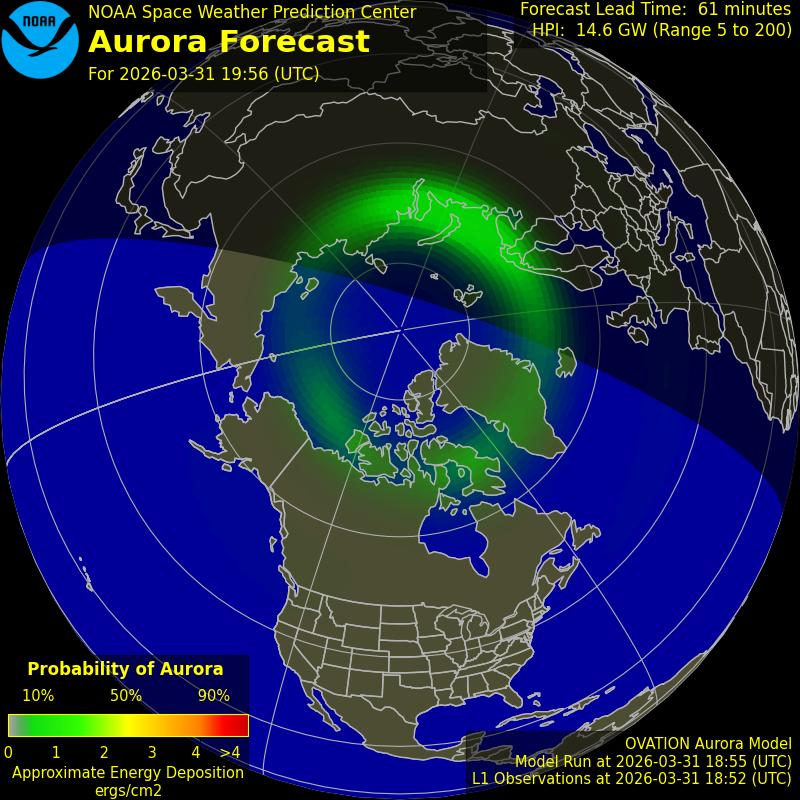
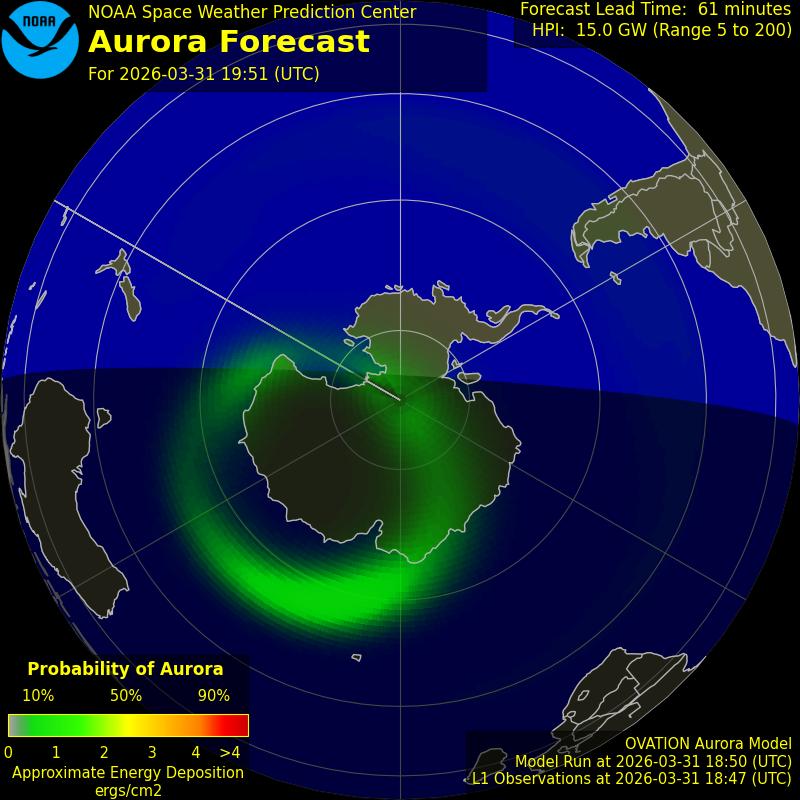
For aurora hunters in the United States, the CME’s arrival is the main event. NOAA’s Space Weather Prediction Center has issued a G2 storm watch for tonight, with moderate storm conditions expected through this evening before easing to G1 levels by tomorrow. Up to 16 states could see displays, stretching from Alaska down to New York, Wyoming and Oregon if conditions strengthen to G3.
Find a dark location away from city lights with a clear view to the northern horizon. The first signs of faint aurora are often picked up better on a phone camera than by eye.
For now, the countdown continues.
 Published by Kerry Harrison
Kerry’s been writing professionally for over 14 years, after graduating with a First Class Honours Degree in Multimedia Journalism from Canterbury Christ Church University. She joined Orbital Today in 2022. She covers everything from UK launch updates to how the wider space ecosystem is evolving. She enjoys digging into the detail and explaining complex topics in a way that feels straightforward. Before writing about space, Kerry spent years working with cybersecurity companies. She’s written a lot about threat intelligence, data protection, and how cyber and space are increasingly overlapping, whether that’s satellite security or national defence. With a strong background in tech writing, she’s used to making tricky, technical subjects more approachable. That mix of innovation, complexity, and real-world impact is what keeps her interested in the space sector.