
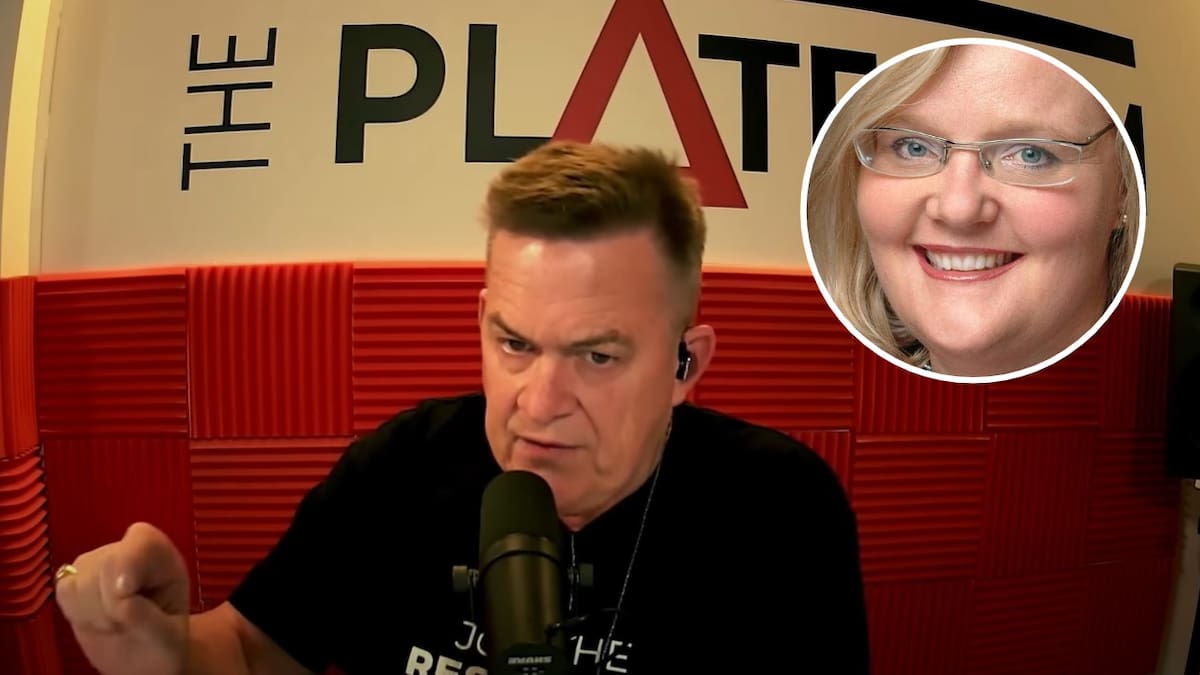
Peters told Plunket today that the BSA move was one of “breathtaking audacity”.
“They say there’s a huge gap between national existing law and modern communications, but virtually in the next breath, they say they have the capacity to bridge this huge span all by themselves and frankly, it calls into question as to whether they’ve got any idea of the modern world they’re living in.”
Plunket himself described the BSA’s decision as a “power grab”, and “gross overreach” and said that it was claiming jurisdiction over an online-only platform that “it simply doesn’t have”.
The Platform owner and host Sean Plunket. Photo / Mark Mitchell
“If it weren’t so tragically true, I would think the story … was an April Fool’s joke.
“The Broadcasting Standards Association’s kangaroo court decision to lengthen or widen its jurisdiction without the permission or the instruction of Parliament … it does represent a threat to the continuation of The Platform, but it is a joke. It is a complete joke.”
The BSA’s position
The BSA decision today said it found programmes broadcast on the internet were transmitted to the public by “telecommunication”, as referred to in the act’s definition of broadcasting. It said this applied an interpretation based on plain English and the purpose of the legislation.
The 1989 legislation “was designed to provide for the maintenance of programme standards in New Zealand broadcasting at a time of deregulation and rapidly evolving technology” and reflected an intent that audiences continued to have appropriate protections as broadcasting evolved, the authority said.
It also found that an exception to the act’s definition of broadcasting, which excludes “on-demand” transmissions, did not apply to The Platform, because it was a broadcaster of live or scheduled online programmes intended for a New Zealand audience.
At the same time, the authority said it had not found it had jurisdiction over on-demand content from the likes of Netflix, AppleTV, Prime Video, Disney+, YouTube, or other overseas entities streaming content for New Zealand audiences, nor over personal online content posted or livestreamed by individuals.
“Having determined the Act applies to programmes streamed by an online broadcaster, further research and public consultation is required to address the implications for any equivalent New Zealand broadcasters and to review our policies, procedures and codes in light of the determination,” the authority said.
“This decision necessarily focuses on the broadcaster that is the subject of the relevant complaint, but our initial research suggests there are a limited number of entities within this group.”
The authority said it would now consider and issue its decision on the substance of the complaint.
‘Mumbo jumbo’
The complaint relates to a broadcast in July last year in which Plunket described Māori tikanga as “mumbo jumbo”.
In an earlier draft decision, the BSA said it had the authority to adjudicate the complaint from a member of the public who took exception to Plunket’s comment.
Plunket says the BSA has no such authority under law. He says its approach is “Orwellian” in nature and a threat to freedom of speech.
On The Platform in October, Plunket heavily criticised the BSA.
“This is the biggest threat to The Platform and its ongoing survival and the freedom of speech that we were set up to encourage. This is the Orwellian bureaucrats coming for us.
“I can lie down, I can walk away, or I can fight, but if I fight, it is going to be difficult and tough. It’s a hill I’m prepared to die on.”
As Media Insider reported in October, the BSA’s position seems to fly in the face of years of debate and discussion in which Governments have looked at media regulation in New Zealand – and which agency, if any, covers certain online content.
The regulation and oversight of standards of New Zealand content is currently a mix of full regulation (broadcasting), industry self-regulation (the professional news media) and little to no regulation (social media). In addition, there is a broad range of laws that govern this area.
Until now, the BSA has been focused on traditional television and radio networks and what they have broadcast on air (including later online content).
High-profile businessman Troy Bowker said he would help Plunket in his legal fight. “The BSA is no longer relevant or necessary. If Susie [BSA chair Susie Staley] and her board think they can regulate the internet, then they are all delusional. They should all be sacked by Minister [Paul] Goldsmith for stupidity immediately.
BSA chair Susie Staley. Photo / Supplied
“It will bring me great delight to see them lose in court or be put out of existence.”
The complaint
On July 22, Plunket referred to tikanga Māori as “mumbo jumbo” as he commented on a new kaupapa Māori proposal from Fire and Emergency New Zealand.
On July 31, complainant Richard Fanselow wrote to The Platform: “Definition of racist – a definition of a racist is someone who spends a disproportionate amount of time focusing on just one racial group, mainly to emphasise negative characteristics.
“So that’s pretty much a definition of The Platform and its male front people, isn’t it? Making this a probably futile exercise, but one the [Broadcasting Standards] Authority requires. That is to invite comment from the media outlet involved before lodging a complaint with the authority. So that’s what I am doing here.
“My complaint is about Mr Plunket so casually referring to all the customs and beliefs of Māori – tikanga – as mumbo jumbo – a term with a historic racist beginning.
“Casually, as if such a description is of no consequence – it’s what most people think. It is what Mr Plunket may think – coming as it did in the middle of his sarcastic, scornful references to a Māori issue, complete with his totally childish, exaggerated and drawn-out pronunciations of Māori words.”
Plunket responded to Fanselow the next day: “You plonker. We aren’t subject to the Broadcasting Standards Authority.”
Fanselow then took the matter to the authority, asking it if Plunket was correct. “Is there any kind of remedy for such obviously racist talk?”
The BSA’s provisional decision
In an earlier “provisional interlocutory decision”, marked “not for publication”, the authority said it had accepted jurisdiction “on the basis the transmission of the programme met the Broadcasting Act’s definition of ‘broadcasting’”.
“Taking a purposive approach to the act, which is designed to provide for the maintenance of programme standards in New Zealand broadcasting, the act is appropriately seen as capturing such modern forms of broadcasting.
“As there is currently no code of broadcasting standards specifically addressing the online broadcasting context, the complaint will be considered with a view to determining the broadcaster’s compliance with its obligations under section 4 of the act.”
BSA chief executive Stacey Wood, in an earlier written response to Herald questions, said: “Yes, we are aware of the ramifications of this decision.”
The BSA board is chairwoman Susie Staley, former TVNZ head of news John Gillespie, Aroha Beck and Karyn Fenton-Ellis.
Wood said the BSA’s jurisdiction had always been determined by the Broadcasting Act.
“We have no intention of acting outside the act – our view is that online broadcasting that resembles a traditional TV or radio station falls within our existing jurisdiction.
“The definition of ‘broadcaster’ and ‘broadcasting’ in Section 2 of the act isn’t limited to TV or radio – it talks about programmes transmitted to the public by any means of telecommunication. Laws often have to be applied to changing circumstances – an obvious example is that laws referring to ‘documents’ aren’t limited to paper and parchment, but include PDFs and other digital forms.”
The BSA produced an explainer video in June in which it stated: “Consumers are exposed to more content across more platforms than ever before.
“If you have seen or heard something that concerns you, you may be unsure of where to go to voice your complaint. The good news is there are regulators who can help you, depending on the type of content.
“The Broadcasting Standards Authority, or BSA, handles complaints that TV or radio programmes breached broadcasting standards. It can also take complaints about online content that was first broadcast on TV or radio.
“In all cases, you must complain within 20 working days of the TV or radio broadcast.”
Editor-at-Large Shayne Currie is one of New Zealand’s most experienced senior journalists and media leaders. He has held executive and senior editorial roles at NZME including Managing Editor, NZ Herald Editor and Herald on Sunday Editor and has a small shareholding in NZME.