
The war started on the last day of February. So its impact will be buried in the first-quarter numbers.
We get the first-quarter labour market and unemployment data on April 8. We’ll see the first-quarter Consumers Price Index inflation on April 21, and we don’t see the first-quarter GDP until June 18.
Economists at ASB and Westpac have forecast an economic contraction (0.3% and 0.4% respectively) in the second quarter.
Here’s hoping that by the time we get to actually see that data, the war is over and the worst of the oil supply shock has passed through.
We don’t see the second-quarter GDP figures until September 17.
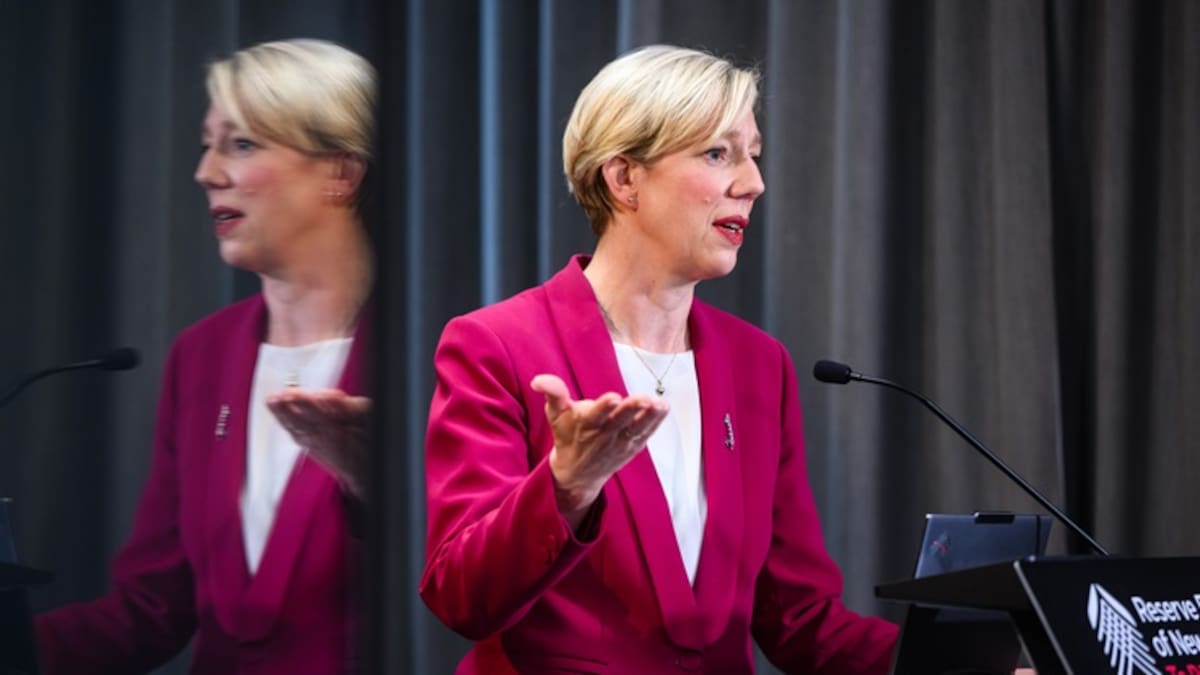
All of that’s just a reminder of the extent to which the Reserve Bank (RBNZ) is flying blind for its upcoming Official Cash Rate (OCR) review.
Confidence crash
At this stage, the strongest post-conflict indicators it has to go on are the timely ANZ Consumer Confidence and Business Outlook surveys for March, which have been released in the past week.
Neither of those made for pleasant reading.
Consumer confidence fell to a 17-month low in March.
The ANZ-Roy Morgan Consumer Confidence index dropped 8.8 points from 100.1 in February to 91.3 in March.
A score below 100 indicates more pessimists than optimists.
The proportion of households thinking it’s a good time to buy a major household item (the best retail indicator) fell 10 points to -14.
Meanwhile, inflation expectations jumped a full percentage point to 5.7%, the highest level since March 2022.
The ANZ Business Outlook survey for March showed confidence fell 26 points, down from 59 to 33.
The survey calculates a net score by subtracting those who expect a deterioration from those who expect improvement.
“The world changed this month,” ANZ chief economist Sharon Zollner said.
She noted that the survey responses received in the later part of the month were much darker than those from earlier.
And businesses were already feeling the knock-on effects of the war.
“It’s not just anxiety about the future,” Zollner said.
“Many firms are already reporting that their activity has taken a hit as people defer their decision-making in the face of uncertainty.”
The “own past activity” indicator fell from 23% to a net 18% of firms reporting stronger activity than a year ago, with a particularly sharp fall for retail (down 20 points to +5) and construction (down 16 points to -13).
Inflation indicators were higher.
The net percentage of firms expecting cost increases – 85%, up from 79% – was the highest since early 2023.
RBNZ pathway
How then should the RBNZ respond?
As I’ve written before, the surge in oil prices will both cause inflation, as higher costs flow through the economy, and disinflation as they hit consumers in the pocket and curb demand.
It has been described as the worst of all worlds.
As BNZ head of research Stephen Toplis put it in his OCR preview: “Normally, accelerating growth drives rising prices. But this time around, it is rising prices driving weakening growth because inflation is supply, not demand, induced.”
The net result of these two opposing forces will determine what needs to happen to interest rates.
But the Reserve Bank won’t see hard data on this for months.
That means it has at least one and probably two OCR calls (April 8 and May 27) to make while flying largely blind.
It’s for that reason that economists are more confident than markets that the RBNZ will sit tight and keep the OCR on hold for the next few months at least.
BNZ’s Toplis remains among the most hawkish local economists but still doesn’t expect an OCR move until September.
He notes that in her recent speech, Reserve Bank Governor Anna Breman stressed that the bank was focused on medium-term inflation.
“It accepts there will be a near-term spike in prices (how could it not?!) but will only raise (or lower) rates based on how permanent that inflation shock becomes,” Toplis said.
“And it will take time to establish a strong view on this, perhaps many months.”
We’ll publish a full preview of next Wednesday’s Monetary Policy Review early next week.
New Zealand’s R&D Failure
Q: Hi Liam,
I would like to see the above topic explored in one of your articles.
While New Zealand’s low productivity is a frequently mentioned subject, none of our governments or leaders from the centre-left or right over the past 30 years has made much impact.
It’s widely accepted that R&D is a significant factor in boosting productivity; we spend only 50% of the OECD average. While AI is touted as the next big thing for boosting productivity, the Government has allocated only $70 million over the next seven years, an insignificant sum in the context of the Government Budget and what countries we want to emulate, like Singapore, are spending. It’s almost like we are not serious about improving productivity.
Shouldn’t we be spending more than the OECD average if we want to catch up with the top countries in the OECD? Are we in danger of falling further behind if we don’t ramp up investment in areas critical for growing productivity?
Best regards,
Kushlan Sugathapala
A: Hi Kushlan,
It’s hard to argue with anything you say there. For many decades and across governments of all stripes, politicians have talked a big game about productivity and transforming the economy, without ever making the kind of commitment to R&D that is required to do so.
I’ve been looking at World Bank data for R&D spend by GDP (for all countries) and see that New Zealand ranked 28th.
For comparison, Australia is 21st.
The OECD average is 3.02% and we spend 1.47% of GDP (2022).
The highest-spending nations were Israel, Liechtenstein and South Korea – all above 5%.
Then we get to the US, which spends about 3.6% of GDP.
How can New Zealand produce more companies like Rocket Lab? Composite photo / NZME
That’s pretty remarkable when you consider the scale of the US economy.
There’s clearly a correlation between the amount being invested and wealth, particularly when we look beyond resource-rich countries.
So what is our problem?
I don’t think it is as simple as just lifting the Government’s investment.
For the record, I would like to see more Government investment in this area, but we need to be sure it pays off and that isn’t easy to guarantee, or even measure.
There are good arguments against Government funding, which is often hard to target. Should the state be picking winners and investing directly in promising start-ups? Or just ensuring that the science and technology sector is broadly well-funded and thriving.
I think the Government’s role is probably the latter.
What New Zealand really lacks is depth of private investment in R&D.
If you look at the breakdown of the US R&D investment (according to the US National Science Foundation), only 18% of US R&D investment is from the US Government.
About 75% is from the private sector, with the remainder from higher education, nonprofits and state governments.
In New Zealand, according to the latest Stats NZ R&D Survey (2024) the private sector was the largest contributor to total R&D expenditure, accounting for 63% ($4 billion) in 2024.
The rest was covered by higher education (universities) and government sectors (including Crown Research Institutes), contributing 21% and 16% respectively.
We would certainly benefit from more business investment in R&D – whether that be existing businesses or the creation of more businesses in the high-tech space.
Achieving that requires looking at the availability of capital for that kind of investment. It’s not cheap and, in the short term at least, can be high-risk.
We end up back at the thorny issue of where New Zealanders prefer to put their money.
Whatever its merits or failings, property investment will not boost R&D investment.
But if we can encourage a culture where New Zealanders save and invest more in capital markets generally, we’ll start to see higher percentages of investment in the innovative tech sector.
KiwiSaver is making a difference. As we get our mortgages paid off and our KiwiSaver balances into healthy territory, some of us will start to look for other, more specialised investment opportunities, like venture capital, which skews to the tech-heavy R&D end.
Proof of the possible payoff for investors is there already – with the likes of Xero, Rocketlab and now Halter.
The payoff for the country as a whole comes from creating more high-growth tech companies offering higher wages and reasons for our smartest to stay in New Zealand.
It is a virtuous circle in which the Government does have a role to play with smart policy settings.
I think our major parties understand this, despite having slightly different approaches to how directly government should be involved.
Unfortunately, we seem to keep losing sight of the bigger picture and long-term goals because of short-term economic problems, like Covid or oil shocks.
It is, to be fair, a tough cycle to break out of. But that is the challenge for our leaders.
Debt woes easing
The Centrix Credit Indicator for March showed some promising signs of improving strength.
Whether this is a high tide mark for consumer balance sheets pre-war, who knows?
But consumer arrears fell to 12.09% of the credit-active population in February, down from 12.56% in January and 2.4% lower than a year ago, Centrix said.
The number of people behind on payments declined to 473,000, down 18,000 from the prior month.
This reflected improved financial resilience among many households compared with a year ago, Centrix said.
Mortgage arrears held steady at 1.42% in February, with 22,700 home loans reported as past due. This was an 8% improvement on a year ago, supported by lower interest rates easing repayment pressure for borrowers.
Auto loan arrears improved to 5.6% in February, while credit card arrears also improved to 4% and are now 12% lower than a year ago.
Liam Dann is business editor-at-large for the New Zealand Herald. He is a senior writer and columnist, and also presents and produces videos and podcasts. He joined the Herald in 2003. To sign up to his weekly newsletter, click on your user profile at nzherald.co.nz and select “My newsletters”. For a step-by-step guide, click here. If you have a burning question about the quirks or intricacies of economics send it to liam.dann@nzherald.co.nz or leave a message in the comments section.
Tags:
- about
- blind
- burning
- Business
- Click
- comments
- deeper
- dilemma
- dive
- economic
- Economics
- every
- fallout
- flying
- have
- here
- how
- inside
- into
- intricacies
- leave
- leftfield
- liamdannnzheraldconz
- message
- missed
- more
- New Zealand
- News
- newsletter
- NewZealand
- NZ
- oil
- on
- our
- Plus
- question
- quirks
- R&D
- rbnz
- respond
- section
- send
- shock
- sign
- some
- take
- week
- weekly
- welcome
- will