
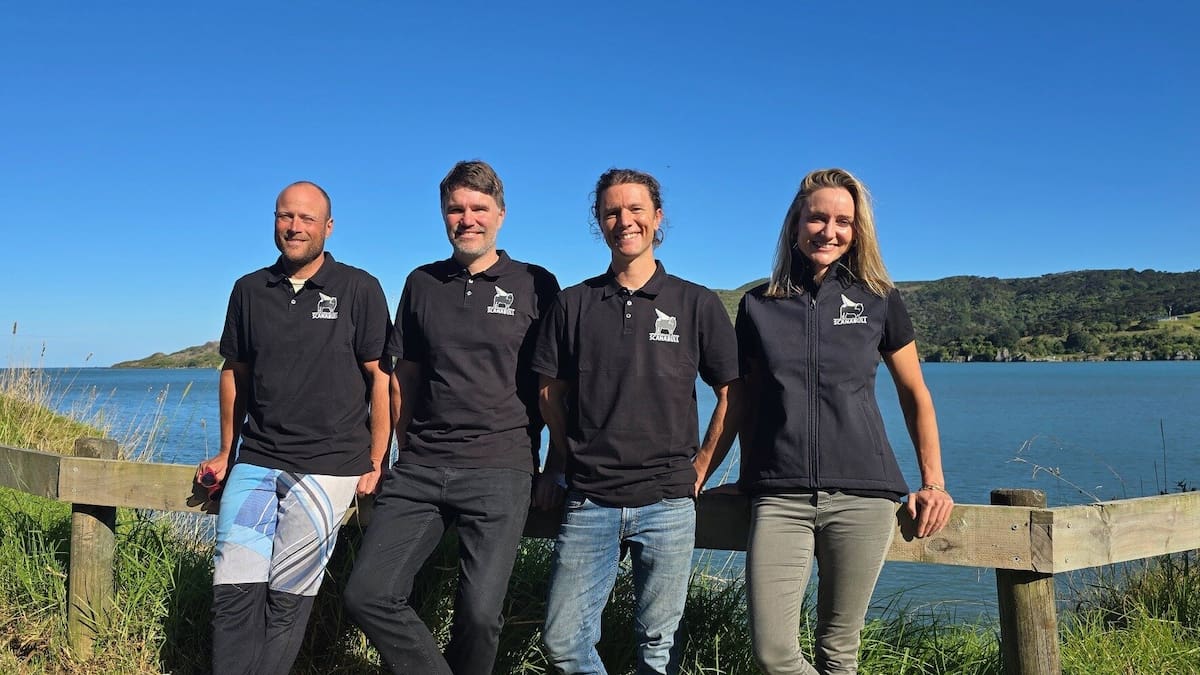
“I’m deeply upset that the system is so bad. This will affect other start-ups and researchers,” he says.
Scanabull’s grant application was rejected by the Ministry of Business, Innovation and Employment (MBIE), which has absorbed the start-up funding team that used to operate as part of Callaghan Innovation.
Bull says he was told there was no genuine gap in the market that would just justify new R&D and that the technology his company was developing was widely available in the public domain.
The founder disputes those takes, which were relayed to him in early February.
“We applied for $70,000 to follow up on AI-on-edge research to work out carcass weights from 3D images. No one in the world has done this,” he says.
“We’re working with industry on a genuine problem. In the application, I said specifically this is tech that the industry has been asking for, and hasn’t been done before.”
Scanabull uses the LiDAR sensor built into an iPhone Max or Pro Max.
Moreover, he argues the Crown is being inconsistent.
Last year, through its backer Sprout Agritech, Scanabull was able to secure a $750,0000 loan, at a commercial interest rate, through a Callaghan programme to support deep tech start-ups (now also absorbed into the government department, MBIE).
In the new environment, where the Government has ordered that science and research funding have a focus on commercial return, Scanabull was deemed viable enough for a loan, but not a co-funded R&D grant at a tenth of the size.
The $70,000 will be missed. “A start-up is like a small plant you need to water,” Bull says.
“We’ve been self-funding for most of our journey [Scanabull was founded in April 2024], which has involved working nights and evenings and scraping money from here and there. So even that little bit of extra money is enough to allow you to hire that extra person to push you ahead or buy that extra piece of equipment, or gain you a month and a half before going commercial.”
The founder says that while he understands that the Callaghan team, now shifted to within MBIE, has to collect a lot of information about a start-up. But he says the complexity and time required to address the paperwork goes too far, and he refused on principle to hire one of the consultants who have sprung up to help with MBIE red tape.
Bull, who was raised on a farm, said he wanted his market research and 10 years of experience in machine learning and artificial intelligence (AI) to count, not the ability to use the right buzzwords. And especially in the context of the Government earmarking $70m for the AI-focused Institute for Advanced Technology (which will take over Callaghan’s research role).
There were also unexpected twists. He says Scanabull successfully applied for an Experience grant from Callaghan to hire a student for 10 weeks at $29 per hour – but withdrew after learning the Experience grant would render his start-up ineligible for a grant under the Crown agency’s New to R&D scheme.
MBIE responds
Minister of Science, Innovation and Technology Dr Shane Reti declined the opportunity to comment, referring questions to MBIE.
“Due to the confidential nature of the assessment process, we are unable to comment on individual grant and funding applications,” MBIE director of grants Spencer Willis said.
“That said, the Deep Tech Incubator Loan and the New to R&D Grant are distinct products with different purposes.
“The Deep Tech Incubator Loan is designed for businesses that are already underway on their R&D journey and seeks to support the commercialisation of the goods and services they are developing.
“The programme is delivered in partnership with five of Aotearoa New Zealand’s leading incubators and venture capital firms, all highly experienced in the deep tech space and with their own specialisms.
“In contrast, the New to R&D Grant is administered by MBIE with different assessment criteria and is solely intended for those businesses first starting their R&D journey to kickstart commercial research and development projects.”
Xero chief executive Sukhinder Singh Cassidy.
Xero has ‘significant upside’
The market shrugged when Xero CEO Sukhinder Singh Cassidy climbed to the rooftops (or at least took to LinkedIn) to shout about her company’s new partnership with AI giant Anthropic.
The accounts software firm’s shares, which have lost more than half their value since June last year, rose 0.61% to A$72.84.
Last November, Morningstar analyst Roy Van Keulen gave Xero a fair value rating of A$100. At the time, the shares were sitting at around A$140.
Xero shares since the cloud accounting firm shifted from an NZX/ASX dual listing to ASX-only in February 2018.
He was unconvinced by Xero’s purchase of money-losing, 87,000-customer US-Israeli payments platform Melio in a mid-2025 deal worth up to US$3 billion. Van Keulen saw it as Xero’s latest attempt to crack the North American market, where Intuit still dominates. He saw its energies better spent on easier-to-crack territories.
After Xero’s recent investor day, Van Keulen stuck with his A$100 valuation, putting him now even-steven with the market.
He said: “The Melio features demonstrated were underwhelming and the bare minimum … the integration with Xero was a poor user experience.”
But he was impressed by Xero’s in-house artificial intelligence efforts, writing: “Xero has implemented AI agents across the platform, including for cashflow forecasting, invoice generation and bank reconciliation. The implementations felt natural and useful. Customers will appreciate them.”
Sing Cassidy said on March 27 that Anthropic’s Claude would boost Xero’s AI efforts.
On Tuesday morning, Van Keulen said his Xero fair value remained at A$100.
But now, as the market moved around him (shares were at A$72.69 in early Tuesday trading), he’s by default shifted from an effective “sell” to a “buy”.
“We [Morningstar] don’t expect material impact from the Anthropic partnership,” Van Keulen told Tech Insider.
“We have reviewed our coverage for AI impacts and have left Xero unchanged, meaning we now see significant upside.”
Mevo co-founders Erik Zydervelt (left) and Finn Lawrence.
What EECA blew on Mevo
Rent-cars-by-the-hour start-up Mevo went into voluntary administration on Monday.
Mevo wanted to return 147 vehicles to Sustainable Fleet Finance so it could pivot to “Mevo Pool”, a “revolutionary earn-while-you-own model” in which individuals and dealers would rent their cars to Mevo, which would pool them out to customers.
The two companies ended up in a dispute – elements of which are still unresolved – which derailed a Mevo capital raise.
Mevo, which began in Wellington in 2015 and then expanded to Auckland, lost $1.91m on $5.55m revenue last year.
Crown agency the Energy Efficiency and Conservation Authority (EECA) put $1m into the failed carshare firm over two co-funding rounds ($500,000 during 2016-17 for 50 plug-in hybrids and chargers in Wellington’s CBD and the same amount in 2019 to help Mevo deploy 100 pure EVs and “ensure the efficiency and sustainability of the vehicles in use”).
Most start-ups fall over.
In this case, the EECA says it wasn’t a total failure, as insights were gained.
“The high-level objective of this targeted investment was to demonstrate different use cases – including barriers for business deployment of EVs [electric vehicles] – of which car-sharing was one avenue to explore in New Zealand,” EECA partnerships head Richard Briggs told Tech Insider.
“At this point [2016], there were only a handful of EVs in the country,” Briggs said.
“From an EECA perspective, the Mevo projects delivered valuable insights into how PHEVs [plug-in hybrid electric vehicles] and then full battery electric vehicles best operate under this new model, picking up traction internationally.
“They demonstrated how to give users confidence in an EV’s share model, when range anxiety and the ability to charge were a barrier to adoption.
“We have also noted overall an uptake in the car share concept utilising electric vehicles in the years since, despite a challenging market at times.”
Chris Keall is an Auckland-based member of the Herald’s business team. He joined the Herald in 2018 and is the technology editor and a senior business writer.