
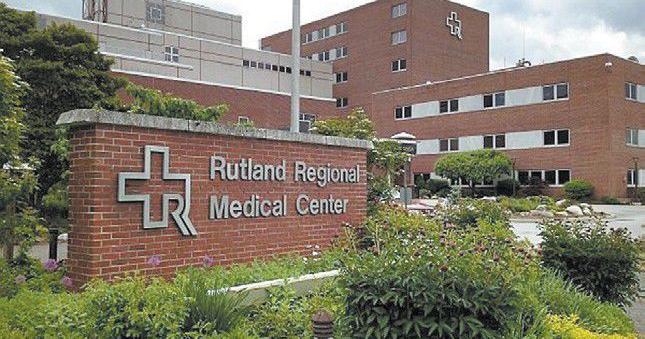
Support and technical staff at Rutland Regional Medical Center are looking to unionize, but the hospital’s leadership is trying to dissuade them.
Medical techs and support personnel are getting ready to vote on whether to organize as part of the American Federation of Teachers, which, in addition to educators, represents health care workers at facilities around the state, including the University of Vermont Medical Center in Burlington and Porter Hospital in Middlebury.
RRMC staff members who spoke to the Rutland Herald this week say they were brought to this point by noncompetitive wages, staffing issues, and a feeling of not being listened to.
“After COVID, it was really apparent we’re really overlooked as support staff and technicians,” said Heather Ikerd, a unit secretary in the emergency department. “It’s hard to get our opinion across or anyone to listen to us.”
Ikerd said the problem was shown in stark relief late last year when the hospital announced plans to close its pediatric unit — an announcement that was made without any input from the pediatric staff and then abandoned after an initial presentation to the Green Mountain Care Board.
“I’ve been there for 10 years, and it feels like we’re having the same conversations,” said Chris Kiernan, an imaging technologist. “Over time, a lot of us have realized that any real concerns we find that we have, we bring them up and nothing really comes of it. (Unionizing) feels like the only way we can find of having a voice.”
Robert Knox, a respiratory therapist who has been at the hospital since 2000, said staffing has been a perennial issue that might improve if a union can bargain for better wages.
“Despite what management is trying to say … we want to get back up to having RRMC truly be the best employer of choice, to have us leading the way in care of our patients. Right now, that’s not happening with the leadership we have.”
Ikerd and others said hospital administrators have taken to wearing name badges urging staff not to vote. The hospital has also been putting anti-union messaging on its website’s landing page for employees, according to screenshots shared with the Herald.
Moreover, staffers said the hospital has hired outside consultants who hold what purport to be neutral informational meetings but that Kiernan and others say have a distinct anti-union tone. Claims made at the meetings, Ikerd said, have included that the local union members would have no decision-making power and that it would all rest with AFT-Vermont’s higher-ups.
That wasn’t the experience at UVMMC, according to Heather Bauman, a phlebotomist who helped organize the union there.
“We made all the decisions,” she said. “We sat and bargained our contract … We had a table team of five and a bargaining team of 60 folks from across the hospital. We made the decisions together.”
Bauman, who is helping the organizers in Rutland, credits unionization at UVMMC with benefitting recruitment and retention. She said her colleagues in Burlington did not face nearly the pushback from management that the local workers are dealing with.
“They’re up against some pretty egregious opposition,” she said. “It’s off the charts. It’s crazy how intense the hospital is coming for these folks — scorched Earth.”
UVMMC did not hire any outside consultants, Bauman said, pledging to stay neutral in the process. She contrasted that with RRMC, where she said CEO Judi Fox refused to meet with organizers when they submitted their petition.
The hospital responded to inquiries with a prepared statement saying they respected the legal right of its employees to unionize and encouraged all eligible employees to vote.
“At the same time, we believe in maintaining a direct, collaborative relationship with our staff that supports open communication, responsiveness, and our shared commitment to patient care,” the statement reads. “For these reasons, we believe introducing a third party into our workplace is not in the best interest of our employees, the hospital, or our patients.”
Hospital representatives did not acknowledge specific questions on Monday about how much RRMC was spending on East Coast Labor and from what part of the budget it was allocating that money. They did not immediately respond when the questions were repeated in a follow-up email on Tuesday.
A work agreement acquired by the Herald shows the hospital agreeing to pay $350 an hour, plus travel expenses and a $65 daily meal allowance, to Reliant Labor Relations, which, according to the U.S. Department of Labor website, also operates under the name East Coast Labor Relations.
Knox and others said the company had four representatives onsite who appeared to be working eight-hour days all week, which would appear to put the hospital’s expenses at more than $10,000 a day.
“Even our providers don’t make that much money,” Ikerd said.
Bauman said the support staff vote as one bargaining unit and the medical technicians vote as another. Voting is scheduled for April 8 and 9.