
The deal values Whoop at $10 billion, and while private market valuations can be notoriously fluid, that’s more than the public stock market value of four other prominent Boston-area tech companies — online auto site Cargurus, travel service Tripadvisor, cybersecurity firm Rapid7, and software company Progress Software — combined.
Get Starting Point
A guide through the most important stories of the morning, delivered Monday through Friday.
Lately, Whoop has been playing a more visible civic role as well, hosting Governor Maura Healey for the public kickoff of a private-sector effort led by the company to attract more AI startups to the area.
It’s all adding up to Whoop taking a potentially critical leadership position in the local tech ecosystem. The company is “stepping into the breach to strengthen the local community,” said longtime venture capital investor Michael Greeley, general partner at Flare Capital in Boston.
Greeley compared Whoop, which he has not invested in, to an earlier wave of local stalwarts such as Internet pioneer Akamai Technologies, biotech leader Biogen, and marketing tech company Hubspot. That group “trained the next generation of entrepreneurs and launched other great companies,” Greeley said.
Whoop was dreamed up about 14 years ago by former Harvard squash team captain Will Ahmed. He started by offering a screen-free wristband that athletes could use to track their performance and improve training and later marketed it to everyone from pro athletes to local high school teams.
But the market for elite athletes isn’t likely worth $10 billion.
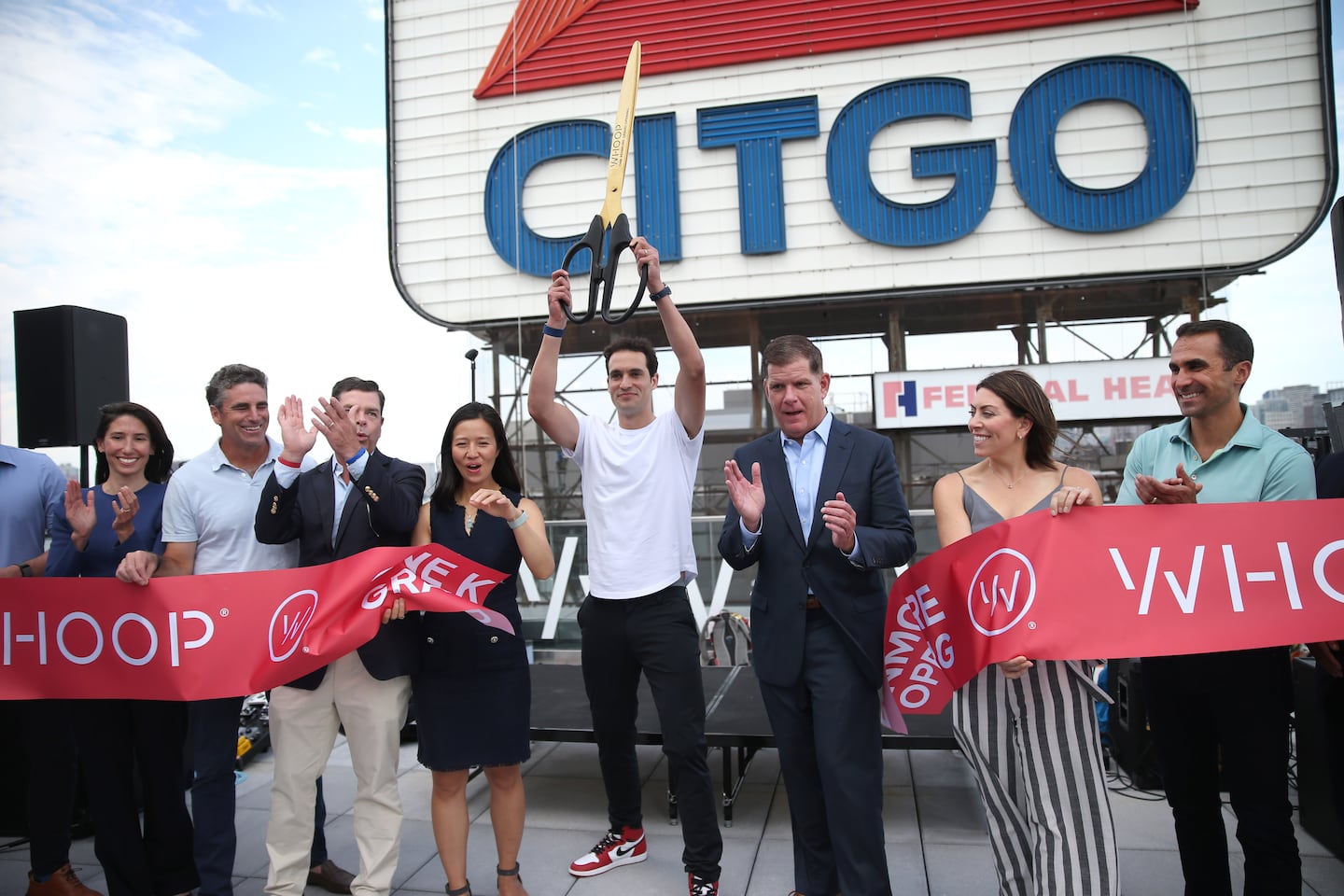
 Whoop chief executive Will Ahmed (center) recently hosted local tech executives at his firm’s Fenway headquarters to discuss how to encourage more startups working on AI apps to come to Boston.Massachusetts AI Coalition
Seeing growing interest in wellness and health data, Ahmed hired the company’s first chief medical officer, primary care physician Dr. Pat Carroll, in 2022. And over the past few years, Whoop has expanded with a variety of consumer-oriented products and subscription services, including a wearable band cleared by the Food and Drug Administration to take electrocardiogram heartbeat recordings, and a service to integrate blood test results into a customer’s health analysis dashboard.
The company also offers its bands in dozens of colors and styles and hooked up with British fashion designer Samuel Ross to sell a line of limited-edition bands and workout clothing.
Ahmed calls the combination of monitoring gear and analytical services a “personal health platform” that consumers can use to get in shape, improve their physical wellbeing, and deal with chronic diseases. Instead of selling monitoring bands for one-time purchases, Whoop sells subscriptions ranging in price from $149 to $359 per year that include a band and online services (Whoop generated some bad press last year when it introduced an upgraded wristband but didn’t give it free to some existing subscribers, as it had seemingly promised.)
The company now has 2.5 million members and doubled its 2025 bookings, or cash collected from customers up-front for subscriptions, from the year before to over $1 billion (Bookings are recognized as revenue over the life of a customer’s membership).
The fresh cash infusion will help pay for the new 600 employees, nearly doubling the current workforce of around 800. Whoop said it will also use the funding to expand overseas in Europe, Latin America, Asia, and the Gulf states.
Still, the history of tech is littered with failed consumer hardware companies. Pioneering smartwatch maker Pebble collapsed after a few years, as did wearable maker Jawbone, while VR headset company Magic Leap chewed through billions of dollars of backing but never produced a hit product. And more recently, AI pin maker Humane AI flopped.
And as it expands into more consumer-oriented services, Whoop could face competition from tech giants with products of their own. Apple’s smartwatch is the most popular in the world and has many health tracking features similar to Whoop’s, while Google owns Fitbit, one of the closest direct rivals for Whoop customers.
Analysts at Gartner forecast the wearables market will grow at about 4 percent per year over the next five years to reach close to $100 billion of annual revenue. Adding generative AI to analyze data from wearables for coaching and advice, as Whoop and others are doing, could “enormously enhance” the appeal of the devices, the analysts noted in a report last year.
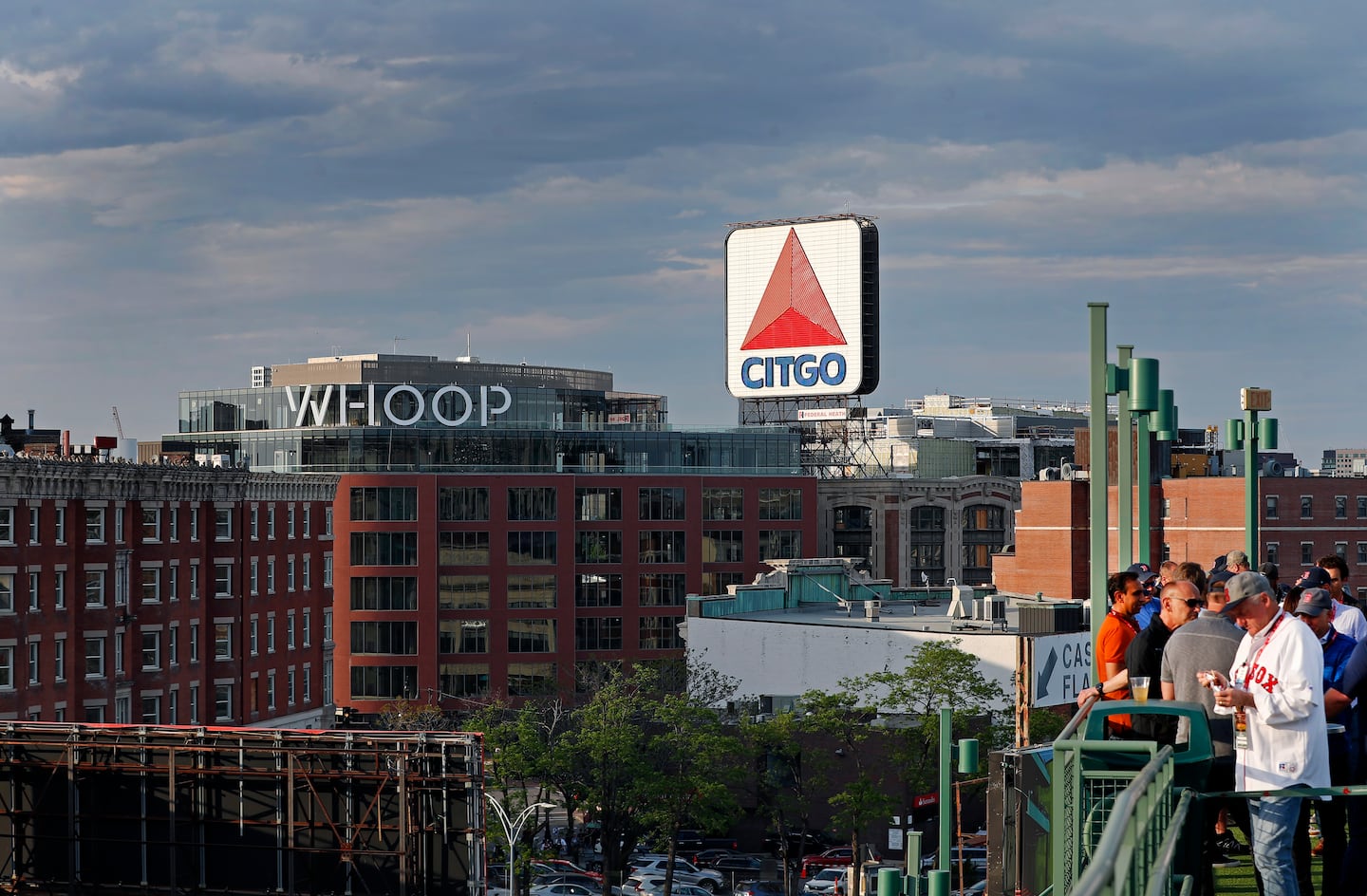 Whoop’s name sits atop the Kenmore Square building housing its headquarters, alongside an even more prominent sign on the Boston skyline.Jim Davis/Globe Staff
No shrinking violet, Ahmed has bolstered Whoop’s presence on the local tech scene, and the skyline. In 2023, the company moved into an eight-story headquarters building in Kenmore Square, with a huge sign visible inside Fenway Park (just under the shadow of the famed Citgo sign perched on the building next door) and along the route of the Boston Marathon.
This year, Whoop led the formation of the Massachusetts AI Coalition backed by dozens of local tech companies and VC firms. The goal is to convince more students graduating from local schools and other entrepreneurs to found their AI companies in the state.
“The reality is you can build a great company here,” Ahmed told the Globe in a recent interview. “Whoop has proven that. A lot of companies here have proven that.”
At the AI coalition kickoff event, in the modern airy meeting space at the top of Whoop’s headquarters, Ahmed got handshakes from Governor Maura Healey and Healey’s secretary of economic development, Eric Paley, himself a longtime venture capital investor who backed Whoop before joining the state government last year.
“I’m a competitor — I played not squash like Will, but I played basketball in college — and I’m really competitive and I am ever mindful of folks nipping at our heels,” Healey told the crowd, before announcing a deal to provide OpenAI’s app to 40,000 state workers. “We are grateful that you are here. I am grateful to you personally for being here and for building opportunity.”
At some point, Whoop will likely go public, listing its shares on the stock market. In November, Ahmed said the company was considering the move “over a horizon of two years.” It might be prudent to wait out 2026, with turmoil in the markets from the war in Iran and plans by two or three of the largest private companies ever — SpaceX, OpenAI, and Anthropic — to launch IPOs.
But with the fresh $575 million infusion, Whoop should be able to pick the moment for that debut.

🚗 Driver tracking firm Cambridge Mobile Telematics raises $350 million for expansion in Europe. Read more from business reporter Aaron Pressman.
🪫 As electric vehicles lose their juice, Mass. battery startups are being hit hard. Read more from tech reporter Aaron Pressman.
🎰 New lawsuit accuses DraftKings, FanDuel and NFL of pushing ‘dangerous’ wagers on sports betting apps. Read more from investigative reporter Joey Flechas.
💰 Tech entrepreneur Paul English gives $1 million to kick-start AI program in Boston Public Schools. Read more from business reporter Jon Chesto.
📀 PAX East 2026: From Pokémon to ‘Backyard Baseball,’ millennial nostalgia was on full display in Boston. Read more from Globe contributor Sam Shipman.
🩺 The early signs of Alzheimer’s often go undetected. These Mass. researchers want to use AI to change that. Read more from health care reporter Jonathan Saltzman.
🎓 Student loan platform Clasp in Boston raised $20 million in a deal led by Crosslink Capital and Digitalis Ventures.
🔒 Cybersecurity company Rapid7 in Boston acquired AI software firm Kenzo Security. Terms of the deal were not disclosed.

💸 Payments tech company Flywire in Boston added Christine Katziff, former chief audit executive at Bank of America, to its board of directors.
🤝 Cybersecurity company Rapid7 in Boston struck an agreement with activist investor JANA Partners Management to support the nomination of Kevin Galligan, JANA’s director of research, for its board of directors. JANA agreed not to acquire more than 19.9 percent of Rapid7’s shares.
⚖️ Legal software startup Summize in Boston hired Alexandria Lutz as general counsel. Lutz previously was senior corporate counsel at Nordstrom.
📚 Edtech company Skillsoft in Boston added Art Gilliland, chief executive of Delinea, to its board of directors.
🧬 Life sciences software firm ConcertAI in Cambridge hired Missy Jerome as chief people officer. Jerome previously was CPO at Commonwealth Financial Network.

🌲 The Maine Startup Challenge is accepting student and early-stage entrepreneur entrants starting on April 1. Winners will be announced on May 20, with cash prizes ranging from $1,000 for the K–8 division up to $8,000 for the open division.

📱 A New Mexico jury decided that Meta knowingly harmed children’s mental health and concealed what it knew about child sexual exploitation on its social media platforms. Meanwhile, a California jury found that Meta and YouTube designed their platforms to hook young users without concern for their well being.
Meta Is in Risky Legal Territory After Back-to-Back Court Losses (Wall Street Journal)
How Apple became Apple: The definitive oral history of the company’s earliest days (Fast Company)
Against the Smartphone Theory of Everything (The Argument)
👋 Thanks for reading. We’ll be will be back next Tuesday.
❓ Have a tip? Email Aaron at aaron.pressman@globe.com.
✍🏼 If someone sent you this newsletter, you can sign up for your own copy.
Aaron Pressman can be reached at aaron.pressman@globe.com. Follow him @ampressman.