
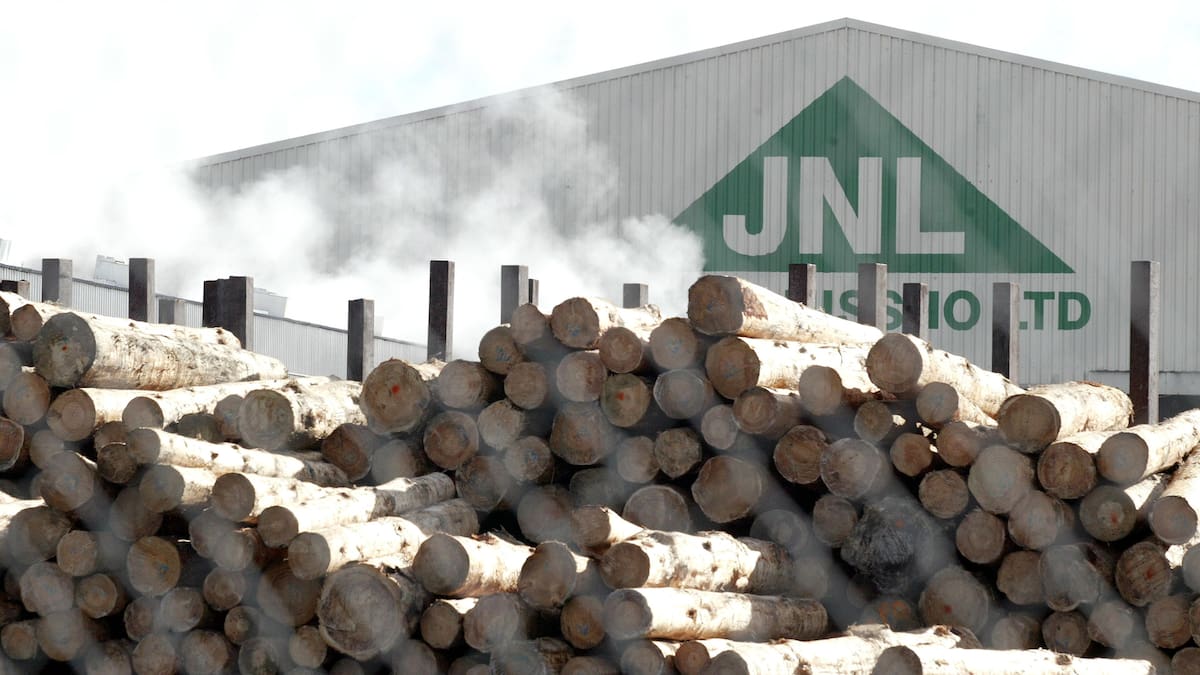
Juken New Zealand said it had been working over several years to improve the finances of its two Kaitāia sites but had not been able to make them sustainable.
Kaitāia has about 6000 people and the two mills employ more than 200 people.
Resident and former editor of the Northland Age newspaper Peter Jackson said nobody saw the development coming.
“There would be massive unemployment, there would be shop closures, there would be all sorts of financial fallout,” he said, if closures happened.
“I’d hate to think what the outcome would be but it would be a blow to the heart of Kaitāia, it really would.”
Jackson said there was not a lot of other work on offer in the town, and no other employer like Juken New Zealand.
“I can remember when Juken came into the picture and people were praying, literally, that they would buy it,” he said.
“This is part of Kaitāia’s big dream, we were always sold on the idea that forestry was going to be our future … and the fact that a processing plant was built in Kaitāia was regarded as a massive win for this community … and you just sort of think it will always be there.”
Jackson said an old, months-long workers’ strike brought the town to a standstill.
“No one paid their bills, there was no money going around, it was a nightmare.”
The strike was something former publican Dave Collard, who had a tavern nearby, remembered well.
His premises were used for strike meetings.
The Kaitāia mills employ more than 200 people in a town of about 6000.
‘Critical’ for town
Collard said he had served “many, many” Juken timber workers over the years.
“It’s absolutely critical in terms of the town here,” he said.
“We have enough challenges up here as it is without one of our biggest employers potentially closing down, I would hate to see something like that, there’s [got] to be an alternative somewhere, or a remedy.
“You know what is real scary about this is we’re seeing it all over New Zealand, look at the places that have closed up – the frozen veggies people, sawmills, all sorts where people work for years and years and years, it is very much a reality and if we’re not thinking about it I think we’ve got our heads buried in the sand.”
There has been a raft of other mill closures around the country, with many owners blaming high energy costs.
The Far North District Council and Northland Regional Council were set to appeal for the Government to intervene in Kaitāia.
“Seriously, we’re going to think about it big time,” New Zealand First leader Winston Peters said at Parliament.
New Zealand First leader Winston Peters. Photo / RNZ, Mark Papalii
“Because it’s not the first time we have done that, both Shane Jones and myself, we’ve kept close to that timber mill for a long long time in our political career.
“So we’re going to pay attention to it … it is a concern and we’ll look seriously at it.”
Juken New Zealand said it was looking at whether the two mills could keep operating “under a different structure” which included a sale or a joint venture.
“We are taking the mills to market to assess whether there is interest from potential buyers,” it said.
“Our focus is on testing whether there is a viable pathway that would allow the mills to continue operating and to preserve employment where possible.”
The company said in the meantime, operations were continuing as normal at its Kaitāia mills with no immediate changes.