
The importance of two-way discussions between New Zealand and the Cook Islands has been well-documented by Ministry of Foreign Affairs and Trade officials across multiple decades. It is a self-governing nation in free association with New Zealand.
A joint centenary declaration was signed by the Prime Ministers of either side in 2001 and reaffirmed in 2015; New Zealand’s High Commission to the Cook Islands was established in 1965 – after the Pacific country attained statehood.
Mark Brown and Winston Peters met in Auckland last month and promised more talks.
The 2022 agreement, signed in Rarotonga by Cook Islands Prime Minister Mark Brown and then-Foreign Affairs Minister Nanaia Mahuta, was dated from 2022 to 2025. In bold on the first page was the phrase “He waka hourua, he waka eka noa” – translating to a double-hulled waka bound by a common purpose.
Themes wove throughout the agreement – which, on the page with signatories, stated “He waka horua ki te titiro ki te heke ma” – translated as a double-hulled waka helps when looking to the future.
Another phrase was also etched in bold on the agreement: “Piri’anga toto, ka oki te toto, ka kimi i te toto” – the statement meaning the aforementioned saying, “Blood kinsmen, no matter how separated in time and place they may be, will always find each other.”
Despite the paper being dated through to 2025, it was not seen as an end date for diplomatic relations between New Zealand and the Cooks. Timing was a mere coincidence.
As Mahuta and Brown signed four years ago, the two countries affirmed a “joint ambition to elevate the relationship to a new level of expanded strategic co-operation in the years to come, with the aim of advancing the safety, prosperity, and well-being of our respective peoples, the Pacific and international community.”
The document underpinning the double-hulled waka metaphor stated work would be guided by a vision for the next 100 years; a common purpose is once again under discussion.
Peters appears to be aiming to reaffirm the importance of clear dialogue between New Zealand and the Cook Islands.
Drummers welcoming Winston Peters to Rarotonga.
In 2022, Mahuta and Brown agreed on five principles for the years ahead, listed in both te reo Māori and Cook Islands Māori. All but one touched on the significance of back-and-forth dialogue.
Manaakitanga/Te Ko’u Mana was listed first – defined in English as a promise to “engage in a mutually respectful way” that uplifts the mana of both. That sentiment was woven through the agreement Mahuta and Brown signed.
Whanaungatanga/Piri’anga Toto, the second point, reiterated the importance of conversations. “Embracing our familial connections, we will engage in a respectful and supportive way, and kanohi-ki-te-kanohi as able.” Points three and four shared the values of collaboration, with the third directly stating the two nations would “collaborate, share insights, and consult one another for our mutual benefit”. The fourth promised to carefully listen to one another, even “when there are differences.”
The agreement finished with an acknowledgement to act as good stewards of the environment, and a wish to collaborate on development seen as sustainable.
One could seemingly argue that all five of these points could be looked at in the lens of the Cook Islands’ deal with China, which, to the diplomatic ire of Peters, did not include full consultation with New Zealand.
Other documents share similar insights. The significance of facilitating open dialogue is reiterated, strongly, in the Boe Declaration.
It is again mentioned in the Ministry of Foreign Affairs and Trade’s Cook Islands Four Year Plan, from October 2021 – the latest one published on the agency’s website.
Officials wrote that engagement would recognise that New Zealand and the Cooks share “common values” and that “connections can be further enhanced by the shared value of reciprocity.”
An enduring principle for New Zealand’s engagement in the Pacific was titled tātou tātou: all of us together. Dialogue, as expected, was noted as one of the most significant aspects of diplomatic ties. “Our co-operation will be underpinned by the principles of whanaungatanga and friendship, including honesty, trust, and respect,” officials wrote.
“The strength of friendship allows us to communicate openly even when our views differ.”
Historic ties run even deeper than formal diplomatic ones. Many believe the original waka that settled New Zealand had departed from the Cook Islands, with officials defining the relationship as one of “tuakana-teina” – with the Cook Islands the older sibling and New Zealand the younger child.
But siblings disagree. They fight and have arguments. Sometimes, they apologise to each other.
Perhaps putting an end to disagreement was what sparked Peters’ surprise visit to the Cook Islands.
The free-association country’s deal with China had been under question by the New Zealand Government since February, 2025.
Peters’ diplomatic visit to the Cook Islands comes after Prime Minister Mark Brown spoke to Peters at his private residence weeks ago – in Auckland on March 20, 2026. After the fact, the two delegations released a joint statement, saying they had discussed “fundamental challenges facing the New Zealand-Cook Islands relationship over the past 18 months and possible ways forward”.
Both promised more talks in the weeks after that meeting – an agreement which was met.
Some last-minute aspects of the trip have thus far been apparent.
Media were informed the day before the visit was publicly announced, which was the day before the NZDF plane, affectionately titled Betty by reporters, took off from Wellington’s Rongotai, bound for Rarotonga. A press pack were briefed at the back of the plane about certain details of official talks – a briefing which was temporarily interrupted by turbulence, prompting journalists and officials to return to their seats, with belts fastened, as officials gave audible information above a quite-loud jet engine, across two rows of seats.
Other details appeared better planned.
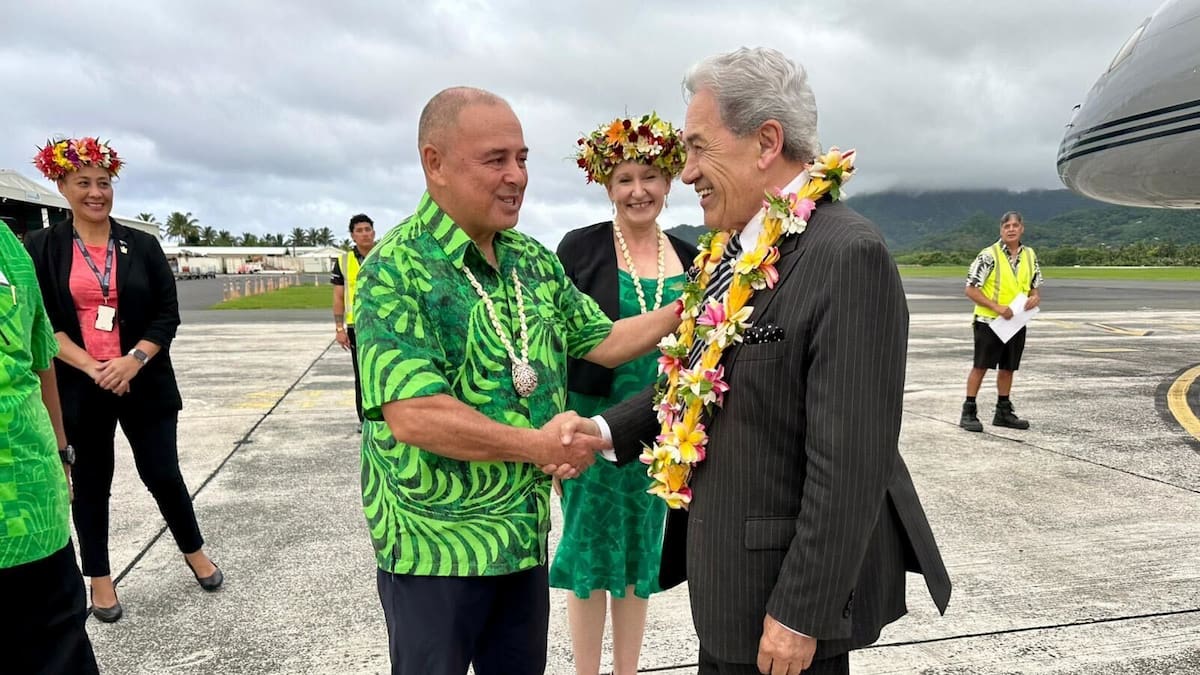
Brown met Peters as the NZDF aircraft touched down in Rarotonga, the classic, almost caricature smile on the Foreign Minister’s face following him across borders, somehow still prevalent across decades of political life. The pair shook hands, a fresh lei was placed around Peters’ neck, and they walked together, looking like old friends.