
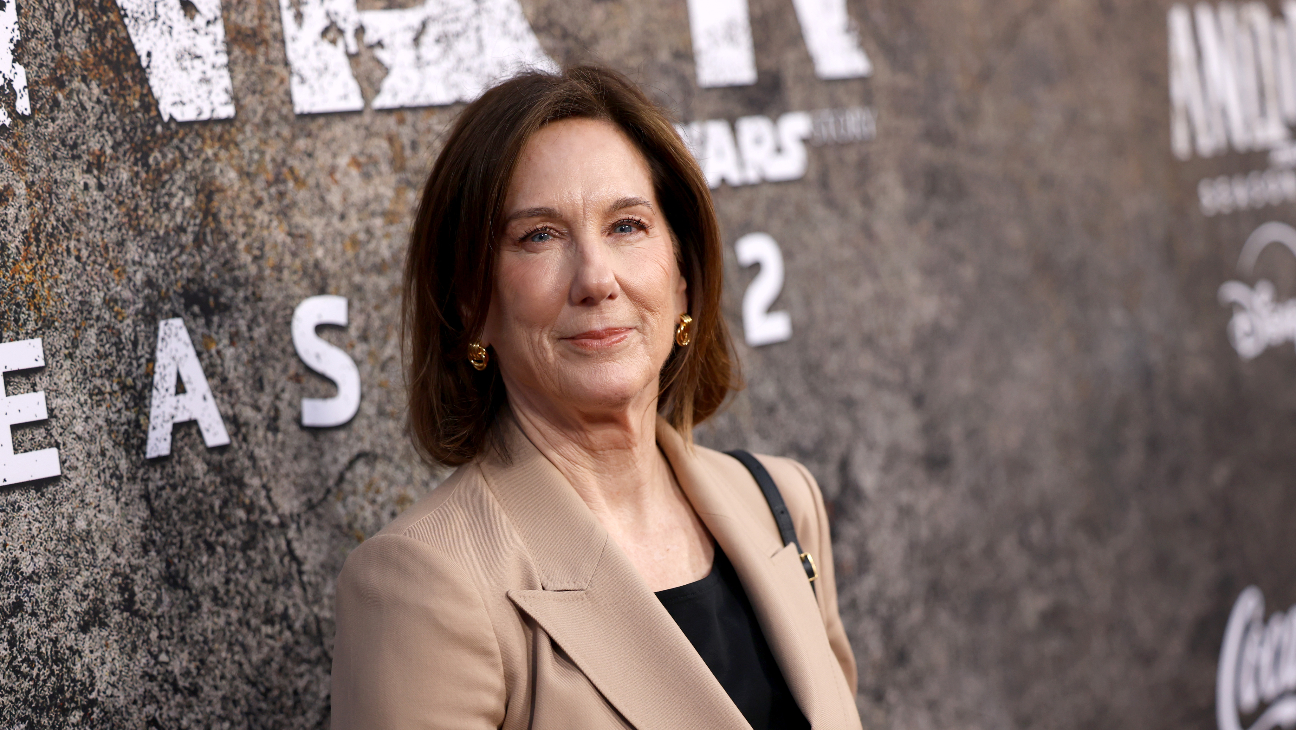
Over her more than four decades in in the film business, Kathleen Kennedy has been at the vanguard of tech, whether via her work on the Star Wars universe or all those Steven Spielberg ones. Jurassic Park alone makes you a pioneer.
You might expect the uber-veteran, then, to be similarly enthused about AI in filmmaking. But Kennedy sounded a more skeptical note Tuesday — even while speaking to an AI founder at an event he hosted.
“Taste is so fundamental to the process of creating things,” she said, in an on-stage conversation with Runway co-funder Cristóbal Valenzuela as part of an AI summit that the New York-based startup hosted in Manhattan Tuesday. “It’s life experiences; it’s educational. The best directors of films and photography came out of art, they studied art,” she said. She suggested AI-driven films by definition couldn’t have that experience.

Kathleeen Kennedy and Cristobal Valenzuela at the Runway AI Summit on Tuesday March 31, 2026. Kennedy has some thoughts about AI.
Steven Zeitchik
The event saw a litany of high profile personalities talk about the promise of AI in cinema, a cause Runway has dedicated itself to pursuing. Valenzuela gave a keynote titled “normalizing magic” to a packed ballroom of hundreds, and executives from Adobe, Promise AI and Paramount all hailed the artistic potential of the tech with thoughts like “Human creativity will 1775042230 not be constrained by time,” (Adobe’sVP of GenAI New Business Ventures Hannah Elsakr).
Kennedy, who left her role as head of Lucasfilm in January, didn’t entirely dismiss the technology, saying it could help for the kind of nuts-and-bolts tasks that nearly everyone agrees it could be useful for —
“previz, planning, budgeting, scheduling.” But this was faint praise as she questioned more sweeping applications.
“Once you get into execution,” she said, a model could falter at the essence of filmmaking. “What are you trying to do? What’s the painting you’re trying to create?” Kennedy said. “There’s [beautiful] unpredictability in the creative process that’s going to be tricky to preserve because AI is so predictable.”
At one point she also stood up for the Hollywood creative community, leveling a charge, if mutedly, against parts of the tech world for how it was carrying forth the AI movement.
“I think what’s missing in the discussion right now is transparency,” she said, “I think people [in Hollywood] feel that there’s a lot they don’t know about what’s going on. When there’s conversation around how these language models are being trained, for instance…. I think if we can reach a point where there’s more transparency in those discussions — and, frankly, more transparency, consequently, in people using these tools,” she added, “then I think that will help greatly to dissipate [the distrust].”
Valenzuela mostly deferred to Kennedy and did not challenge her, even as the AI community of which he’s a part believes there has been transparency and largely sees AI-skeptic filmmakers as hyper-traditionalists who need to get on board. He sometimes did bring up popular counterpoints, such as the idea that AI tools will lower the barrier to entry for filmmakers.
Companies like Runway see themselves as a bridge between the Silicon Valley hypesters and Hollywood skeptics, catering to filmmakers with tools and eschewing social applications like ByteDance’s Seesaw (The Brad Pitt-Tom Cruise fight people).
Kennedy did embrace some potentially novel use cases of AI in filmmaking, like getting simulated opinions from a host of actors on a script without needing to pry it from them (the idea would be to get new points of view on material). She also said that, thanks to AI, “we are on the precipice of something that might look and feel quite different than a two-hour movie experience…or television,” likely in short-form.
But she largely seemed wary of integrating AI into the filmmaking process, even raising an eyebrow at 3D printing, saying that it didn’t create props as durable as those made by conventional human means.
“The interesting thing that happened with the props is that after about take 3 many of them started to break, and we realized that when so many things we do are hand-done, then the materials that are used and choices that are made…was something decided by a human being. And when we were doing this with the new technology, we didn’t have the benefit of that.”
Kennedy’s most philosophical response to the AI camp came when she described the value of human experience in film.
“I’m going to sound like a traditionalist,” she said, “but I have a deep appreciation for learned experiences that then contribute to the collaboration and the creative process. And it’s just like when we’re working with a composer, if you know that somebody’s classically trained, but they’re still doing a very modern rock-and-roll type score, you’re just going to get a depth to the decisionmaking along the way that I think is really valuable.”
Ditto, she said, with lighting.
“It’s one of the trickier tools in art because it permeates everything we do,” she said. “And you need to see many examples in order to do it the right way.”