

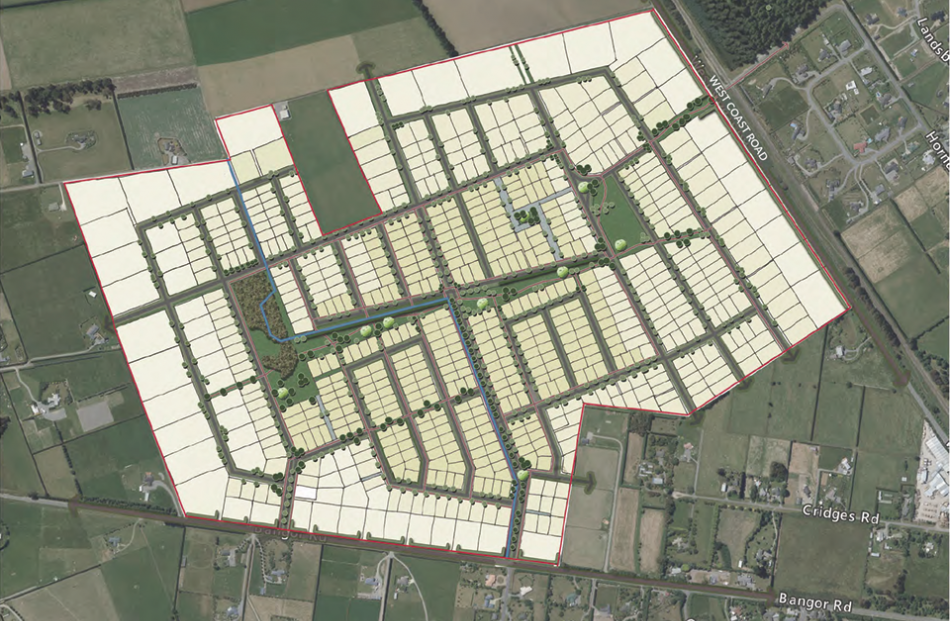
An illustration of what the 800-home Bangor Village subdivision on the outskirts of Darfield could look like. Image: Supplied
The public may not get a say on whether a large subdivision goes ahead in Canterbury.
Hughes Developments is using the government’s fast-track process to get consent for Bangor Village, a 700-800 home subdivision on 126ha of farmland between Bangor Rd and State Highway 73 in Darfield.
If approved, the development could increase Darfield’s 3600 population by 50%, putting it over the 5000 mark to be classed as a town.
The fast-track process also does not allow for public feedback.
The application comes after the Darfield Estates subdivision received consent to go ahead on the other side of the township.
It will add another 800 homes and a supermarket. Bangor Village would also have a supermarket and provisions for a school.
Darfield Residents Association chair Harvey Polglase is worried the new supermarkets may attract people away from the township’s centre.
“We want to make sure we retain the main street as the focus of the community, and we don’t want to see it fragment the township,” Polglase said.
Hughes Development director Jake Hughes declined to comment while the consent application was being processed.
The urban assessment for the application said any potential effects a possible new supermarket could have on the existing businesses would be considered at the detailed design phase.
Polglase was also worried there was little control over the growth of Darfield.
“We believe the council should have the controlling interest in how Darfield is going to grow.”
The fast-track process is controlled by the Ministry for the Environment.
While the council can make submissions on fast-track applications, it has no control over decisions.
Hughes Developments used the previous government’s fast-track process after the Covid-19 pandemic to get 1000 homes consented as part of its Faringdon subdivision in Rolleston.
It was one of many developers to take advantage of housing rules, designed to promote more affordable homes in cities like Auckland and Wellington, to push subdivisions through in the district.
Selwyn MP Nicola Grigg said she understood concerns around growth pressure but noted the project was currently only in the application stage.
“The next step is a review by an expert panel who will consider the concerns raised and weigh them against the overall benefits of the project,” she said.
Grigg said the project should be considered for fast-track approval on its merits, like providing significant job opportunities during the delivery period, as well as contributing to the Canterbury economy.
Malvern Ward councillor John Verry said the project was another example of central government interfering with local government.
“My understanding is the whole purpose of the fast-track is to exclude the community input to a degree,” he said.
Verry shared the residents’ association’s concerns about fragmenting the township. Grigg defended the fast-track process.
“The advantage of the fast-track system is that the project can be processed in a more timely and cost-effective way, while allowing the opportunity for local government input.”