
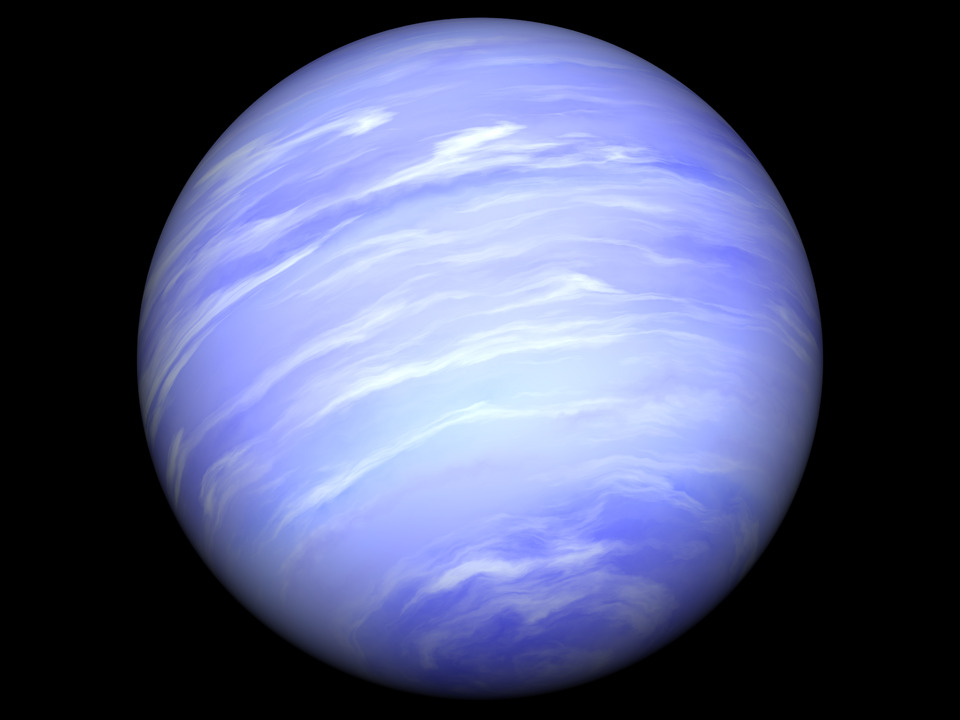
 Neptune. Image credits: NASA.
Most planets in our solar system are tilted. Earth’s 23-degree tilt gives us our seasons, while Mars sits at just over 25 degrees. Then you have the overachievers: Uranus is essentially lying on its side, and Venus is flipped completely upside down.
Usually, these tilts are the scars of ancient, violent collisions. But Neptune is different. According to a new study, Neptune’s 28-degree axial tilt wasn’t caused by a massive impact. Instead, we can probably blame its moon.
A Bizarre Moon
Neptune is the farthest planet from the Sun (sorry, Pluto fans). It’s a giant ball of ice and gas spinning in the freezing dark nearly three billion miles from the Sun. It’s lonely out there, but its moon Triton keeps things interesting.
Triton is a total outlier. Unlike almost every other large moon in the Solar System, it orbits Neptune “backwards” (retrograde). This tells us it wasn’t born with Neptune. It was likely captured by Neptune’s gravity in the early days of the solar system, from the cold reaches of the Kuiper Belt.
These gravitational processes aren’t gentle. According to Rodney Gomes at São Paulo State University, when Neptune first captured Triton, the orbit was elongated like a flattened oval, and the moon itself was tilted relative to Neptune’s equator. This is where the physics gets interesting.
Gomes used a complex model and integrated this system with the gravity of the Sun and the other giant planets. He discovered that as Triton’s orbit slowly became more circular, it dragged Neptune into a particular type of resonance.
Secular Spin-Orbit Resonance
In astronomy, a secular resonance is essentially a frequency match that happens over very long timescales. It occurs when the rate at which a planet’s axis wobbles (precession) aligns perfectly with one of the fundamental frequencies of the Solar System.
Think of it like a playground swing: if you push at the exact same rhythm that the swing naturally moves, the arc gets wider. In Neptune’s case, the “swing” is its axial tilt, and the “push” came from its moon, Triton.
×
Thank you! One more thing…
Please check your inbox and confirm your subscription.
This resonance is sufficient to tilt Neptune, Gomes found.
The researcher ran the numbers and found that in about one-third of his simulations, Neptune reached a tilt of over 20 degrees. In some cases, Triton’s influence was so strong it pushed Neptune’s obliquity past 50 degrees. The real value of 28 degrees was excellently explained by the models. This was a natural resting point created by Triton’s long, slow journey toward its current orbit.
Why This Matters
This discovery does more than just solve a Neptune mystery; it challenges our assumptions about how the entire Solar System (and other star systems) evolved. If Gomes is right, we don’t need catastrophic events to explain why the ice giants are tilted.
But there’s another consequence, may even more impactful.
There’s a theory on how some planets can form called “pebble accretion.” While the old-school theory suggests planets formed through violent collisions between massive bodies pebble accretion proposes a much smoother growth process.
Basically, you start with a a small, solid object that acts as the gravitational anchor. This is called a planetesimal. Then, instead of waiting for another massive rock to crash into it, this seed captures millions of tiny pebbles. As these pebbles drift through the gas of the early solar system, friction (gas drag) slows them down just enough for the planet’s gravity to snag them and pull them into the growing core.
The only issue with this theory is that it doesn’t explain how planets become tilted. Because this process is a constant rain of small particles rather than a few giant, off-center impacts, the planet doesn’t get knocked over. If Gomes’ idea is correct, it would answer that final question.
Perhaps most excitingly, this research suggests that planetary tilts are likely common throughout the galaxy. If a single moon like Triton can tilt a planet the size of Neptune, then any exoplanet with a large, captured moon might be leaning over.