
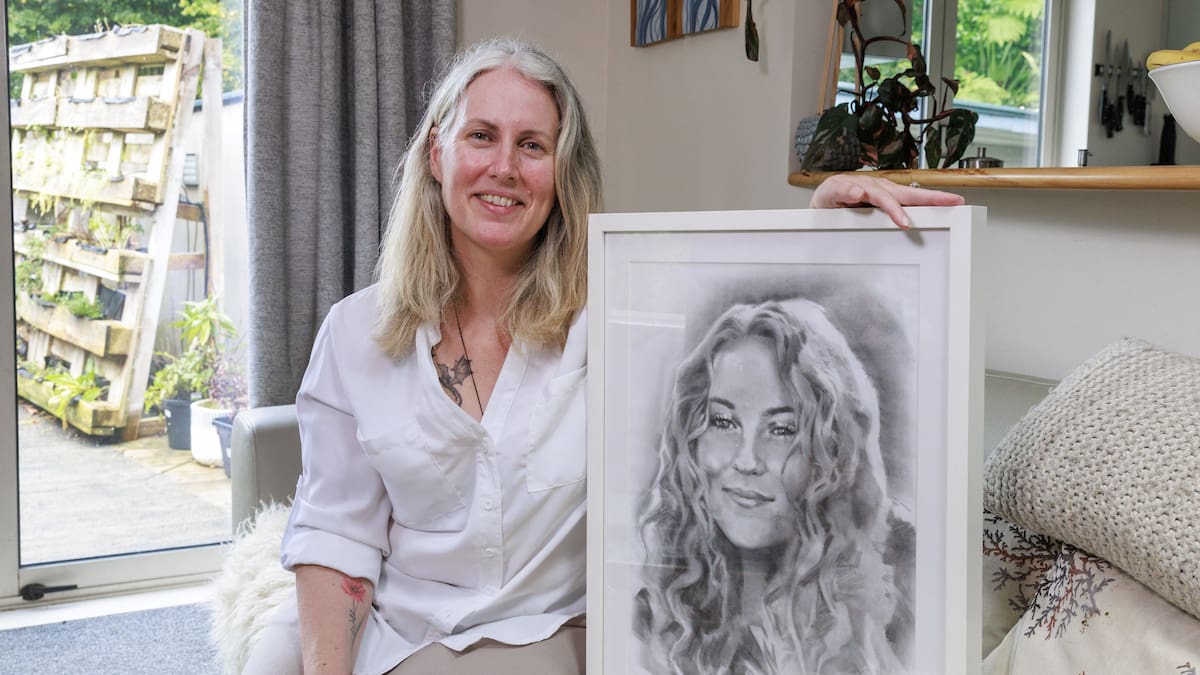
The Wellington mum-of-three has written a book, The Year After Kahlia, and created a website, This Is Grief, in the hope of helping others process and talk more openly about loss.
O’Connor, who works for the Ministry of Justice, drew on her psychology degree and education background to write her book documenting the first year after loss.
There are “strange” administrative tasks that come with death, she says – like closing her daughter’s bank account with just $20 in it.
“I had to produce my ID, I had to go and stand there and say how she had died – just cruel things that happen when you’re not in the space to deal with it.”
She remembers standing in the supermarket in disbelief that people around her were having normal conversations.
“There’s this complete disconnect from the world around you.”
To cope, O’Connor wrote herself lists: take a shower, remember to eat, call that person.
“I lived by the lists and that organisation, because I completely lost control of myself. I lost control of my identity.”
She returned to work two weeks after her daughter’s death, which she now says was “crazy”.
“I didn’t know what to do. I didn’t know whether going back to work was good. I didn’t want to be at home, I didn’t want to be at work, I didn’t really want to be anywhere.
“I would go to work and I couldn’t understand how I couldn’t read or answer an email, which I’ve done for years.”
Kirsten O’Connor, 49, with her daughter Kahlia, left, who died at the age of 24 in April 2024. Photo / Supplied
We all grieve differently, she says. “There’s no timeline on it … one is by no means better than another. It’s about acceptance and allowing people to be their own person.”
The popular “stages of grief” framework isn’t necessarily helpful, she says, noting it was created for dying people coming to terms with their own death, not for those mourning others.
“We’ve latched onto this, I guess because we like things a bit simpler, nice and easy. We would like a prescription [for coping with grief].
“I would have loved a stage of grief. I would have loved there to be a tick box.”
O’Connor is also a mum to two sons aged 28 and 17.
“One thing that I found in parenting my children after Kahlia’s death was I couldn’t get paranoid and I couldn’t smother them – that I still needed to parent them the same as I would have prior to Kahlia’s death.”
Milestones like birthdays can be especially difficult after loss. In O’Connor’s family, there is a two-week period that includes her dad’s birthday, Christmas, Kahlia’s birthday, New Year’s, her youngest son’s birthday and her own birthday.
She calls it “a really awful disaster zone”. And for the past two years, they haven’t celebrated those days.
“We just took the days as they came, and I think that was the best thing we could have done.”
That might change later this year, but for now, O’Connor lights candles to remember her daughter and buys flowers to put next to her urn each week.
There is no end point to grief, she says.
“I will grieve Kahlia for the rest of my life. And I don’t want it to be any different. Some people don’t like that … but I don’t see it as a bad thing. I think I can be happy and grieve my daughter in the same breath.”
There are “unwritten rules” about how to act while grieving, she says.
“You can cry, but not too much; you can seem like you’re happy, but not too much. I didn’t know how to navigate that.”
O’Connor remembers another situation when she heard someone ask: ”Has she not gotten over it yet?“.
“It’s not people being horrible, it’s just that we don’t sit in uncomfortable very well. We want people to be happy and we want them to be healthy and real.
“People are so scared of death and I think losing a child is probably one of our worst fears communally. So that was hard, because people didn’t want to talk about it or they wanted to skirt around it.”
Losing a child to suicide is even harder for people to talk about, she notes.
“There was such an isolation because people didn’t know how to talk to me or deal with the fact. I would have been exactly the same – it is a hard topic. We need training in it, to sit with someone and be okay and just not say anything a lot of the time.”
She suggests meaningful ways to support someone through grief include helping them make decisions they can’t – and not getting offended if they struggle to accept that help.
“It’s not about taking control – it’s about saying ‘have you thought about that? Can I help you that way?’. It’s a softly, softly approach. It’s people coming and mowing your lawns because you don’t care about the lawns. Those things are really powerful. There’s people bringing you food and not expecting you to say thank you.”
O’Connor says talking openly about her daughter’s death has enabled others to open up to her about their own suicidal thoughts, or fears for friends and family with mental health struggles.
“I think it’s so important to talk about [suicide] and I don’t shy away from it … I believe that Kahlia would be passionate talking about that as well.”
Nothing can prepare a parent to lose their child, she says – but she feels lucky to have had a close relationship with her daughter.
“I knew how much she loved me and she knew how much I loved her.
“That love is so important and it doesn’t end. Just because they’re not here doesn’t mean your relationship with them is not here. It does not mean that you’re not their parent anymore.”
Five things Kirsten O’Connor wants you to know about grief
1. You can’t do grief wrong
There’s no correct way, no timeline, no tidy stages. Your grief is as individual as your relationship was.
2. Grief isn’t something you ‘move on’ from
The relationship doesn’t end when someone dies. Continuing bonds aren’t something abstract or “woo woo”, they’re essential. The love is still there, it just has nowhere physical to go.
3. Grief isn’t contagious, but people treat it like it is
Support isn’t predictable. The people you expect to show up sometimes don’t, and others quietly do. A lot of people stay away because they’re uncomfortable, but the silence can deepen the isolation for those already carrying so much.
4. Grief isn’t simply an emotion. It’s a full-body experience
It lives in your nervous system. The exhaustion, brain fog, anxiety, physical pain. It’s not you coping badly, it’s your body trying to process something overwhelming.
5. What helps most isn’t fixing, it’s being willing to stay
You don’t need perfect words. You need people who aren’t afraid to sit in the reality of what’s happened and let it be spoken.
Bethany Reitsma is a lifestyle writer who has been with the NZ Herald since 2019. She specialises in all things health and wellbeing and is passionate about telling Kiwis’ real-life stories.