
The U.S. had its Wright brothers, France its “Light” brothers.
A few years before Orville and Wilbur piloted the first flight, Auguste and Louis Lumière (coincidentally, the French word for light) were innovating in a different sphere – the new medium of cinema. The siblings shot some of the first motion pictures ever made, beginning in 1895, on equipment of their own design.
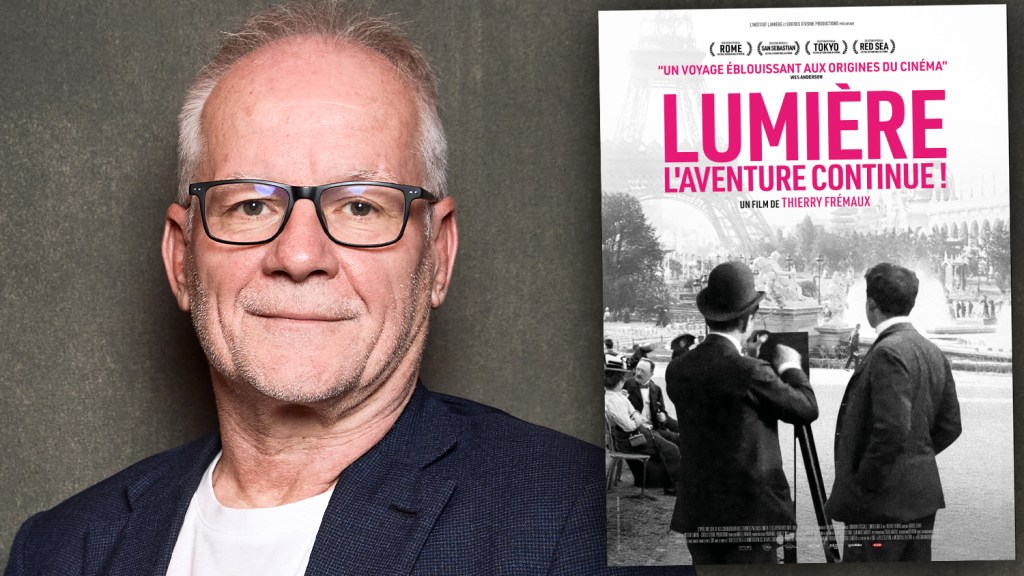
“When [Louis] Lumière turned the crank of a beautifully crafted metal and wooden device, the technical achievement of his invention made history,” remarks Thierry Frémaux, chief of the Cannes Film Festival. He makes that observation in Lumière, Le Cinéma!, a documentary he wrote, directed and narrated that’s now playing in select cities in the U.S., through Janus Films. It opens in Los Angeles on April 25 and begins streaming on the Criterion Channel on May 1.
In the film, Frémaux serves as our guide through dozens of newly restored short films made by the brothers, including their debut – the 46 second-long La Sortie de l’usine Lumière à Lyon (Workers Leaving the Lumière Factory), shot outside their own establishment as a workday ended.

Stills from Lumière brothers films, including ‘Workers Leaving the Lumière Factory’ (at center).
Janus Films
“It was a capture of life and capture of human beings,” Frémaux tells Deadline, “and [with] that group of human beings, which was the workers of the factory — women and men — cinema became something to show what human beings are, were, but still are.”
Already, in those early films, a language of cinema was emerging.
“One hundred and thirty years ago, the Lumière brothers invented the cinématographe,” Frémaux says in his narration. “Everything was already there: comedy, drama, actors’ performances, children’s faces, tracking shots by boat, and panoramas by streetcar.”
Portrait of the Lumiere brothers, Auguste (left) and Louis, on December 28, 1895 in Paris. (Photo by: )
Photo 12/Universal Images Group via Getty Images
Louis Lumière, as the primary cameraman and indeed creative and technical force of the team, did not simply set up his tripod randomly and catch shots.
“[Louis] Lumière knew nothing about cinema. So, he had to invent his own behavior, his own way to make cinema,” Frémaux explains. “And the first question, of course, was where do I put the camera? What do I do with the camera? What is this camera? What is specifically cinema, which is not photography, which is not painting, which is not telling a story by words.”
A Lumière brothers short film featuring young acrobats.
Janus Films
He adds, “Every Lumière film is directed, and especially because they did not have any possibility to view through the camera [to see] the frame of what they were doing, they had to think about what they wanted to film. So, it’s a mise-en-scène; everything is directed.”
Georges Méliès, another French pioneer of cinema, attended the Lumières first public exhibition. Méliès would take the artform in a more self-consciously fanciful direction – into science fiction and fantasy. The Lumières would remain comparatively grounded, sometimes working in what could be called actualities, other times in deliberately fictional sequences.
“Méliès, his origin was the show, illusion, theater, magic world,” Frémaux points out. “And of course he got the potential of how to use cinema to do his things… [Louis] Lumière didn’t have any agenda. That’s why Lumière made cinema for what cinema was. And that’s why, how can I say, the ontologie of cinema, the essence of cinema, was right away present more in Lumière than in Méliès. Which doesn’t mean the Méliès path and school is not essential as well. It is. But what I say in the film is that, of course, we have that separation made by the historian… that ‘Lumière is documentary and Méliès is fiction.’ Not at all. Lumière is not documentary. Lumière is a way to get life and even to get the poetry of life. And because life is poetic, films about life are poetic.”
Thierry Frémaux at the 77th annual Cannes Film Festival at the Palais des Festivals.
Stephane Cardinale – Corbis/Corbis via Getty Images
In addition to serving as the Cannes Film Festival leader, Frémaux is director of the Institut Lumière in Lyon. He credits the Lumière brothers not only for their foundational work in moviemaking but for championing exhibition of films. That would become the bedrock of the motion picture industry in the 20th century.
“The two inventions of Lumière are cinema as an art, technique, et cetera. And the second dimension is movie theater and audience,” Frémaux argues. “A film can’t exist without an audience. So those two dimensions, one is totally a triumph. Cinema won. Cinema is everywhere. A post on Instagram, a video, a newsreel on TV, and so on. It’s the language of cinema. It’s a camera… So, cinema is everywhere, on YouTube, everywhere. Cinema in a movie theater, that is another situation.”
Streaming poses the greatest threat to the continued viability of the exhibition business (and explains why the Cannes Film Festival insists that any film competing for the Palme d’Or get a theatrical release in France, a direct retort to Netflix).
“Human beings, in the 20th century, used to go out of their home [to see] movies. Today, we all know that everywhere, and especially in [the U.S.], because of the triumph of the [streaming] platforms, there is another way to watch film,” the director says. “And we could say that in a way, it’s a revenge of Thomas Edison, the individual use of watching films. And what Lumière wanted — to have people going out and being all together watching in a movie theater, that is a fragile situation.”
An early Lumière brothers film.
Janus Films
While Lumière, Le Cinéma! will be available to stream on Criterion, Frémaux extols seeing it the way the Lumière brothers first projected their work.
“A lot of films, when they are in good shape, restored, beautiful, they give something more,” he says. “Especially Lumière films on the big screen, they give their complete potential… Even the oldest film, it’s still very interesting to see it on the big screen.”