
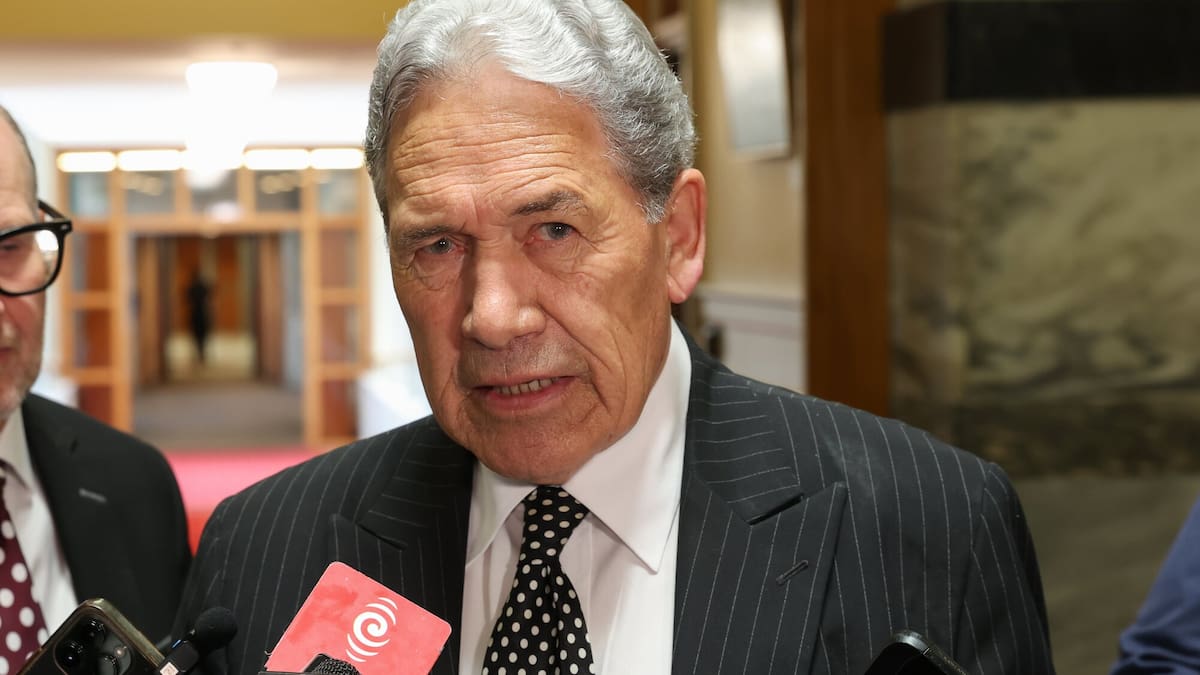
During a period of defining moral and political change, Peters and NZ First were not outsiders holding the line from the wilderness. They held office, had leverage and made choices. But Peters now speaks as though history merely happened around him.
This parliamentary term, the same habit of performance over principle can be seen in NZ First’s use of the members’ bill process. One bill goes in, with much fanfare and anti-woke celebration, while another, previously trumpeted, is quietly withdrawn. A bill against DEI (diversity, equity and inclusion). A bill about biological sex. A bill on flags. The pattern is familiar: enough to reassure an aggrieved audience that someone is still fighting for them, at least until next week, when the bill is withdrawn to make space for the next cause.
Never mind actually progressing public policy through thoughtful legislation.
Remembering this matters because social conservatism is not a tone of voice: a sneer at “woke” excess, or simply a culture-war slogan. Whatever you think of social conservatism, it represents something more serious. It speaks to restraint, steadiness and a willingness to defend certain goods: family, continuity, duty, inherited norms and the institutions that sustain them, even when doing so costs.
By that standard, Peters is no social conservative. Nor, of course, is he a progressive liberal.
Nobody imagines him as a creature of the activist left. He is something else: a populist nationalist, a political type that has real currency at the moment. It feeds on suspicion of elites and hostility to bureaucratic managerialism and progressive moral vanity. Its core instinct is protection of the nation, its borders, its symbols and its ordinary citizens.
Populist nationalism is not known for its consistency (just ask Pauline Hanson, Nigel Farage or Maxime Bernier) but Peters’ gift has never been ideological coherence. It has been political mimicry, along with impeccable timing. He knows how to gather the frustrated, the anti-woke, the nostalgic and the disaffected under one banner and assure each that he is really “one of them”.
He does not inhabit traditions so much as raid them, repurposing them for his own political advantage. The claim by Groucho Marx seems appropriate: “Those are my principles, and if you don’t like them … well, don’t worry, I also have others.”
The same elasticity of principle can be seen in the coalition Peters is trying to assemble. Alfred Ngaro and Stuart Nash do not represent a natural ideological pairing. Both former ministers, one comes from a values-driven conservative tradition, the other from Labour machine politics. If both can plausibly fit under the NZ First umbrella, that does not suggest philosophical breadth as much as a vehicle broad enough to house several kinds of discontent, provided they can all be rallied against a common enemy.
This may be a sound political tactic. But Peters did not claim NZ First was a party of shrewd political actors. We already know that. He claimed they are social conservatives.
Even on economic questions, Peters is not especially conservative. Conservatism is not just cultural suspicion. It also involves restraint, responsibility and some obligation to those who come after us. Yet, in addition to regional slush funds and retaining inefficient national assets, NZ First has long been the chief defender of a superannuation system that robs the future to pay for today’s comforts.
This is not stewardship. It is grey populism.
This is one of the strangest features of Peters’ attempted reinvention. He wants the moral authority of conservatism while defending one of the least conservative fiscal orthodoxies in New Zealand politics. He talks like a custodian of the permanent things while acting, again and again, as a custodian of the merely popular things.
In reality, the voters deserve some criticism, too. Peters remains viable not simply because he is opportunistic, but because too many voters keep rewarding the performance.
There is nothing wrong with wanting a politics that rejects progressive excess, takes national identity seriously and defends social order. Those are legitimate concerns. But voters who care about them should at least demand the real thing.
Peters is many things: shrewd, durable, entertaining, and unusually gifted at locating the frustrations of the age. But a social conservative is not one of them.
Jonathan Ayling is a strategy consultant and professional director. He is the former-Chief Executive of the Free Speech Union (NZ), and has worked as a ministerial staffer and senior Parliamentary advisor in both Government and Opposition.
Catch up on the debates that dominated the week by signing up to our Opinion newsletter – a weekly round-up of our best commentary.