

Star Trek: Infection
Release Date: March 31, 2026
Formats: Windows PC via Steam VR or Meta Quest 3
Developer: Played With Fire
The world of Star Trek games has been diversifying recently, not unlike how the modern era of Trek TV has tried to make series that defy single genres. If you’re a tried and true MMORPG fan, Star Trek Online continues you covered. If you’re a fan of strategy games like Civilization, Star Trek Infinite scratched that itch in 2023, with Star Trek: Resurgence delivering story-based adventure. And from just a couple months ago, Star Trek Voyager: Across the Unknown is custom-built for players who like equal parts exploration and chance. In the same, decidedly unique vein, Star Trek: Infection looks to fill both survival horror and virtual reality (VR) gaps. And the experience is pretty entertaining as a Trek game, but don’t expect much in the frights department.
Welcome to the USS Lumen
Set in the late 24th Century on a Defiant-class ship (made iconic by Deep Space Nine), Infection puts you in the Starfleet regulation uniform of Ferak, a Vulcan officer who quite possibly is the U.S.S. Lumen’s only hope.
Ferak, something of a mystery himself, is a new recruit to the Lumen; compromised by the same titular infection that’s swept through the ship, he awakes with little idea of what’s happening, but a clear objective: fight the plague, save the Lumen and its surviving crew, and reveal the infection’s secrets.

Infection gives you the chance to stroll through the decks of a Defiant-class ship (Steam VR version).
Virtual reality or bust
Star Trek: Infection is available on one of only two platforms: Windows PC via Steam VR, and the Meta Quest 3. Therefore, virtual reality is not optional, but mandatory; if you don’t have a Meta Quest 3 or a VR headset compatible with Steam VR, then you’re out of luck. I’ve had a chance to play both and The Meta Quest 3 version is a scant 3GB download compared to the Steam VR’s 10GB one, and it’s for that reason that the latter is more visually impressive (provided you have a PC that can play it).

The Steam VR version of the Lumen’s bridge…

… and the slightly less visually-impressive Meta Quest 3 version.
When starting Infection, you’ll be able to quickly tell the kind of gameplay experience you prefer, playing while sitting or standing, using your VR headset’s controllers to move around in-world. I opted to almost immediately go into settings and change camera movement and rotation to smooth, which means you won’t need to hit left or right and reposition your character in 45- or 90-degree arcs.
From there, you’ll use your controller’s grips and buttons to grab in-game items like isolinear chips and spanners, a tricorder, and a phaser in order to function in the world. You’ll also be able to perform actions like grabbing objects, performing a Vulcan nerve pinch, and so on. While these actions are technically intuitive – reach out to hit a button on a PADD, as an example – the nature of virtual reality gaming may sometimes mean that your actions don’t always translate 1:1 in the game itself. Trial and error will happen – sometimes quite frequently – so it’s best that you prepare yourself for that.
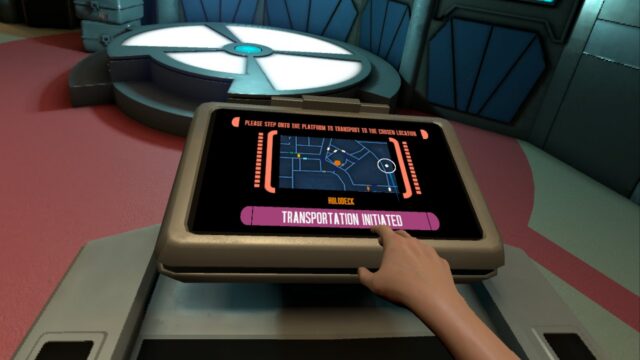
Prepare for transport! (Meta Quest 3 version)
Is it Star Trek?
While far from perfect, Infection is clearly made by a team that gets Star Trek. Its best moments come from simple actions, like deciding to leave the Lumen’s captain’s chair and explore its bridge before even starting the game, or helping a fellow crew member repair a shuttle in the shuttle bay of Deep Space 38. When it’s just you and Trek, Infection evokes feelings that I reveled in playing the now-defunct, fan-made Stage 9 or the higher-budget Star Trek Voyager: Elite Force, both of which let you roam the halls of the Enterprise-D or Voyager respectively.
Without getting into too much of Infection‘s plot, it revolves around the cultures of the Vulcan and Cardassian peoples, and handles each race with the care and concern they deserve. Ferak also is Starfleet to his core as the game begins, first heading out for a spacewalk in order to save Deep Space 38 before finding himself alone and unarmed on an infected Lumen. There, he’s left to sneak around infected crew members or mercifully render them unconscious thanks to a well-timed Vulcan nerve pinch.
In its initial hour or two, Infection is, well, infectious.

Is this Cardassian who he says he is? Maybe. (Steam VR version)
… or is it a horror game with a Trek skin?
Things sadly take a turn for the more generic when more of Infection‘s titular malady kicks in. Ferak is forced to succumb to the threat and develops plant-like tendrils rather than his own, Vulcan arms. This brings about a series of new mechanics that feel more space-magic than Trek, and are often clunky and awkward to perform. Frustration can abound.
It should be said for those worried that Infection isn’t too scary, but does delve into psychological terror. That said, it’s a bit gross at times – you are required to basically gnaw at your arm to get rid of the foreign DNA in some instances – and there is a jump scare or two to be had. Consider yourself warned.
All up, Infection is akin to that one zombie episode of Strange New Worlds – you can see what they were going for, but don’t necessarily agree if they got there. It takes a bit of a leap of faith (and perhaps logic), and while some may be willing to go to those lengths, others will not.

The actual infection leaves a lot to be desired… (Meta Quest 3 version)
At the end of the day, this game is only for a very small subset: those Star Trek fans who also happen to have a (remarkably pricey) VR headset. If you happen to be in both of those camps, Infection‘s asking price of $29.99 (or on sale for $26.99 until April 15) might just be worth checking it out. If you were contemplating buying a fancy new device for this one, I’d personally recommend that you hold off, or ensure there are enough other games you are interested in. Star Trek: Infection is a decent title, but not worth the upgrade to VR alone.
Star Trek: Infection is now available on Meta Quest 3 and Meta Quest 3S headsets, alongside Windows PC via Steam and its supported VR headsets.
Steve Wright is a longtime Trek fan, an experienced Australian-based games journalist, and the editor-in-chief of Stevivor.com, the country’s leading independent video games site.