
Plus, another significant symbol of this ever-welcomed season is the bunny rabbit.
With spring well and truly in the air, it is the season of not knowing what coat to wear, bunches of daffodils filling window frames, and hot cross buns a constant in many shopping baskets.
At long last.
The grounds of the University of East Anglia (UEA), within which the Sainsbury Centre Sculpture Park sits, is home to the longest studied rabbit colony.
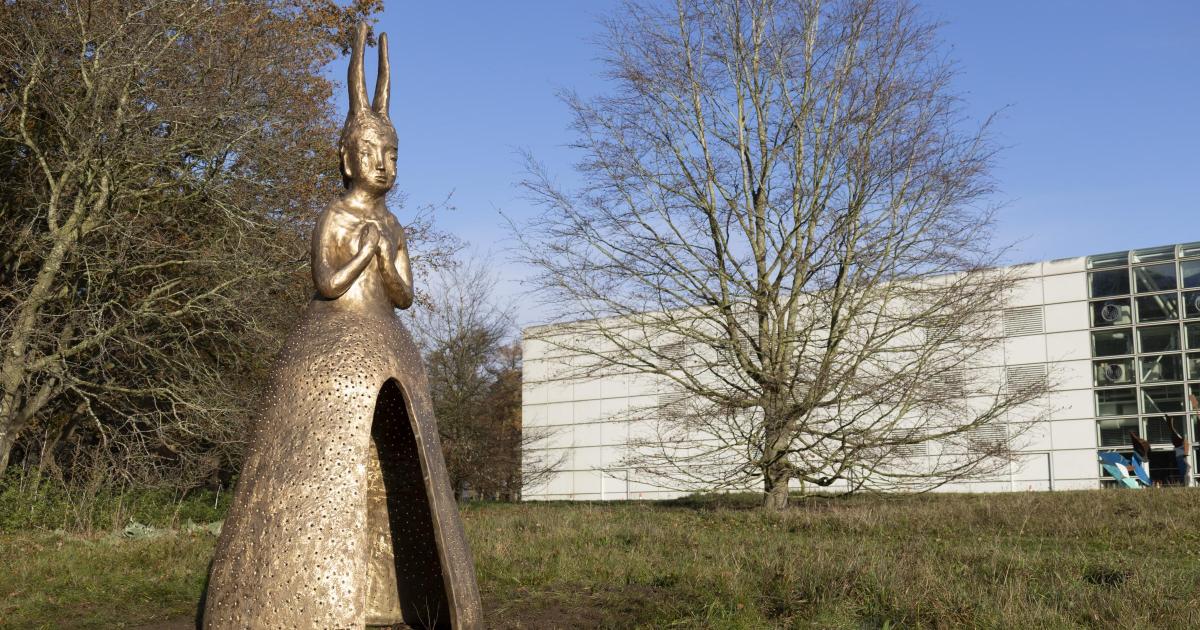
One very special rabbit who sits at home in the grounds of the Sainsbury Centre Sculpture Park and whose season is just beginning, is artist Leiko Ikemura’s sculpture Usagi Kannon.
Usagi Kannon, which translates as ‘Rabbit Bodhisattva of Mercy’, is a towering figure with rabbit ears and a human face.
A recurrent and significant motif in Ikemura’s work, the rabbit represents rebirth, fertility, and renewal.
At 3.4m tall and dazzling within the landscape, Usagi Kannon is certainly well-loved.
From the children who run in and out of her skirt, to the dog walkers who say hello to her every day, she has a sort of magic to her.
Those with a keen eye will notice that she changed her dress to gold in the last few years, as a different iteration of the sculpture took up home in the patinated bronze’s place.
This ethereal sculpture gives lots of joy to those visiting the Sculpture Park, but it is important to remember that the rabbit is also an important reminder of a moment in history.
This hybrid character was first created in 2011 in response to the Fukushima nuclear disaster in Japan and the subsequent reported birth defects in animals.
With a crying face in mourning, the artwork is dedicated to the people and living beings who died and suffered losses in the tragedy.
Usagi Kannon offers shelter through their bell-shaped skirt, acting as a protective shrine.
Once inside, the small holes in the skirt shed star-like rays of light creating an encompassing universe around the viewer.
With both a sadness and kindness about her, she is a peaceful figure set nestled amongst the tranquil landscape.
There is a sort of quiet about her, an empathy which cannot be described.
With the skirt only big enough for young children and animals to fit inside and enjoy, there is a feeling that this is a protected place of innocence and joy, filtering any harsh natures of the outside world.
Every child I have seen to enjoy this element of the sculpture is filled with joy and excitement at being able to step inside – inside where their human guardian cannot fit, a place especially for them.
As the infamous rabbit colony of the UEA dance around, at home here when the humans have left, I like to think of them dancing and playing together, with Usagi Kannon watching over protectively, joyful from afar.
World Art Day was established in 2019 at the UNESCO’s General Conference.
It is a celebration to promote the development, diffusion, and enjoyment of art.
This World Art Day on April 15, why not come and say hello to Usagi Kannon and dance with the rabbits to welcome in spring.
The Sainsbury Centre Sculpture Park is open in daylight hours.