
In the late 20th century, the world came together to plug a hole in the ozone layer — the part of Earth’s atmosphere that absorbs most of the Sun’s harmful ultraviolet radiation. If left unchecked, this hole would have exposed life on Earth to dangerous — and in some regions potentially lethal — levels of radiation, but an international treaty brought us back from the brink of disaster.
That treaty, the Montreal Protocol, is a lesson in human resilience: We can save the world, because we already did it once before.
An epidemic of deadly fridges
The story of the Montreal Protocol starts, bizarrely, with an epidemic of deadly fridges in the 1920s. In those pioneer days of electric home refrigeration, everyone’s favorite new kitchen appliance relied on highly toxic, flammable, or corrosive gases to keep food chilled. A faulty compressor or leaky pipe could wipe out an entire family in their sleep, and in the first half of 1929, gas from fridges killed at least 15 people in Chicago alone.
Danger drove innovation, and in 1928, General Motors engineer Thomas Midgley Jr. synthesized the first chlorofluorocarbon (CFC) — a cheap, non-toxic, non-flammable gas marketed in the U.S. under the brand name Freon. CFCs seemed miraculous, and post-war consumers fell in love with them. They became the coolant in every refrigerator and air conditioner in the world, as well as the propellant of choice in billions of aerosol cans, ejecting hairspray, deodorant, whipped cream, and countless other consumables, all at the push of a button.
But CFCs, the solution to an earlier problem, turned out to be villains in disguise. In 1974, University of California scientists F. Sherwood Rowland and Mario Molina asked an inconvenient question: Where do all the CFCs go?
The message was clear: Earth’s immune system was compromised, and the infection was spreading.
Because CFC molecules are so stable, they don’t break down in the lower atmosphere. Rowland and Molina hypothesized that they drifted upward into the stratosphere, 10 to 30 miles above the Earth’s surface, where they would be smashed apart by the Sun’s ultraviolet (UV) rays. This releases chlorine atoms — like a microscopic, demented Pac-Man, a single one can devour more than 100,000 ozone molecules.
If their hypothesis were correct, that would be catastrophic. The ozone layer is like Earth’s sunscreen: It lets through most of the Sun’s relatively benign UV-A rays, absorbs most of the harmful UV-B, and blocks all of the even more dangerous UV-C radiation. Without the ozone layer, those unwelcome UV rays would reach Earth’s surface, where they’d mutate DNA, cause skin cancers and cataracts, and kill crops and marine ecosystems.
Fellow scientists were skeptical of the theory, while the chemical industry was downright hostile. Leading CFC manufacturer DuPont dismissed it as “pure science fiction” and launched a decade-long PR campaign in defense of its star compound.
But confirmation of Rowland and Molina’s dark calculus came from the bottom of the world in the mid-1980s. Physicist Jon Shanklin, working at Halley Research Station, a cramped U.K. science outpost on the Brunt Ice Shelf, measured a 40% decline in spring ozone levels in the stratosphere over Antarctica in less than a decade. Those readings were so dramatic that at first he thought his creaky Dobson spectrophotometer had finally given up the ghost, but a replacement instrument confirmed the horrifying readings.
When the findings were published in Nature in May 1985, they hit the world like a thunderbolt. As NASA’s eyes in the sky soon confirmed, there was a dangerous rip in the Earth’s protective layer. In the late 1990s and early 2000s, this ozone hole expanded to around 11 million square miles (28 million km2), roughly the size of North America.
Satellite imagery turned the abstract threat into visceral geography — terrifying technicolor maps showed a deep purple bruise spreading over the South Pole. Those visuals galvanized public opinion in a way mere chemistry equations never could. The message was clear: Earth’s immune system was compromised, and the infection was spreading. CFCs, the human-made chemicals that powered our conveniences, were literally eating the sky.
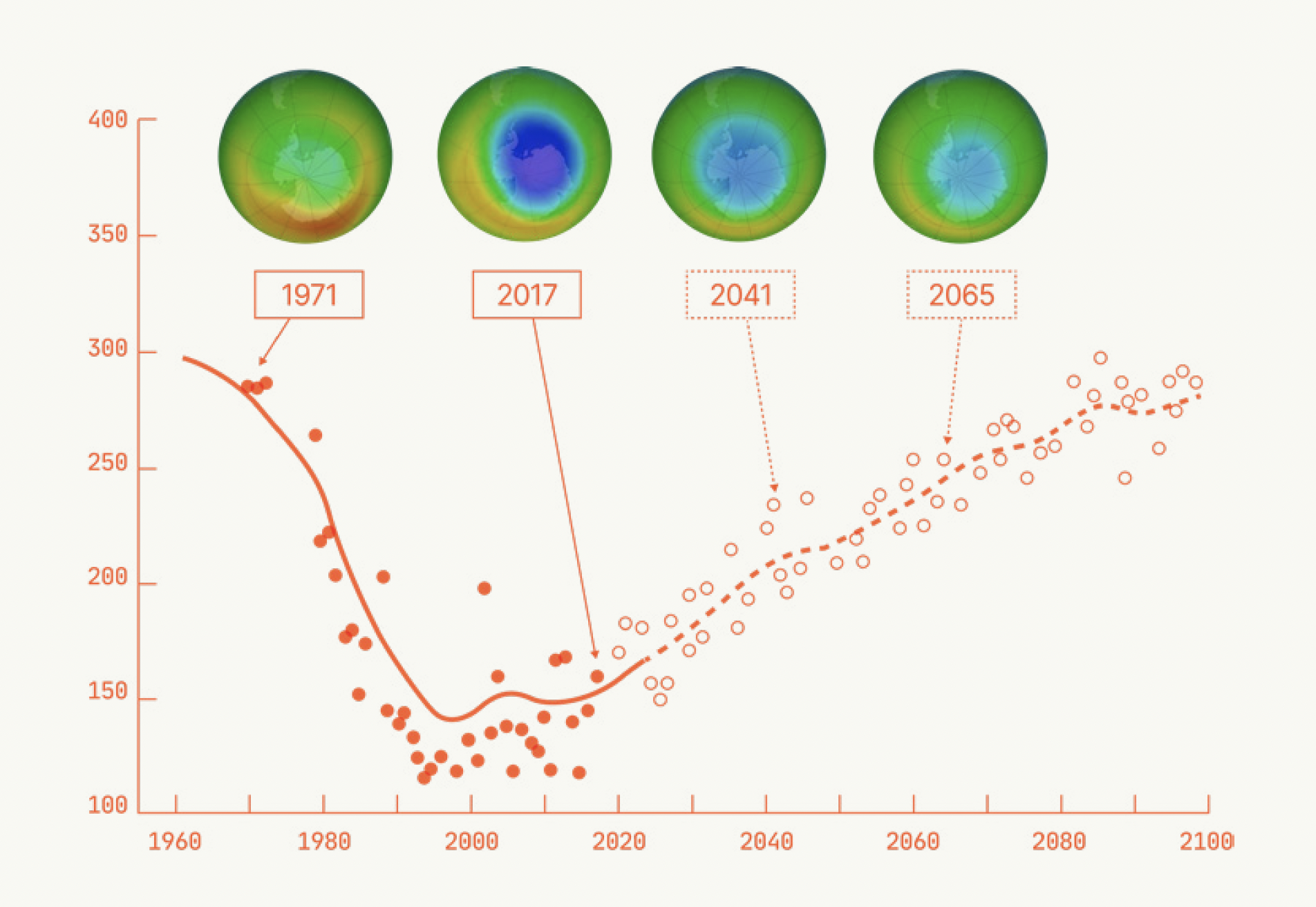
NASA reports of ozone concentration over Antarctica and projected recovery / NASA, WMO
The Montreal Protocol
With scientists and the public aligned in their alarm, governments took note, and something extraordinary materialized: a concerted global effort to tackle a problem no single country could ever hope to fix alone. In less than nine months of global dealmaking, and after a final midnight session of negotiations, the Montreal Protocol was signed on September 16, 1987. Its aim was radically and elegantly simple: to reduce and eventually eliminate the production and consumption of CFCs and similar ozone-depleting substances.
And it worked, thanks to its ingenious design:
First, the treaty recognized that developed and developing nations had “common, but differentiated responsibilities.” Acknowledging that rich nations had created most of the problem and had most of the resources, it set up a binding timetable for them to act, but gave developing nations a 10-year grace period.
Second, the Montreal Protocol wasn’t a toothless treaty. It included threats to restrict commerce with non-compliant countries and completely ban the trade in products made using CFCs.
Third, it was intended to be flexible, capable of adapting as science advanced and alternatives became available. Since its inception, the Protocol has been amended six times, most recently — and most consequentially — in Kigali in 2016.
Fourth, it created a Multilateral Fund to help developing countries meet their commitments.
And finally, it fully embraced the precautionary principle: act now if waiting for scientific certainty could be catastrophic or irreversible.
Driven by the treaty, industry developed alternatives to CFCs faster than predicted, allowing multiple accelerations of the phase-out throughout the 1990s. To date, the parties to the Montreal Protocol have phased out roughly 99% of ozone-depleting substances compared to 1990 levels — effectively eliminating the chemicals once used in nearly every refrigerator, air conditioner, and aerosol can on Earth.
The ozone layer is responding by healing. It’s projected to recover to 1980 values over most of the world by 2040 and over Antarctica by 2066. Last year’s seasonal ozone hole was one of the fifth-smallest since recovery began in 1992 and broke up nearly three weeks earlier than the average over the past decade. The Environmental Protection Agency (EPA) estimates that full implementation of the Montreal Protocol will help avoid, in the U.S. alone, more than 280 million cases of skin cancer, around 1.6 million skin cancer deaths, and more than 45 million cases of cataracts.
The treaty spared crops, marine life, and — unintentionally — the climate. Because most ozone-depleting substances are also potent greenhouse gases, the treaty’s measures from 1990 to 2010 alone have prevented the equivalent of 11 gigatons of CO2 emissions into the atmosphere per year. This could have reduced future warming by as much as 0.5°C.
 A protocol-less world
Without the Montreal Protocol, the ozone layer would be dangerously depleted. Imagine UV radiation strong enough to cause sunburn after just five minutes outside, even in mid-latitude cities like Washington, D.C. or Paris — that would have been one of the more trivial effects. Let’s doomscroll to the bleak, ozone-less futures we managed to avoid in Australia, South America, and the Mediterranean — three parts of the world that would have been most affected by inaction.
Nocturnal Australia
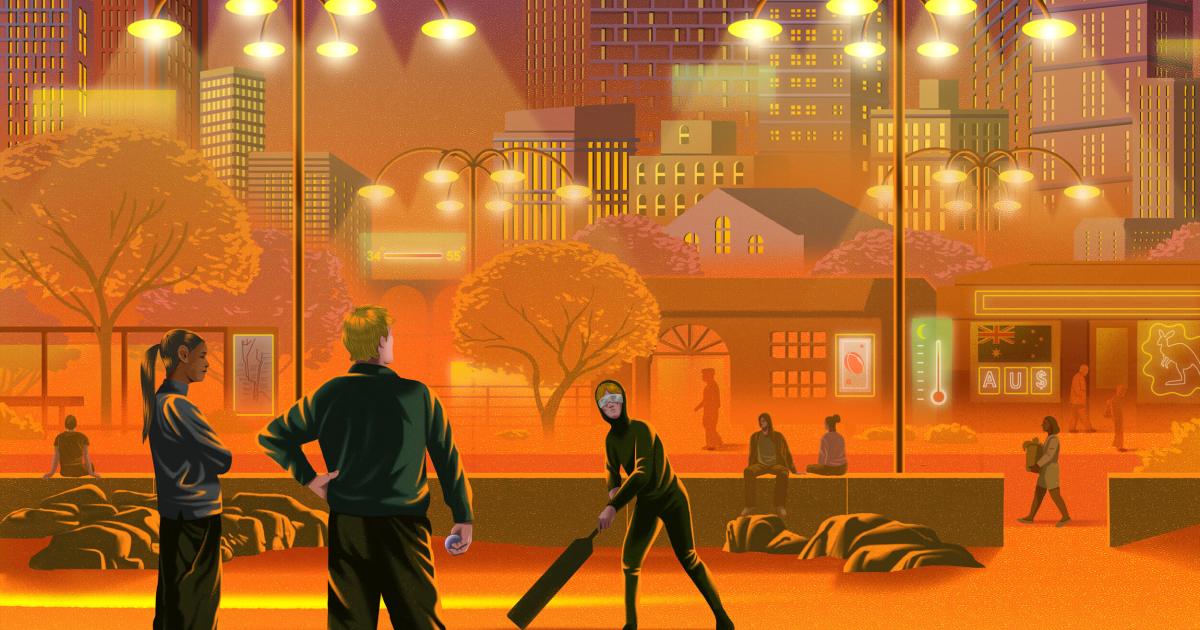
In the ozone-depleted future we avoided, Australia has abandoned the daytime and gone nocturnal. Artwork by Glenn Harvey
Australians have a complicated relationship with the Sun, suffering the world’s highest melanoma rates even with a functioning ozone layer. In the ozone-depleted future we avoided, that relationship has degenerated into a full-on restraining order.
Australia has abandoned the daytime and gone nocturnal. Schools and workplaces open at night, construction sites buzz in the small hours under massive floodlights, and outdoor recreation takes place in the twilights of dawn and dusk. The middle of the day is for mandatory Sun siestas. Going out at noon is dangerous — probably requiring immediate hospitalization. Fashion goes wide-brimmed and long-sleeved. Exposing your skin becomes a lifestyle choice in the same risk-seeking category as free solo rock climbing.
Is Australia’s laid-back carpe diem attitude replaced by an equally carefree carpe noctem in this future? Probably not. Deprived of the Sun, Australians acquire afflictions more commonly associated with northern Scandinavia, like vitamin D deficiencies and seasonal affective disorder, only all year-round. Still, those are better than the alternative: skin cancer.
Terraforming South America
In cities of the Mediterranean, urban spaces are covered by UV-filtering canopies. Artwork by Glenn Harvey
In our counterfactual future, Argentina, Chile, and Uruguay in South America’s southern cone, so close to Antarctica, have to adapt to some of the harshest effects of the widening hole in the ozone.
Agriculture in Patagonia, the southern tip of the region, dies off — the local sheep get eye cancer at a rate that makes extensive farming impossible. Southern right whales no longer come to breed near the Valdés Peninsula. If the Sun’s harsh UV rays didn’t kill the whales directly, they would have at least fried the krill and plankton the majestic creatures used to eat, forcing them to look elsewhere for food.
Assuming the area is not abandoned entirely, adaptation would resemble a terraforming project on Mars: polycarbonate domes on an industrial scale. UV-B stunts photosynthesis and kills useful bacteria in the soil, so Chile’s famous wine industry and Argentina’s proud cattle-raising tradition continue indoors, under UV-filtering plastic. UV-sensitive staples like potatoes and grapes give way to hardier crops like quinoa and other Andean grains. As the ocean’s surface is effectively sterile, fisheries pivot to deep-sea species or to land-based aquaculture in shaded tanks.
Reinventing the Mediterranean city
South American fisheries pivot to land-based aquaculture, as the ocean’s surface is effectively sterile. Artwork by Glenn Harvey
The ancient cities of the Mediterranean are forced to reinvent themselves to survive the new reality. For millennia, life in the region was lived out in the open, in the agora, the forum, the café terrace. No more. Going outside now means scurrying along giant arcades, shaded from the Sun by massive canopies that filter 99% of its UV light.
Exploring cities like Rome, Madrid, and Athens now means walking through shaded canyons and subterranean malls that feel like airport terminals. This redesign of the urban environment has a profound effect on the way life is lived in these ancient centers of culture. Architects call it “enclosed urbanism.” Barcelona’s ramblas are wrapped in crystal tunnels. Italian piazzas are covered by retractable, UV-filtering canopies, deployed each morning like futuristic umbrellas against an invisible downpour. The siesta, once a charming afternoon refuge from the Sun’s heat, has expanded into an enforced house arrest.
Tourism has evaporated, as has the traditional assumption that, in this sun-kissed region, people can happily spend most of the year outside the walled and roofed confines of their home. That version of life has been replaced by a shared urban space that feels vaguely like a cross between a souk, a spaceship, and a museum: life preserved behind glass.
The next global challenge
There’s a perverse satisfaction in catastrophizing, in imagining how we would have responded to such a dramatic environmental decline. Fortunately, thanks to the Montreal Protocol, most of us don’t have to think about the ozone hole anymore — but that doesn’t mean we should stop thinking about the treaty.
The Montreal Protocol’s flexible setup means it can be amended to changing circumstances. Remember those CFCs? We replaced them with hydrofluorocarbons (HFCs). Those don’t harm the ozone layer, but they are extremely powerful greenhouse gases — some trap thousands of times more heat than CO2. (As you may have noticed, humanity has a knack for solving problems by creating even bigger ones.)
In the wake of this discovery about HFCs, the Protocol did what it was supposed to do: It spurred its signatories into action. In 2016, 197 countries adopted the Kigali Amendment, resolving to phase down HFCs in the same way they did CFCs. Thanks to that agreement, we will avoid emitting more than 80 billion metric tons of CO2 equivalent by 2050. That alone will prevent another 0.5°C of warming by the end of the century. This demonstrates that the Montreal Protocol isn’t just a relic of 1980s environmental activism. It’s a living, evolving framework that continues to protect both the ozone layer and the climate.
Fossil fuels are far more embedded in the global economy than CFCs ever were, and the requisite economic transformation is vastly larger. But if the science is clear, and both the public and the powers that be are on board, the international community can override short-term profit for long-term survival. And if the treaties we produce are dynamic and equitable, they can be effective.
So, the next time you step out into the Sun, think about the timeline we narrowly avoided, about the hazmat suit you don’t have to wear. Thanks to the Montreal Protocol, we know that, if we can break it, we can also repair it. We plugged a hole in the sky. Now let’s fix that next big thing.
Strange Maps #1287
Got a strange map? Let me know at [email protected].
Follow Strange Maps on X and Facebook.
This article is part of Big Think’s monthly issue The Roots of Resilience.