
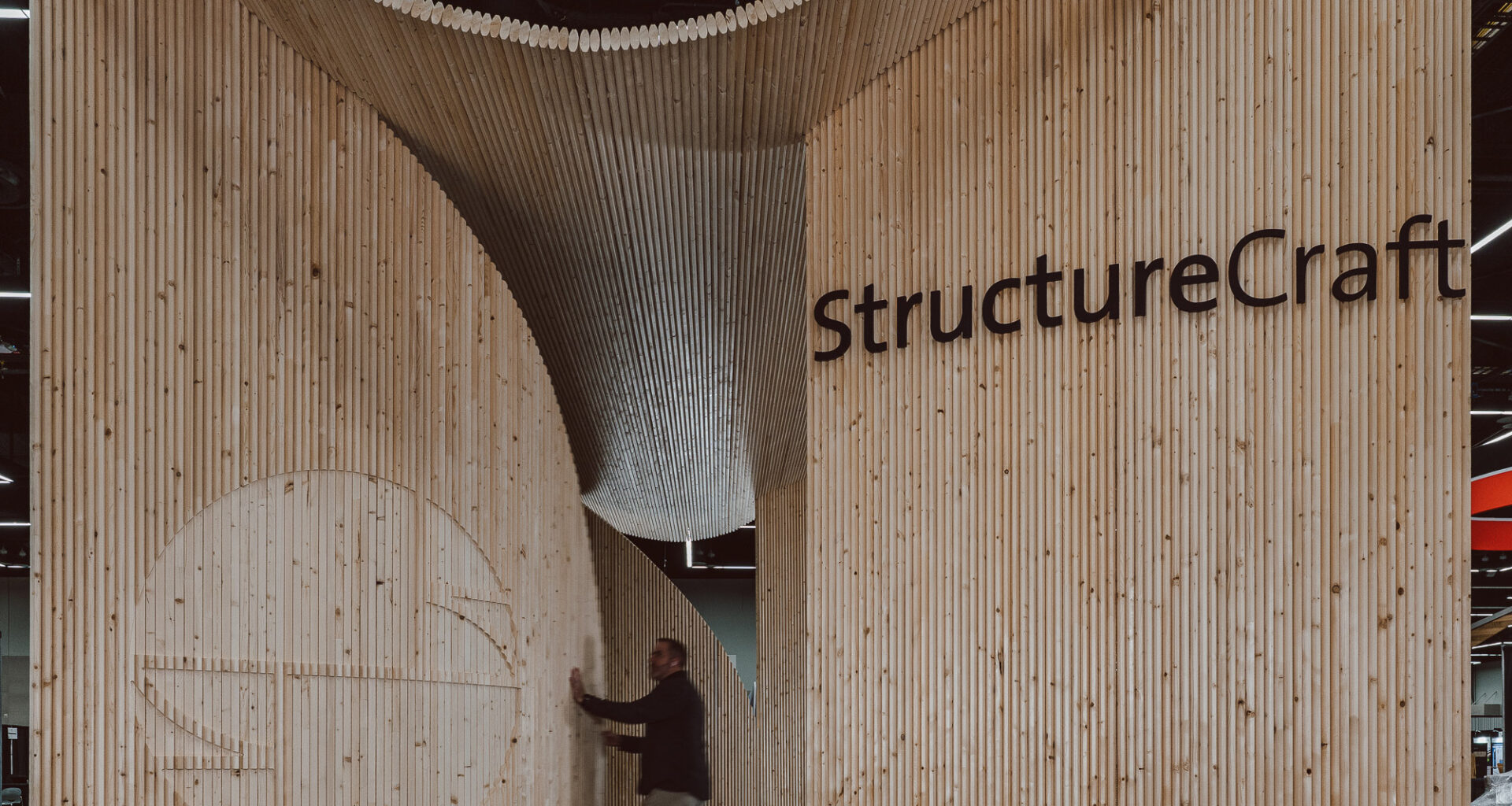
US architecture studio Lake Flato and engineering firm Structurecraft have experimented with dowel-laminated timber for a pavilion at the Mass Timber Conference in Oregon.
Lake Flato and Structurecraft collaborated on the pavilion, which utilises dowel-laminated timber (DLT). Originally engineered in Germany in the 1970s and 1980s, DLT has become more popular in the US market in the last decade.
“The installation introduces a bending-active shell system formed from dowel-laminated timber (DLT), which challenges the rectilinear logic that has defined mass timber construction for decades,” said Lake Flato.
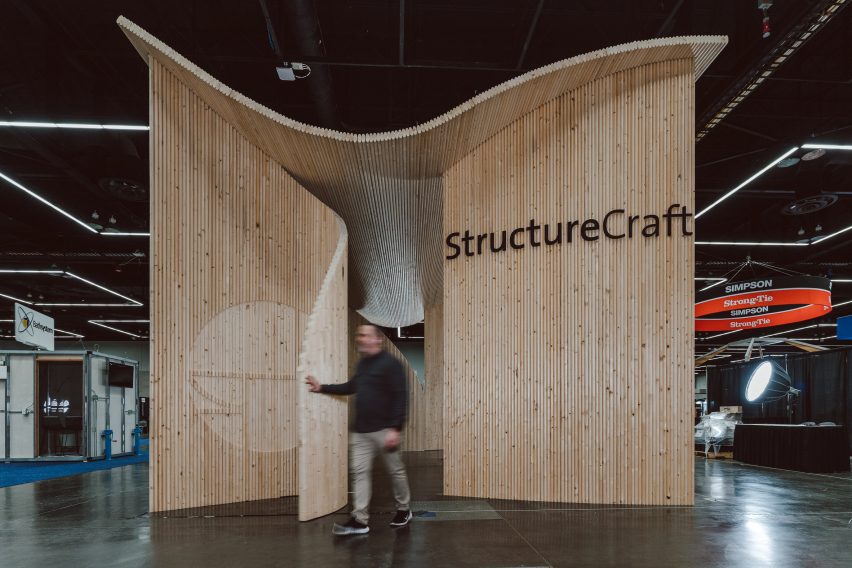 Lake Flato and Structurecraft collaborated on a mass-timber pavilion in Oregon
As with the more popular mass-timber products, glued-laminated timber and cross-laminated timber, DLT uses softwood held together by a hardwood dowel, creating panels that can bend flatwise. It is an alternative to rigid mass-timber slabs.
“It doesn’t use nails, it doesn’t use glue,” Lake Flato associate partner Ryan Yaden told Dezeen.
“It only uses friction between wood. And that’s what was really enticing for us, why we really gravitated to it. We’re trying to reduce the impact on the environment.”
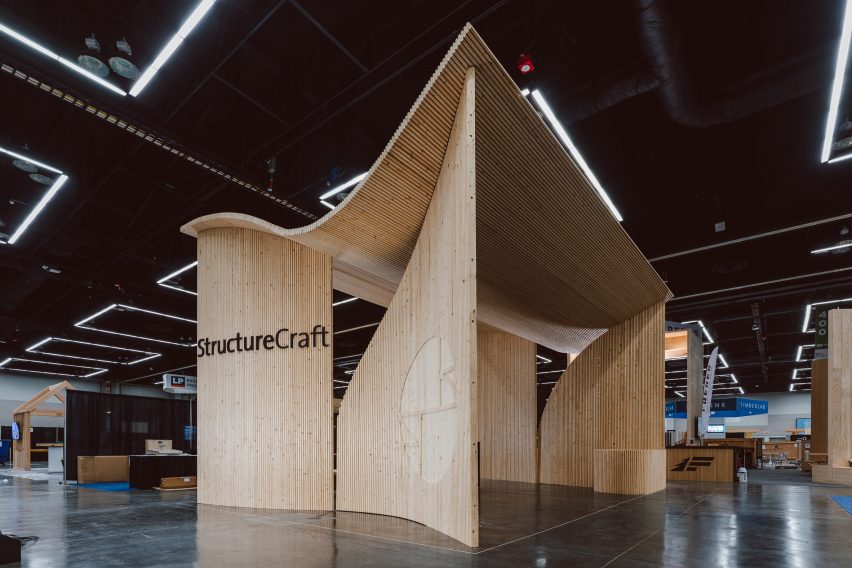 It features innovations in dowel-laminated timber
The effect is an incredibly flexible panel that can be used for flooring and for ceilings, and, as the technology progresses, can potentially be used for more structural applications.
“It’s almost like fabric, but once it’s put together in certain ways, it becomes extremely rigid,” said Yaden. “It just drapes into place and then locks together.”
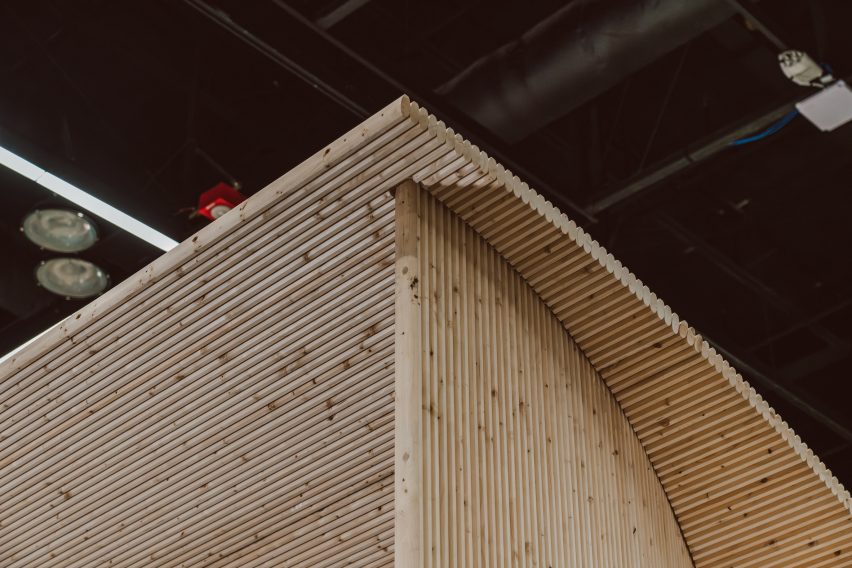 The panels are flexible before being fitted together, where they become rigid
Lake Flato worked with a proprietary dowel model from Structurecraft to create the 20-by-30-foot (six-by-nine-metre) pavilion. It featured standard two-by-four slats and was shipped flat before being assembled.
Once shaped into the wavy forms, the walls were fitted into pre-routed tracks on the ceiling element, which has straps and plywood on top to create extra rigidity.
“Mass timber is no longer flat,” Structurecraft VP and head of engineering Lucas Epp told Dezeen.
“Our structural concept takes flat-packed mass timber panels and drapes them into curves on site to create shell action, greatly increasing structural efficiency,” he continued. “This is the first time a bending-active system has been created with timber enabling shells.”
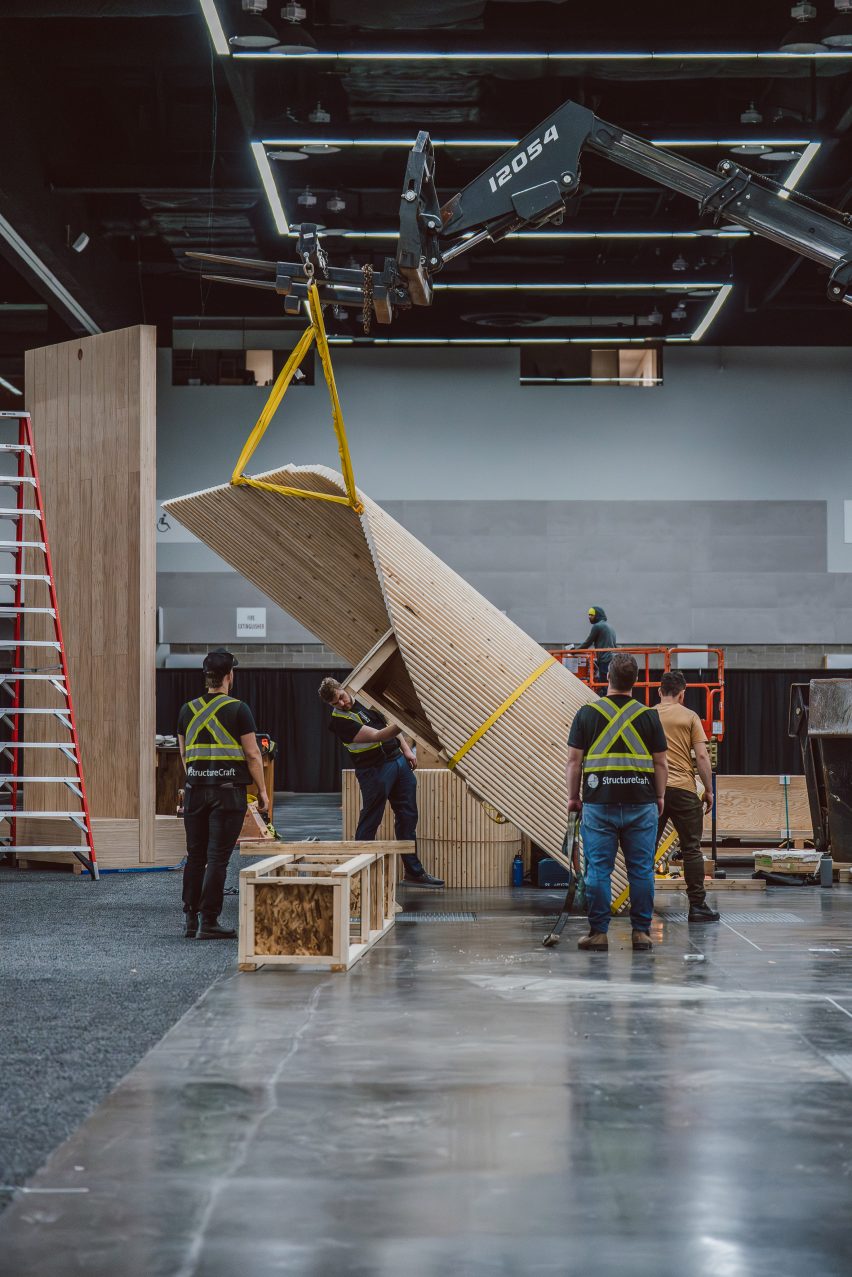 The panel elements were flat-packed and shipped
On one side, the flexibility of the material is demonstrated by a door that swings out.
Yaden said that the structure presents both biophilic elements and a demonstration of physics meant to draw in people, and that the studio wanted to show the technology could be scalable.
“I think there’s something very seductive about the way these forms come together, in the physics of structure, that people naturally gravitate towards,” said Yaden. “It’s a balance of practicality and surprise that makes people want to engage more meaningfully.”
The top 10 mass-timber buildings of 2025
Lake Flato and Structurecraft have used DLT in the past for a hotel building in Austin.
Photographs show a smiling Kengo Kuma, a well-known Japanese architect, interacting with the pavilion on the showroom floor at the conference.
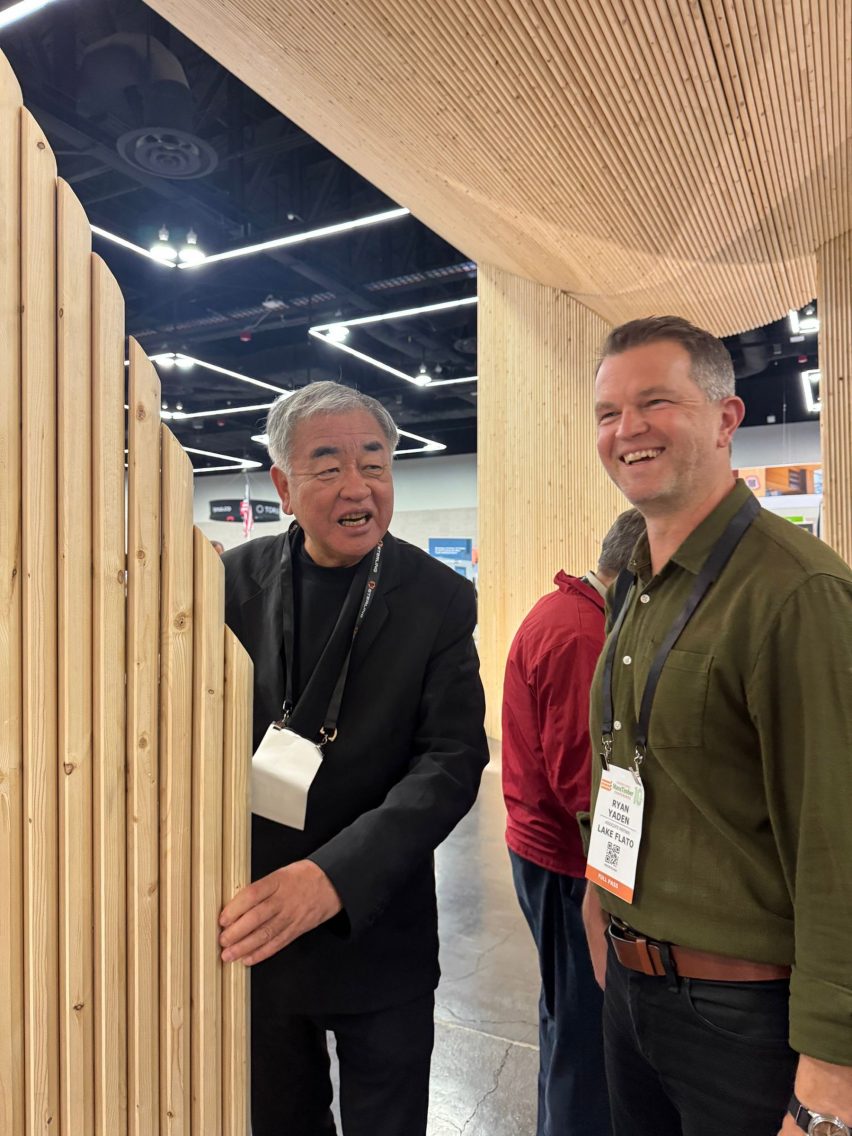 An enthusiastic Kengo Kuma was spotted interacting with the bendable door. Photo by Balazs Bognar
Mass timber continues to be innovated on as building codes around the country change to accommodate it.
Recently, Studio Gang completed a mass-timber educational building at Harvard, while Grafton Architects completed one with an angular roof in Arkansas.
The Mass Timber Conference took place from 31 March to 1 April in Portland, Oregon. For more international events in architecture and design visit Dezeen Events Guide.