
Photo: Warrick Page/HBO Max
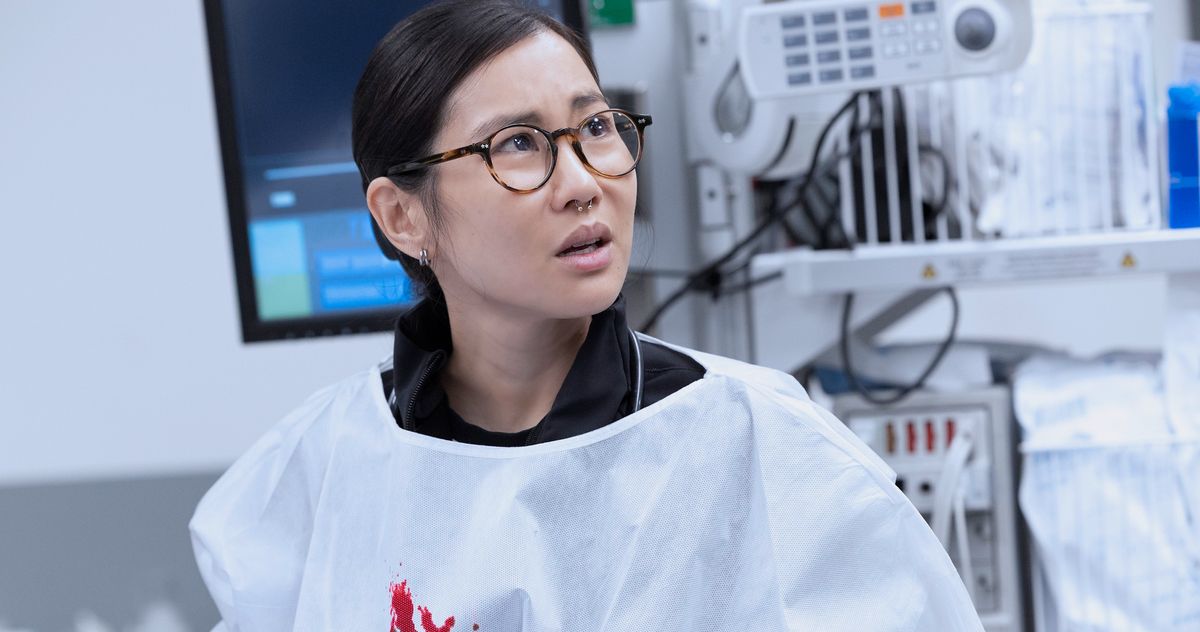
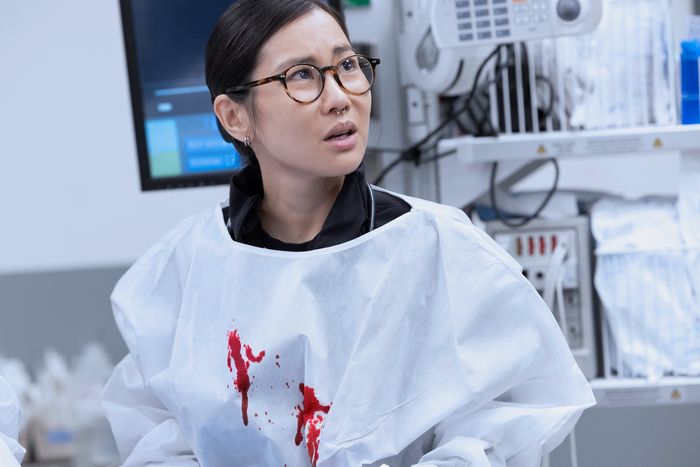
Twelve hours into the second season of The Pitt, the day shift has finally ended. Of course, that doesn’t mean work is over for most of the doctors and nurses in the emergency room. As Dr. Langdon (Patrick Ball) points out to third-year medical student Joy Kwon (Irene Choi), it’s common practice to put in extra time. But Joy isn’t swayed by his appeal. She responds with data: 62 percent of ER docs report suffering from burnout, and she has no desire to contribute to that statistic.
It’s not the first time this season that newcomer Joy has set boundaries for herself rather than succumb to the teacher’s-pet temptations of fellow student James Ogilvie (Lucas Iverson). On a team full of go-getters eager to get their hands as dirty as possible, Joy stands out for her unbothered, verging on bored attitude. In Choi’s words, “She wears her IDGAF card like a name tag.” It’s possible Joy’s passivity comes from a genuine lack of passion for the ER; this is her first rotation, and she admits that losing her grandmother to leukemia made her realize she “doesn’t want to be around people dying.” But Choi also looked to Joy’s background as a daughter of immigrants — an experience she shares — to understand her intensely internal character. “Burnout happens a lot with daughters of immigrant families,” Choi says. “Mohan and Joy both have these obligations to their families whom they’ve had to help navigate the system here. A lot of the well-being of the parents is put upon the daughter in medical school, and there’s pressure that comes with that.”
How were you introduced to the world of The Pitt?
I got the audition through my reps at a time when I was like, I’m really on my way out with how this industry has been going. Everyone has taken a step down. People who were in movies are now in TV, and everyone who was in the series-regular boat moved down to the recurring-guest boat. For a lot of actors, it’s an uphill battle. But especially for a child of immigrants with absolutely no ties to this industry or access points, getting to the next step over the past several years was so difficult. It came at a precarious time for me in terms of uncertainty about my future in the industry.
The character felt like me. With really big auditions, I’ll get coaching or rehearse it with people, but I did not have the time. I hate to sound so nihilistic, but at that stage of your life where you feel like nothing really matters, you take the pressure off yourself. It’s like, I’m just going to give it a go and try to make the character real and authentic. If it doesn’t work, it doesn’t work. I went in for an in-person callback, which used to be the standard, pre-COVID. It’s like you go on a date with someone and you’re like, No, it’s just too good to be true.
What parts of yourself did you see in Joy?
It was clear she was a daughter of immigrants, which was confirmed once I was on the show. One of the breakdowns was “She doesn’t have that much to say. She’s got a strong sense of boundaries.” That’s what struck me as the biggest thing. Actors are so eager to find moments to act and react. That’s how we’re trained. Her realness came from nonreactiveness. She doesn’t say much. One of the tricky tasks I got was to not overtly show too much of what she is thinking or feeling.
Somewhere in the current lexicon of psychobabble, we’ve become conditioned to see boundaries as represented by characters who really stick up for themselves and tell people, “You’re crossing my boundaries.” I’m not as good at speaking up for myself, but I will build boundaries in the form of walls. When I was told, “Joy has a strong sense of boundaries, yet she doesn’t talk that much,” I was like, Okay, so she’s not asserting her boundaries through words. She’s showing them through a set of masks she built for herself. We got a note from Noah as the season went on: “There’s going to be a moment where people’s masks start to slip and you see the doctors’ individual traumas.”
Does Joy’s mask slip?
For Joy, we finally see it with the toddler with heatstroke. We haven’t seen her jump to conclusions that much until this point. She pulls a Santos, so to speak. But how many masks is she wearing? Underneath this mask, is there just another wall?
How do you read her suspicious reaction to the kid’s mom?
The first time I read it out loud at the table read, I felt myself get really hot and teary-eyed. I didn’t play it that way when we actually came down to it because that would be too much of a departure from who she has been so far. Even though Santos’s and Joy’s actions come off the same way, I wanted to make sure the root of their reactions isn’t the same. For Santos, neglect has a lot to do with her trauma. I think she dealt with not having a family system, but there are people who have family systems that can be disciplinarian or too toxic, and that was the backstory I had for Joy. These are personal choices I made that weren’t discussed with the writers.
The fact that she was so accusatory made me think, Okay, there’s a reason I hate this mother right now. For some reason, she triggers something in me. The conclusion she hastily jumps to is that it was a case of punishment gone too far. That’s my dark answer. Joy doesn’t come from a place of much privilege; we find out she grew up in a situation where her family didn’t have access to medical care or insurance. I put together that she probably grew up in a situation where punishment discipline was the way. I wanted to show that Joy is more angry at the mom than sad for the kid. There were enough people in the room who were sad about the kid.
In your final scene, Joy sticks to her guns and leaves the ER. It’s striking to see someone who actually wants to clock out at the end of their shift.
That was in the character breakdown: She’s counting the hours until 7 p.m. Again, that’s where her boundaries are made really clear. If she’s clocking out at seven, she’s going to try her hardest to not let anything get in her way. God, I hate to make everything about race, but again, this is where I felt so much realism. I don’t think I’ve seen a person who looks like me in a situation like, “I’m the first one out of here.” In some ways, she’s kind of like Stanley from The Office. It’s so not stereotypical. I’ve heard this from people, specifically from Asian women, like, “Oh my God, I’m so glad this character is out there because she’s not the type of character often written for us.”
Do you see Joy’s determination to leave on time as a mark of maturity or the opposite?
Your strengths are also your weaknesses. Mohan has that conversation with Robby about leaving everything at the door, and Joy is good at that but maybe she isn’t leaving enough room for when she’s needed at work. She’s just like, “I’ve got my own stuff to deal with.”
It’s a really effective way of showing that strength and weakness of asserting your boundaries and preserving your energy. Maybe we all have to learn from Joy to take a moment to disconnect and say, “No, I can’t do this anymore because if I do this, you’re not going to get a good me tomorrow.”
Everyone is getting put through the wringer mentally this season, and Ogilvie’s perspective on working in the ER seems to be shifting. Does Joy take away anything throughout this shift, or is she defined by how unchanging she is?
This is the start of something internal. Joy has clearly researched burnout for a reason: She’s someone who thinks she’s done enough healing. She’s a Lexapro girlie, and she has built up this arsenal of self-coping mechanisms. In time, she will outgrow them because that’s what all people do. But in this moment, she has found the things that work for her: I take my meds, I try not to let anything faze me, I conserve my energy, I don’t give any more than I need to. She doesn’t have the energy to compete.
The evolution we start to see is when she comes out and says, “Okay, I can actually help you solve this situation with the outage.” She’s hesitant to bring up her photographic memory because she probably knows from the past that if she’s useful, she’ll have to put in the extra effort. She was probably bringing her classroom mentality into this first rotation, like, I’m just here to learn and leave. But there are moments when she starts to see that shrinking back doesn’t help you or the situation. You offer something just by being part of the effort. Maybe she can grow in a way where she can give more energy.
Do you want to see Joy come back to the ER?
I hope this is the start of her journey. We have to get to why she is the way she is. Why does she come off so passive? Why is she so eager to get out of here? I would like for her to find something worth coming back to the ER for.
I do think she occupies a very unique role on the show compared with the other doctors trying to put in as much time as possible.
That’s the note John Wells, the executive producer, gave me and Lucas our first week there. He was saying, “In med school, you’ll always see these students who feel like there’s not enough food in the puppy bowl.” That’s the biggest stereotype, but not all of them are going to be like that. That’s the story line I made for myself: She’s there because she kind of had to be there, because of what happened with her family, and because she’s smart enough to do it.
That was the same for my family — that’s where she and I related hard. It’s like, If you’re smart enough to be a doctor, you should be a doctor. I see this a lot among my Asian cohorts that I went to school with. A lot of them did go to medical school because it was like, Why not, if you have the potential to be there? But they end up not enjoying it as much. That’s where Joy is right now. Maybe she has felt she was forced to be there. Ogilvie says very clearly he’s there because he has always wanted to be there; it’s a childhood dream of his. Joy doesn’t say outwardly if she ever wanted to be a doctor, but she says she wanted to go into pathology. Trust me, no Asian parents want their kids to go to med school to go into pathology. So maybe it was a compromise. But it would be nice to see her realize, Maybe I do have a spot here. I’m worth something here.
Sign up for the Vulture Daily
An entertainment newsletter for the pop-culture obsessed.
Vox Media, LLC Terms and Privacy Notice