
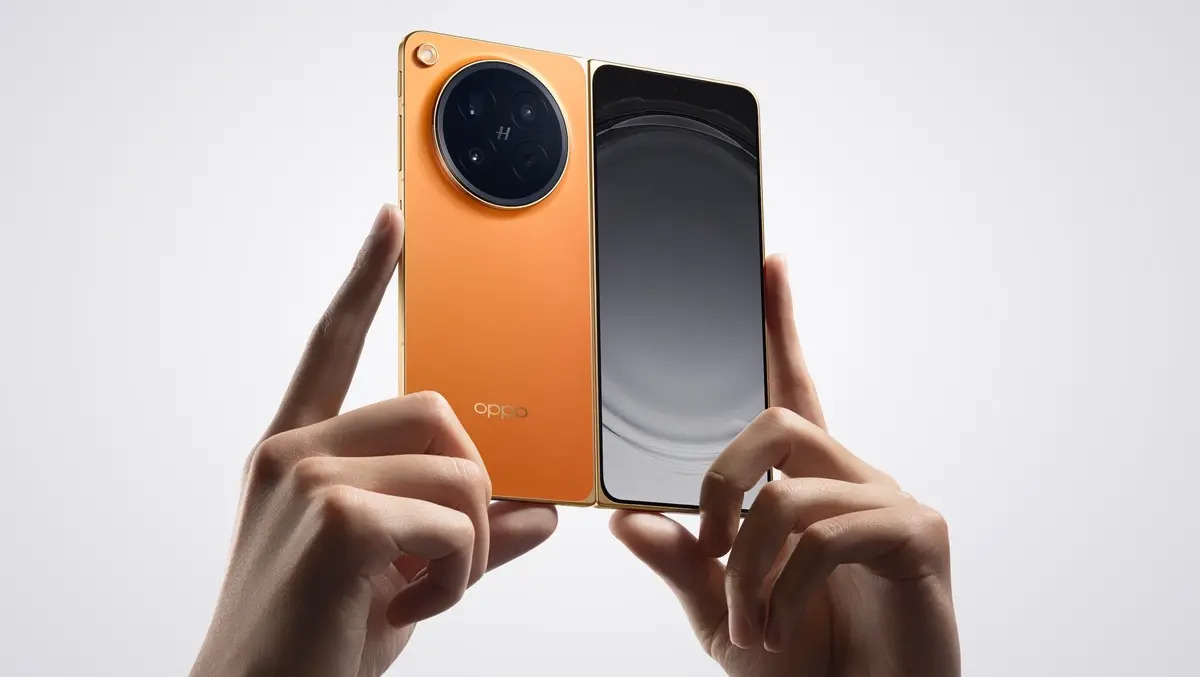
The OPPO Find N6 aims to make a foldable feel like a daily phone. The first impression is its size. At just under 9mm when folded and about 225g, it avoids the bulk typical of book-style designs.
Weight is well balanced. Flat edges and rounded corners make it comfortable to hold for extended use. It remains a large device, but the ergonomics are well judged.
The circular camera module sits centrally on the rear. This helps the phone lie flat and reduces wobble when tapping on a desk. Finishes are distinctive. The metallic option is understated, while the orange variant is more expressive.
A customisable side button, known as the Snap Key, provides quick access to common functions. Its usefulness depends on how often those shortcuts are used.
Display quality
The Find N6 features two OLED displays. The outer screen measures 6.62 inches, while the inner display expands to 8.12 inches. Both support adaptive refresh rates up to 120Hz.
The cover screen behaves like a standard smartphone display. It is wide enough for comfortable typing and everyday use. Brightness is strong, making it usable outdoors.
Opening the device reveals the larger inner panel. It provides more space for reading, browsing and running apps side by side. This is where the foldable design proves its value.
The crease is still present but less noticeable than before. It is hard to see head-on and appears mainly under angled light. It is also less pronounced to the touch during normal use.
Some apps are not fully optimised for the inner display. This can lead to letterboxing or stretched layouts. This remains a broader limitation of foldable software.
Hinge build
The hinge is central to the Find N6’s refinement. It is designed to create a flatter surface when unfolded and reduce the appearance of the crease.
Opening and closing feels smooth and controlled. The hinge holds its position at different angles, which is useful for hands-free viewing.
Durability is a clear focus. The device carries IP56, IP58 and IP59 ratings for water and dust resistance. This is notable for a foldable.
Testing suggests improved longevity. The device is designed to remain flat after hundreds of thousands of folds, with additional testing up to one million cycles . These figures indicate stronger long-term durability.
Performance power
The Find N6 uses a flagship processor with 16GB of RAM. Performance is consistent across everyday tasks. Apps open quickly, and navigation remains responsive.
Multitasking is a strength. The phone handles several apps at once without noticeable slowdown. Switching between windows feels smooth, even on the larger inner display.
Thermal performance is stable. The device remains comfortable during extended use, including gaming.
Battery capacity is 6,000mAh. This is large for a foldable and supports a full day of mixed use. Heavy use of the inner display will reduce endurance, but overall performance is reliable.
Charging is fast. Wired charging reaches up to 80W, while wireless charging supports up to 50W with compatible accessories. Standard chargers deliver lower speeds.
Camera system
The camera system includes a 200MP main sensor, supported by 50MP ultra-wide and telephoto lenses, plus a dedicated colour sensor.
Daylight images show good detail and balanced colour. The ultra-wide camera captures a broad field of view without excessive distortion.
The telephoto lens adds flexibility. It performs well at moderate zoom levels and supports close-up shots. Higher zoom levels depend more on lighting conditions.
Low-light performance is solid. Images retain detail, though highlights can sometimes appear overexposed. Processing is consistent, with minimal noise.
Video is a strength. The device supports high-resolution recording with HDR and high frame rates, making it suitable for casual content creation.
Software tools
The software focuses on multitasking. ColourOS introduces Free-Flow Window, which allows multiple apps to run in floating, resizable windows.
Up to four apps can remain active at once. This creates a flexible workspace, particularly on the inner display. It works well for tasks such as referencing documents while taking notes.
Gestures are intuitive. Switching between apps and resizing windows feels natural. Drag-and-drop support allows content to move easily between apps.
Cross-device features are also included. File sharing between devices is straightforward, though some functions depend on compatible apps and settings.
AI Pen use
The optional AI Pen adds a productivity layer. It supports 4,096 pressure levels and works across both displays.
Writing feels precise, with minimal latency. The pen integrates with system features, allowing quick notes, annotations and screen capture.
It can also act as a remote shutter in the camera app. This is useful for group shots or tripod use.
Charging is handled through a case that stores the pen and uses reverse wireless charging from the phone. A short charge provides enough power for everyday use.
The pen is not essential for all users. It is most valuable for those who regularly take notes or annotate documents.
Buying verdict
The Find N6 represents a clear step forward for foldable smartphones. It combines a slimmer design, strong battery life and a refined display into a device suited to everyday use.
In New Zealand, it is available now for NZD $3,299. The price reflects its premium positioning and feature set.
Closed, it functions like a standard smartphone. Open, it offers a larger workspace for productivity and entertainment.
The optional AI Pen adds flexibility, particularly for work-focused tasks.
The Find N6 delivers a balanced mix of design, performance and usability. It finally shows that the foldable format is ready for real world use.