
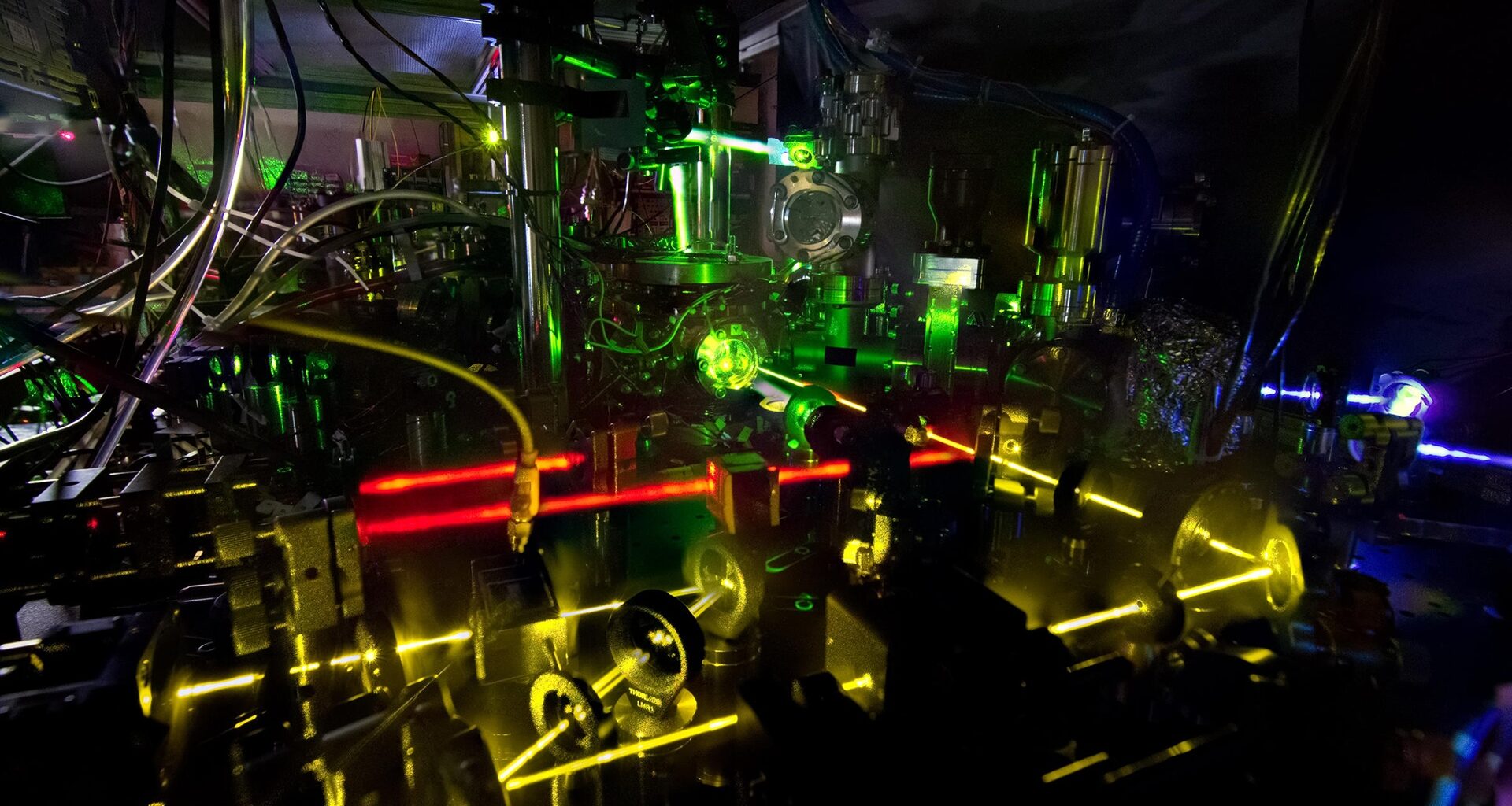
Physicists have developed a highly precise and ultra-sensitive atomic clock based on ytterbium, which could test the limits of the Standard Model and even search for elusive dark matter.
Led by Taiki Ishiyama, PhD, a physicist at Kyoto University’s Graduate School of Science in Japan, the project harnessed a rare orbital transition in atoms, which was long considered promising but too difficult to measure with high precision.
The team believes their approach could enable some of the most rigorous tests yet of predictions made by the Standard Mode, which explains three of the four fundamental forces that govern the universe: electromagnetism, the strong force and the weak force.
“These results open up the way for various new physics search experiments and a wide range of applications to quantum science with this clock transition,” the researchers pointed out.
A rare atomic transition
Atomic clocks keep time by measuring how electrons jump between two specific energy levels inside atoms, most commonly caesium-133, which acts as a highly stable, natural pendulum.
These transitions occur at extremely stable frequencies, making atomic clocks the most accurate timekeepers ever built. The most precise atomic clocks trap atoms in an optical lattice, a pattern of light and dark formed by intersecting lasers.
They operate at optical frequencies with hundreds of trillions of oscillations per second. Some, like the strontium optical lattice clock, are so precise they would drift by less than a second over roughly 30 billion years.
But researchers have long suspected they could achieve even greater sensitivity using a rare type of orbital transition in ytterbium atoms. It occurs between configurations involving an inner-shell electron deep within the atom.
Yet, according to the team, it can still be measured and controlled with the same precision as conventional clock transitions. It also exhibits high sensitivity, which allows it to pick up subtle physical phenomena, like hints of dark matter or other unknown particles.
Although in theory, the transition is ideal for probing flaws in the Standard Model, achieving the needed precision remains difficult in practice. “While our team first observed this transition in 2023 and other groups followed, the measurement resolutions were much worse than those of modern optical clocks,” Ishiyama said.
Chasing dark matter
The team’s early experiments suffered from poor measurement precision, largely due to interference from the very lasers used to trap the atoms. To address the challenge they turned to a technique called ‘magic wavelength,’ which trapped ytterbium atoms in a three-dimensional optical lattice.
This way, they were able to eliminate unwanted shifts in the atoms’ energy levels caused by the trapping light. “By combining this with a highly stabilized excitation laser, we achieved a narrow spectral linewidth of 80 Hz, about a two-orders-of-magnitude improvement over previous results,” Ishiyama continued.
The team brought the system closer to the precision of state-of-the-art optical clocks. This level of control allowed them to conduct a series of high-precision measurements, including observing coherent oscillations between atomic states and detecting an interorbital Feshbach resonance.
What’s more, the team conducted isotope shift measurements and tracked how the transition frequency changes between different forms of ytterbium atoms. These shifts were measured with an accuracy of one part in a billion.
“This is a powerful tool to search for a new boson mediating interactions between electrons and neutrons beyond the Standard Model,” Ishiyama pointed out. The study set strict limits on these possible effects under certain assumptions and improved models of atomic and nuclear behavior.
It also showed that inner-shell transitions can now be controlled very precisely. “Furthermore, our work paves the way for an optical lattice clock combining high measurement accuracy and high sensitivities to new physical phenomena,” Ishiyama concluded.
The study has been published in the journal Nature Photonics.