
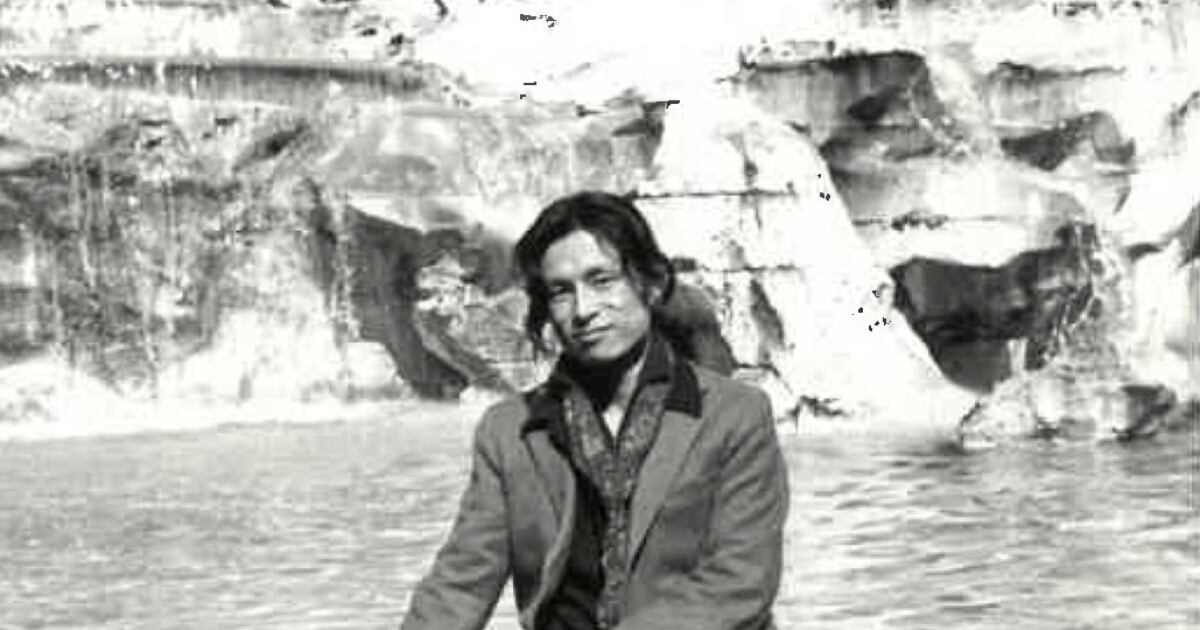
Jacqueline Benard and her husband, Kenji Umeda, moved to Phoenix in the mid-1970s.
They’d met a few years earlier, studying sculpture in Carrara, Italy. The Valley became home to their family and creative lives until Umeda’s death in 2019.
Benard always knew there had been a chapter of Umeda’s life before they met — in particular, his time at Kettle’s Yard, in Cambridge. Umeda arrived in England from Japan still searching for his creative identity, and he befriended a couple named Jim and Helen Ede.
They owned a cluster of cottages where they hosted artists, and Umeda lived there for a time, sketching, reading and having long talks with Jim. Eventually, he made his way to Italy to learn how to carve stone, and met Benard.
These days, Kettle’s Yard is still active as a contemporary art museum. And back in 2024, a curator there made a startling discovery: a suitcase packed with Umeda’s belongings.
The items are currently on display at Kettle’s Yard — but before the curator put the exhibition together, she sent Benard a letter, telling her what she’d found.
Full conversation
JACQUELINE BENARD: It had his personal belongings, his clothes, some books, some sketch pads with drawings, some personal items like a pipe and a little pot and a travel watch, things like that. And she wanted to know what I wanted to do with them since they had found them.
SAM DINGMAN: And what went through your mind in that moment?
BENARD: I thought it was remarkable to receive a letter with that description, but I had remembered that Kenji had told me that he had left a trunk there, and that one day he hoped to go back. But, you know, time passed, life happened, and he never went back, and that was that, you know?
DINGMAN: OK, so there’s kind of an interesting implication in that in my mind, which is that he was aware that he had left this trunk and that it had some things in it.
BENARD: Yes.
DINGMAN: But it seems like in his mind, it was not so urgent to retrieve these items that it necessitated like a special trip?
BENARD: Yes, it wasn’t urgent. His urgency was to become a sculptor.
DINGMAN: So that was really what was at the forefront of his mind?
BENARD: Yes, it was, yeah.
Harry Sowden
/
Kettle’s Yard
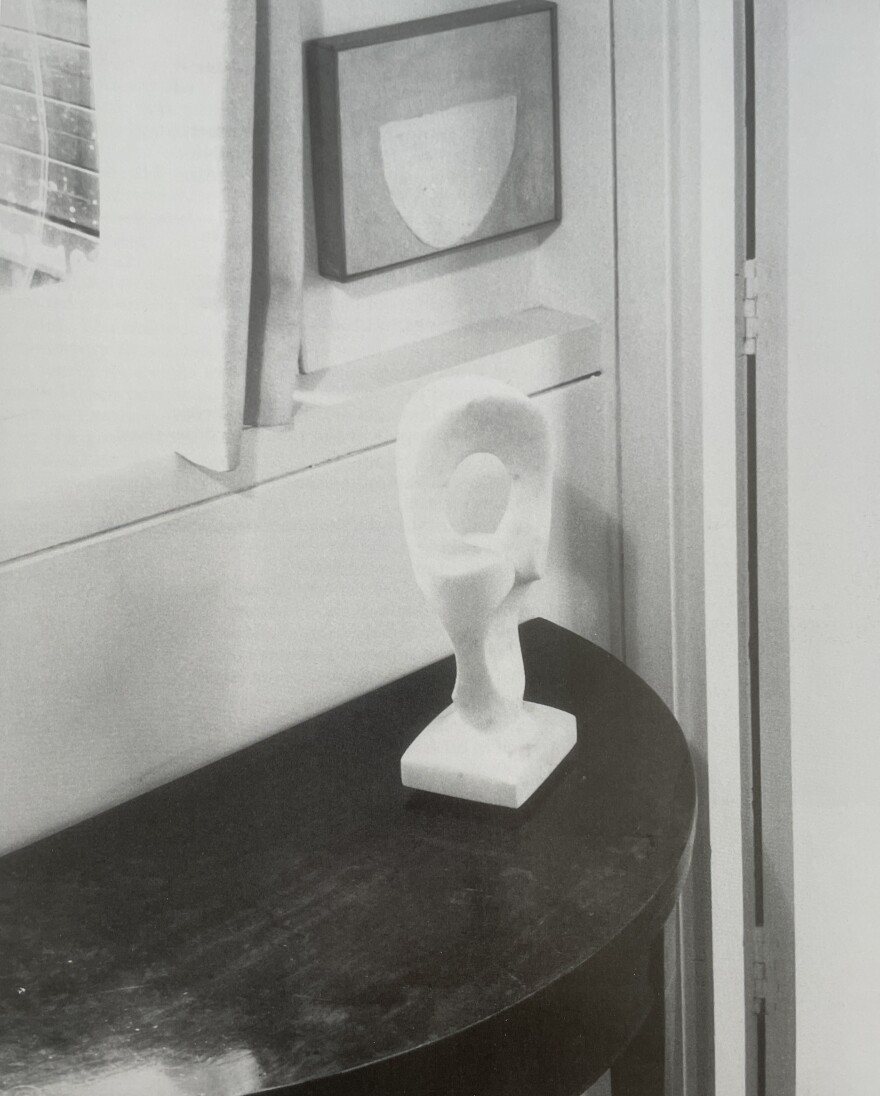
A sculpture by Kenji Umeda.
DINGMAN: What did it bring up for you when you saw them? Because I mean, the personal correspondence, the sketches, these are also such rich artifacts of a person. Did you see the man you knew in the correspondence, say, or in the sketches?
BENARD: Yes, I did see. I did see him. I saw his early types of work that he’d done, and I recognized some of the forms, but then some of them were like small drawings that he imagined would be a sculpture or something. It was a drawing.
They were early works of Kenji’s, things that I had not seen, because I met him in 1974, and he had gone England in 1971. But in those letters, he mentions that he had met an American friend and that was me.
Little did he know and little did I know that we would, you know, eventually go west and come to Arizona and be a couple. And actually, we got married just before coming here.
DINGMAN: ]Well, one of the things that brought you guys to the Valley, originally. You sold a piece, if I’m not mistaken.
BENARD: Yeah, did you read something about that?
DINGMAN: Yes, I did. I did. Tell me that story.
BENARD: So, some of my relatives moved to Arizona, you know, Scottsdale, in 1976. I came to visit and I saw the galleries here. So I brought a sculpture to show to a gallery. It was Elaine Horwitch Gallery, and this was like in May.
And they sold the sculpture during the summertime, which is sort of like the low season for art. So we decided, well, if they could sell in the summertime, maybe this is a good opportunity to come to Arizona.
We took a big chance. We had worked very hard for several years and we had quite a few sculptures that was many crates of sculpture and we opened the crates in my aunt’s garage and we met Riva Yares and she came to see the sculptures and she fell in love with Kenji’s work right away.
So she says, I need to have your work in my gallery. And that was the beginning. We came all the way out to the west without realizing we’d be staying. I think I’ve been here about 45 years now.
DINGMAN: Wow. Wow.
BENARD: Yes.
DINGMAN: What impact did bringing your artistry here have on you both?
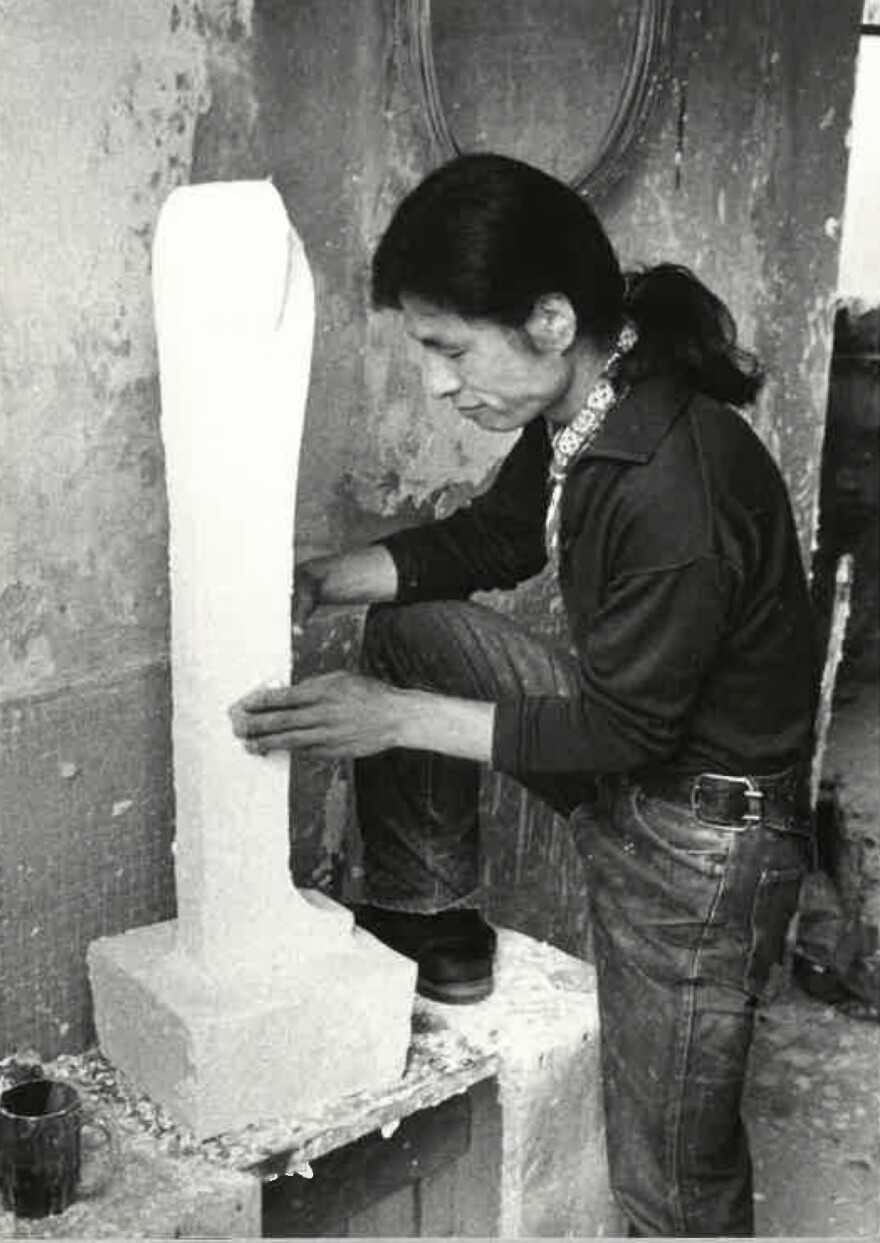
BENARD: It took time to acclimate to the desert. There’s great beauty, but it’s kind of a little sparse. I think that leaves you space to think. It was very important to him to have a certain visual aesthetic and a simplicity. He didn’t like it overly decorated or super bright colors. Of course, he liked color, but in a more controlled way, like a dot, you know, sort of like an accent rather than a yelling at you.
Jacqueline Benard
/
Handout
Kenji Umeda
DINGMAN: But that’s interesting. You referenced the idea of sparseness earlier. One of the other things that comes up in the commentary that I’ve seen about this trunk of belongings, this idea of kind of doing one thing and doing it well. There was this idea of he would buy a fine trench coat, and the idea was that he would always wear that trench coat. Did that resonate with you as well?
BENARD: Well, when we looked at the collection, I saw that they were like good clothes, like he had chosen very specific things to look very nice and proper. He was a very proper person, and he knew that he had to look nice so that people could respect him in that way.
But those clothes also, I didn’t see those clothes when he came to Italy, because we used work clothes, so those were his better clothes that he left behind, the white shoes. I don’t think I ever saw him wear white shoes. That was kind of interesting.
DINGMAN: It’s very striking to me, Jacqueline, that, you know, you’re talking about this trunk as almost like a time capsule of the moment in his life prior to when he stepped into his identity as a sculptor.
BENARD: Yes.
DINGMAN: Do you feel any sense of ownership over this trunk and the items that were in it? ‘Cause I have to imagine it is a strange experience to, you know, this was your husband.
BENARD: Yes.
DINGMAN: And these were his things, even if they were from a period of his life before he met you. And now they’re on display and are kind of representing him to a new audience of people. What is that like for you? That must be such a curious experience.
BENARD: Well, it’s very emotional because, you know — I’m sorry to cry.
DINGMAN: That’s OK.
BENARD: It is a part of him before I met him, you know? So that’s a very emotional thing to know a person that you knew for a long time, but you didn’t know them earlier on, you know? I discovered something more about him, which I knew, but I felt it more in seeing those things, you know? Yeah. I’m sorry.
DINGMAN: No, it’s OK. It’s OK. Thank you for sharing that. I appreciate it. I realize it’s very emotionally potent to relive these things.
BENARD: Yes, especially since he’s passed. And, you know, but anyway, I think he would be very pleased to see that his pieces were on display at Kettle’s Yard.
DINGMAN: What will become of the items once the exhibition concludes? Will they come back to you?
BENARD: No, a lot of the items I wanted Kettle’s Yard to keep for their archives, because they have a large repertory of artists there, and I think it would be best there.
DINGMAN: You mentioned he’s passed away. He said, was it 2019 that he passed away?
BENARD: Yes, that’s right.
DINGMAN: I’m very sorry for your loss.
BENARD: Thank you.
DINGMAN: Do you have any items in your home now that you keep around that, for you, kind of stand for him in the way that these items, for other people, are going to be the way that they maybe meet him for the first time?
BENARD: Well, at home I have a lot of his sculptures. I have a little bronze head that is mentioned in Jim Ede’s letter. that I didn’t realize there were two, and Jim Ede has one, and I have one of them. So that was an interesting, actually, discovery that I didn’t realize that there were two of those. We have a big yard, and there’s a lot of trees that he had planted. You know, so those things are part of my life.
DINGMAN: Well, I have been speaking with Jacqueline Benard, who is a ceramicist, a textile artist, and, as we’ve been talking about, a stone sculptor. And is also the wife of artist Kenji Umeda, whose personal effects were recently discovered at Kettle’s Yard.
Jacqueline, thank you for this conversation.
BENARD: Oh, thank you very much. This is wonderful to be here.
KJZZ’s The Show transcripts are created on deadline. This text is edited for length and clarity, and may not be in its final form. The authoritative record of KJZZ’s programming is the audio record.