
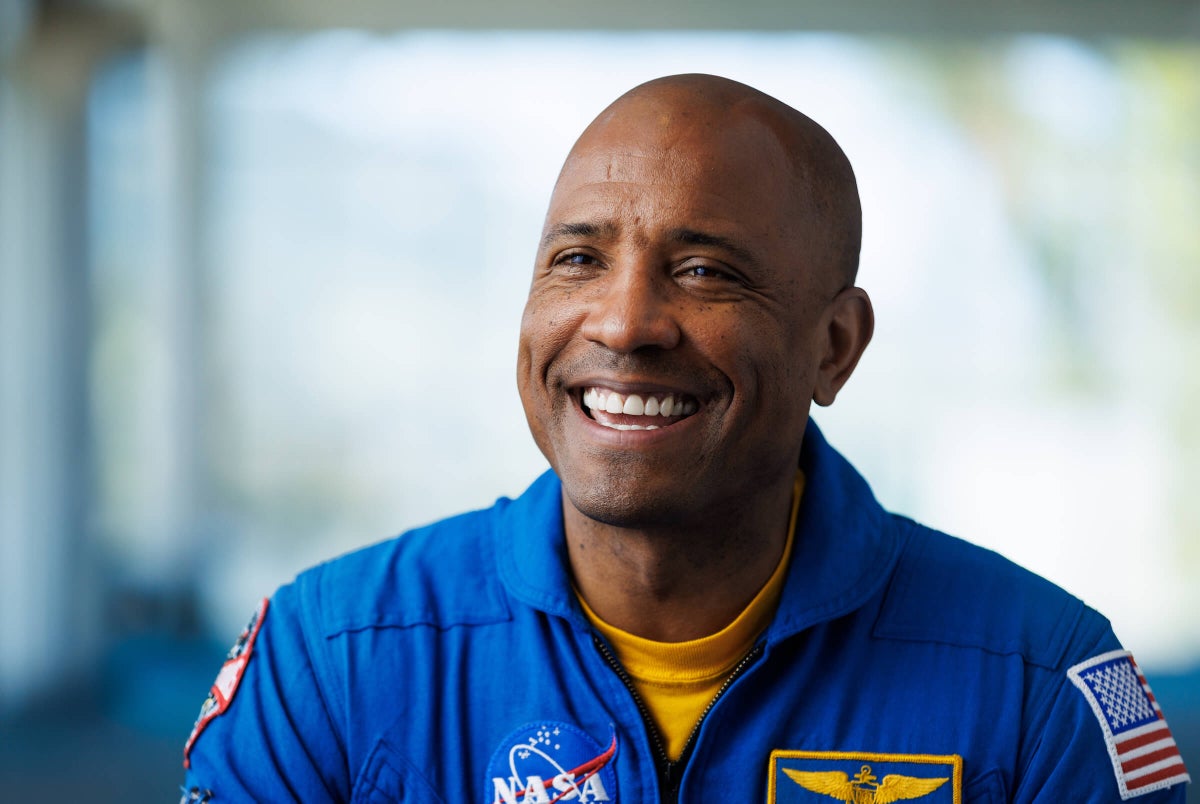
Cal Poly San Luis Obispo President Jeffrey Armstrong was on a video call with Victor Glover while Glover was on the International Space Station. Glover — a 1999 Cal Poly graduate in general engineering — talked about how difficult it was to maneuver through space.
“He said, ‘Imagine a pair of gloves, fill them with rice, and that’s what you’re doing. And your hands do everything,’” Armstrong recalled from their conversation.
Glover, the first Black man to travel around the moon, is part of the four-astronaut crew that launched from NASA’s Kennedy Space Center on Wednesday evening and will travel around the moon and return without landing. It’s the first time anyone has traveled this far since Apollo 17 in 1972.
Before beginning his military career and later becoming an astronaut, the Ontario, Calif., native played defensive back for Cal Poly’s football team and wrestled in the late ’90s.
“The hardest thing that I’ve ever chosen to do in my life was walking in space,” Glover told Armstrong. “The second-hardest thing that I ever chose to do in my life was wrestling practice with Lennis Cowell.”
Cowell was the head coach of Cal Poly wrestling from 1985 to 2003, when the program was Division II. Glover told Armstrong the practice was “so demanding, but also so rewarding.”
“I think that just talks about the epitome of the benefit of being a student-athlete,” Armstrong said.
Glover played football for the Mustangs under Andre Patterson, who most recently was the defensive line coach for the New York Giants.
“He may not have been the fastest guy out there or the most athletic guy out there, but he was going to succeed since he was the best technician out there,” Patterson told the New York Times. “That’s who he is at his core.”
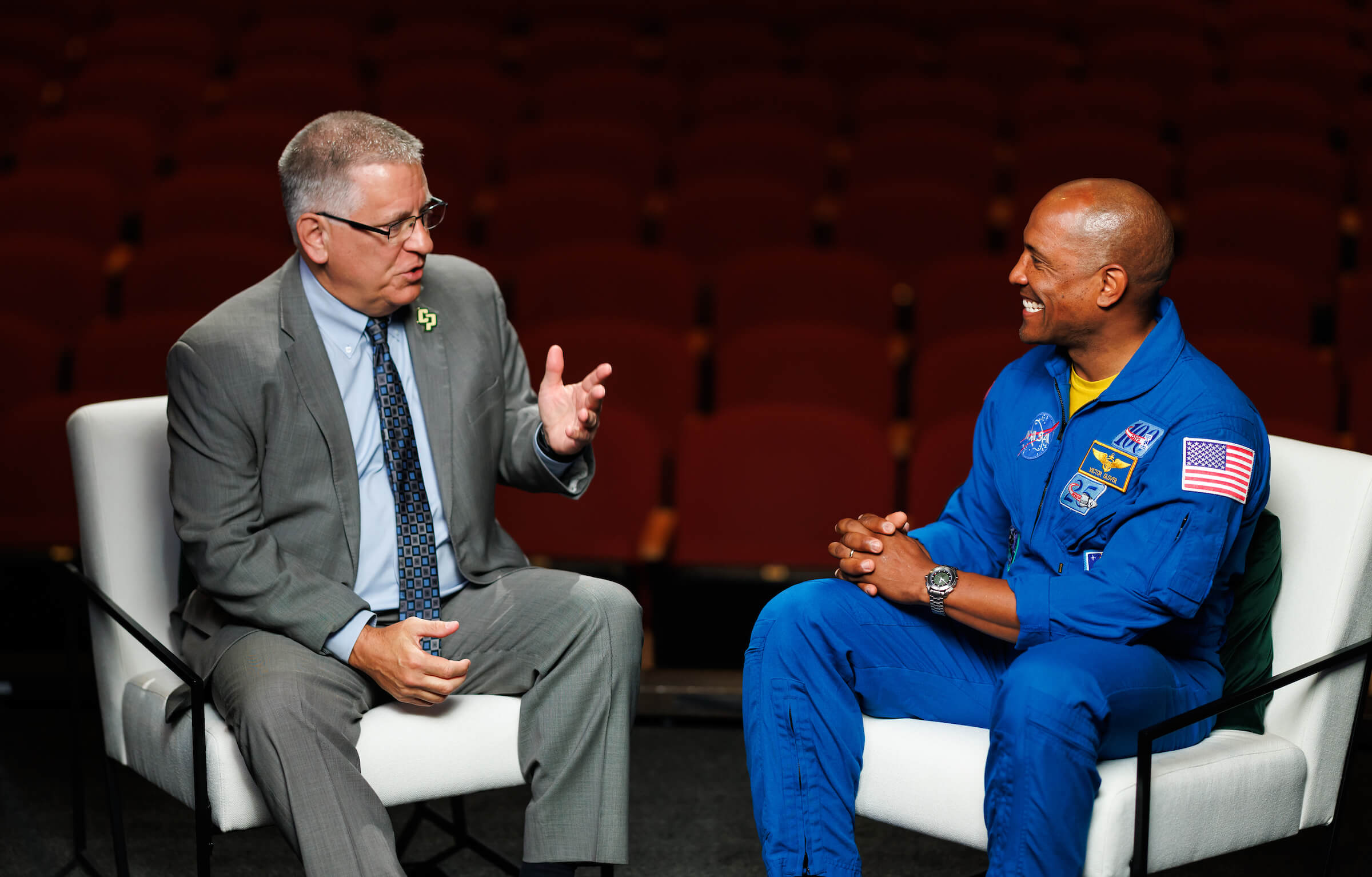
Victor Glover said the second hardest thing he’s ever had to do, after moving in space, was wrestling practice under Lennis Cowell. (Joe Johnston / Courtesy of Cal Poly)
Glover continued to speak at graduations, to the Black Student Union, the wrestling team and other students on campus.
“Our team loved hearing from him and you could tell his experience really resonated,” wrestling head coach Jon Sioredas said via text message. “He has a unique ability to connect his journey to lessons that apply directly to young athletes.”
Glover pushed back on the hero narrative.
“The idea of heroism or heroics, I think that whole narrative is challenging. They make us almost untouchable. That’s not the message we want to give kids. I’m a human, and I make mistakes, and I learn, and I fail people and I fail myself,” Glover said.
Glover is also aware of the moment he’s a part of in history.
“If you think about when we did this, the first time in Apollo, 1968, it was a tough time in the country,” Glover told the New York Times. “And I hope that we can create a touch point for our generation that’s equal to or maybe there’s a path to be even greater than because it’s current and it’s ours.”
After takeoff, Glover caught sight of an American flag on the ground.
“That is a good-looking American flag,” he said.