
Todd McClay
Wellington, April 6, 2026 (from Beehive Website)
New Zealand and India have concluded a Free Trade Agreement, offering exporters unprecedented access to 1.4 billion Indian customers.
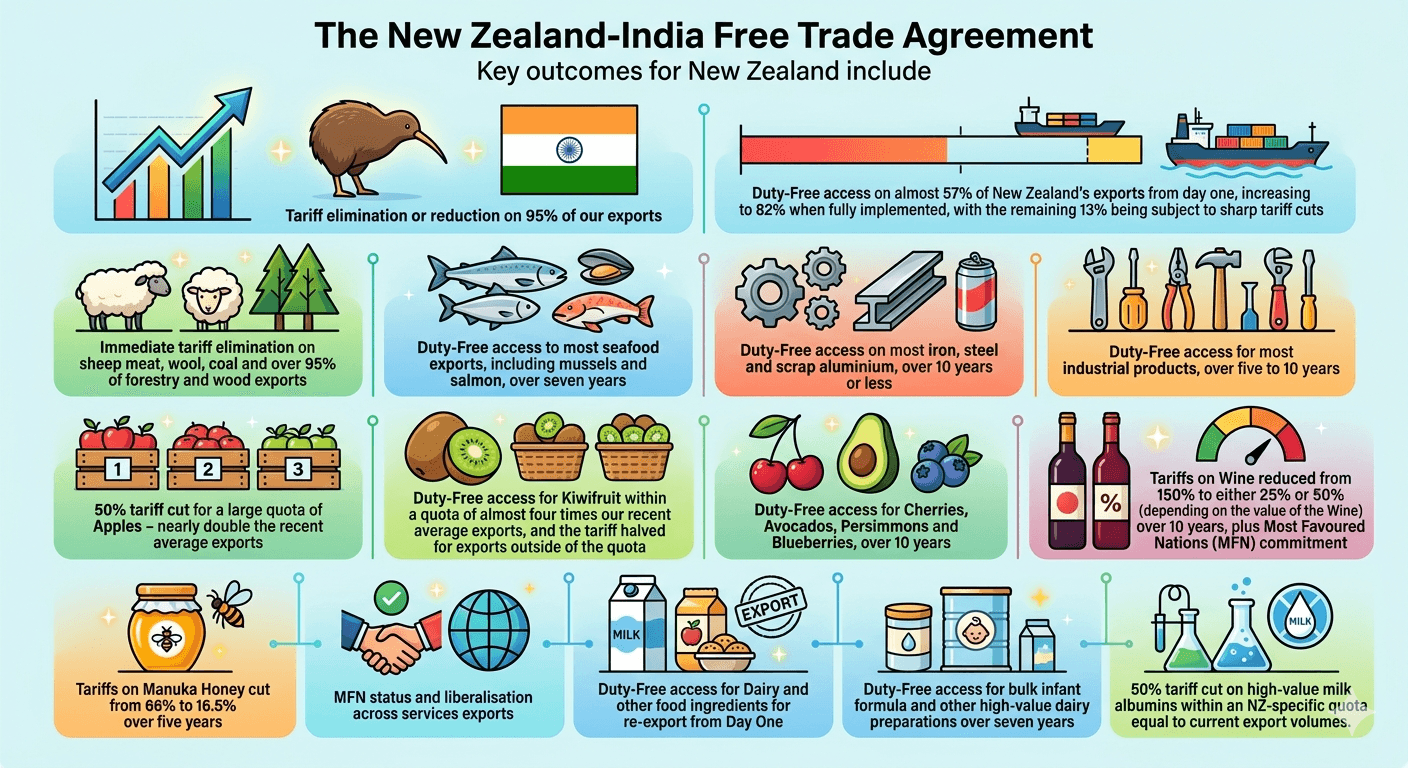
This historic Agreement eliminates and reduces tariffs on 95% of New Zealand’s exports, among the highest of any Indian FTA, with almost 57% being Duty-Free from Day One, increasing to 82% when fully implemented, with the remaining 13% subject to sharp tariff cuts.
It puts New Zealand exporters on an equal or better footing to our competitors across a range of sectors and opens the door to India’s rapidly expanding middle class.
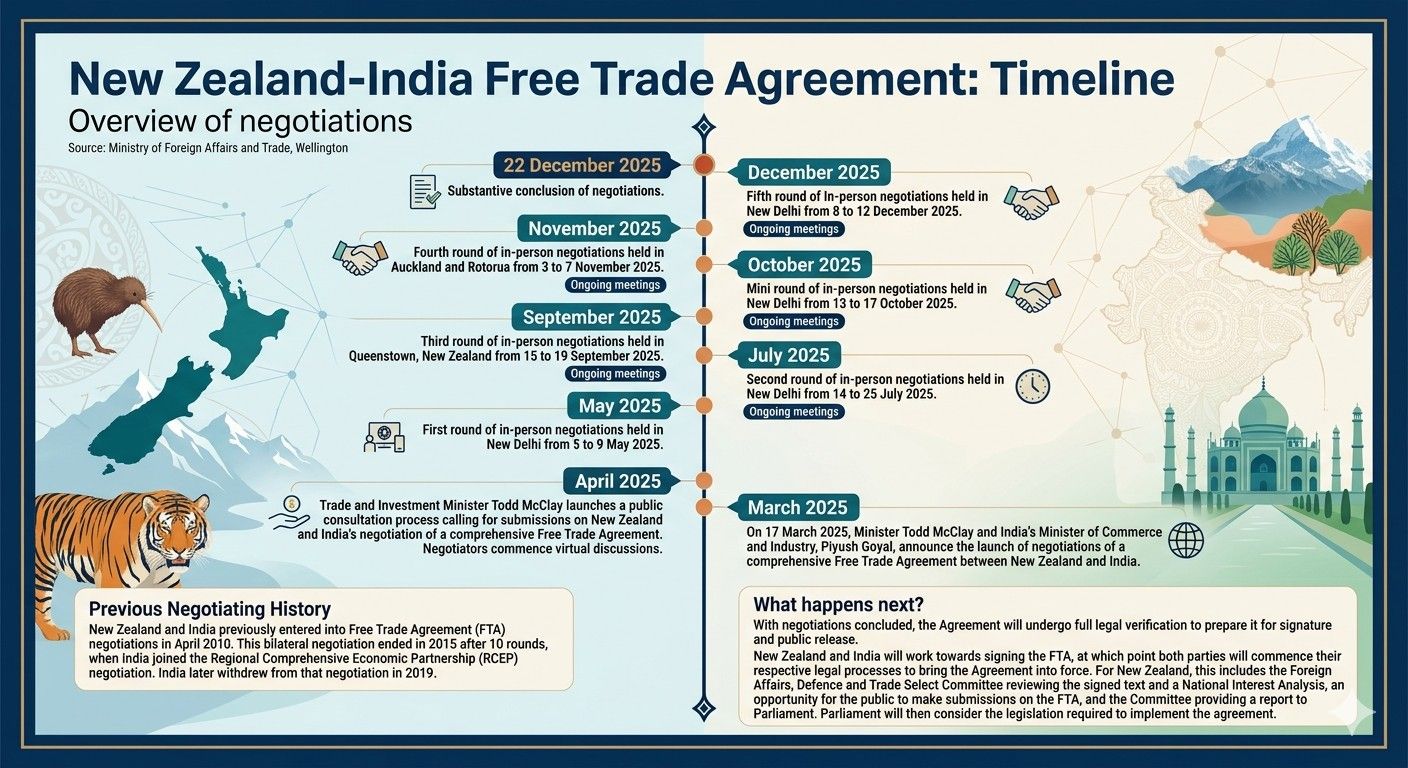
Negotiations began on March 21, 2025 and concluded after nine months of intensive effort.
Fresh opportunities for exporters
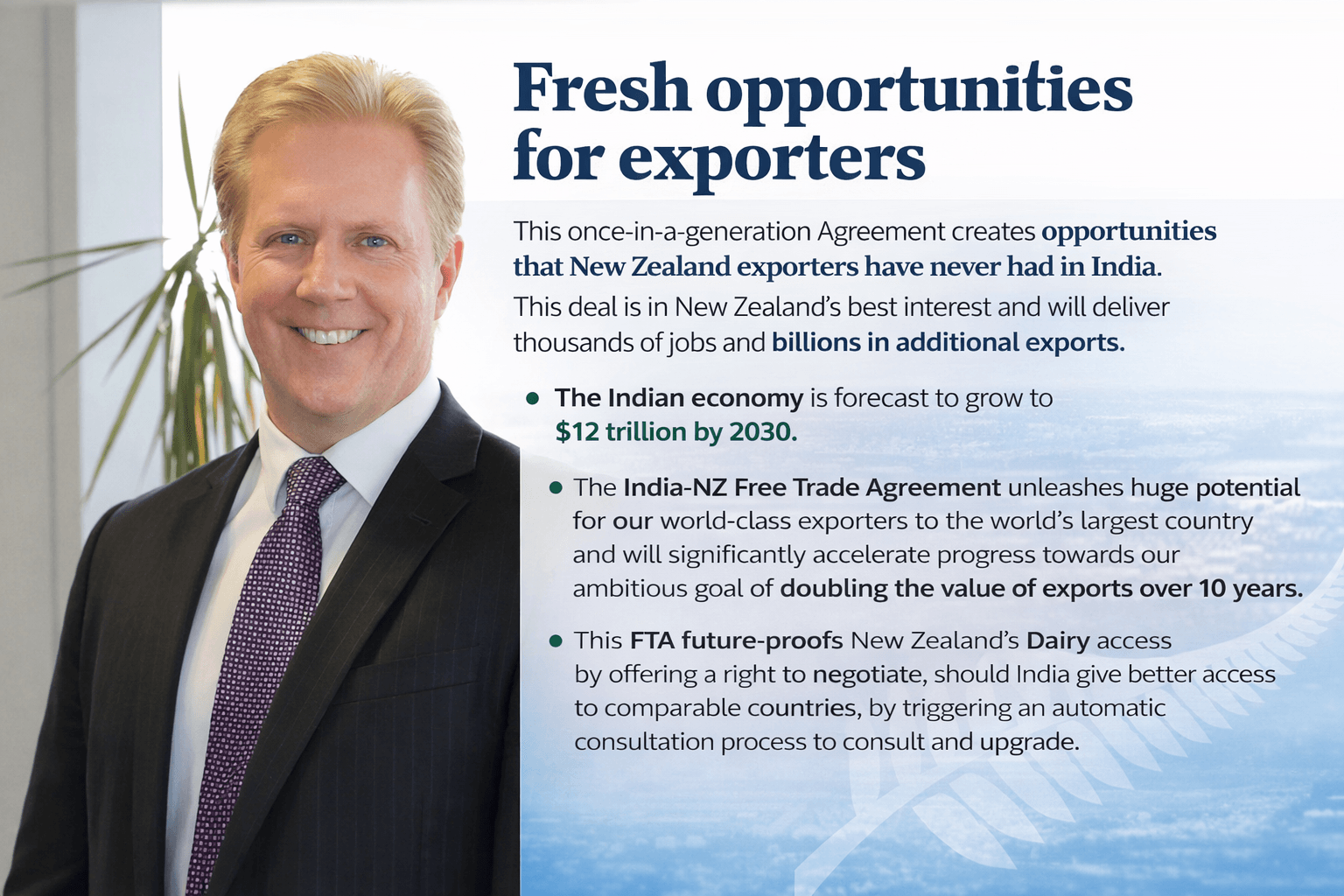
This once-in-a-generation Agreement creates opportunities that New Zealand exporters have never had in India. This deal is in New Zealand’s best interest and will deliver thousands of jobs and billions in additional exports.
The Indian economy is forecast to grow to $12 trillion by 2030.
The India-NZ Free Trade Agreement unleashes huge potential for our world-class exporters to the world’s largest country and will significantly accelerate progress towards our ambitious goal of doubling the value of exports over 10 years.
Preferential Market Access
In a world-first, New Zealand will have Duty-Free access for a large Kiwifruit quota, nearly four times our current exports, with a 50% tariff applying outside the quota.
For the first time in an FTA, India has agreed preferential market access for Apples and Manuka Honey. The FTA has broad service coverage and builds significantly on India’s WTO commitments, with a focus on financial services, e-payments, and FinTech, and includes an MFN clause to future-proof our services trade.
To protect specialist and iconic New Zealand product names in each other’s markets, we have agreed to establish Geographical Indication rules comparable to those we have with the EU.
This FTA future-proofs New Zealand’s Dairy access by offering a right to negotiate, should India give better access to comparable countries, by triggering an automatic consultation process to consult and upgrade.
New Zealand exporters will enjoy Duty-Free access for Dairy and other food ingredients for re-export through the FTA, opening the door to greater collaboration and processing and offering access to India’s growing number of FTA partners through a dedicated fast-tracking mechanism.
Addressing Skills Shortages
To better provide the skills to grow the New Zealand economy, the Agreement establishes a process for up to an average of 1667 skilled three-year work visas per year. These temporary visas will focus on priority jobs where New Zealand has skills shortages, including doctors, nurses, teachers, ICT and engineering and are non-renewable.
Sectors will be drawn from the New Zealand skills shortage ‘Green List,’ with all immigration screening and qualification/experience requirements remaining unaltered. We have retained the ability to change the Green List to match skills shortages in the economy.
In addition, to ensure our tourism and rural sectors have the workers they need , we have aligned our Working Holiday Scheme with Australia’s Indian FTA, providing up to 1000 places each year.
Meeting Treaty Obligations
The Agreement includes a Treaty of Waitangi clause allowing us to meet Treaty obligations, as well as Chapters on Customs Facilitation and Clearance, Technical Barriers to Trade, Sanitary and Phyto-Sanitary Standards, Culture, Trade and Traditional Knowledge, Economic Cooperation, Trade and Sustainable Development.
We have also agreed to review the FTA one year after entry into force, which provides a mechanism to pursue further improvements for the future.
This is a good deal that delivers for every New Zealander.
Trade grows the economy and creates jobs – the NZ India Free Trade Agreement is about future-proofing opportunities for our exporters and allowing Kiwi companies to continue to punch above their weight on the world stage.”