
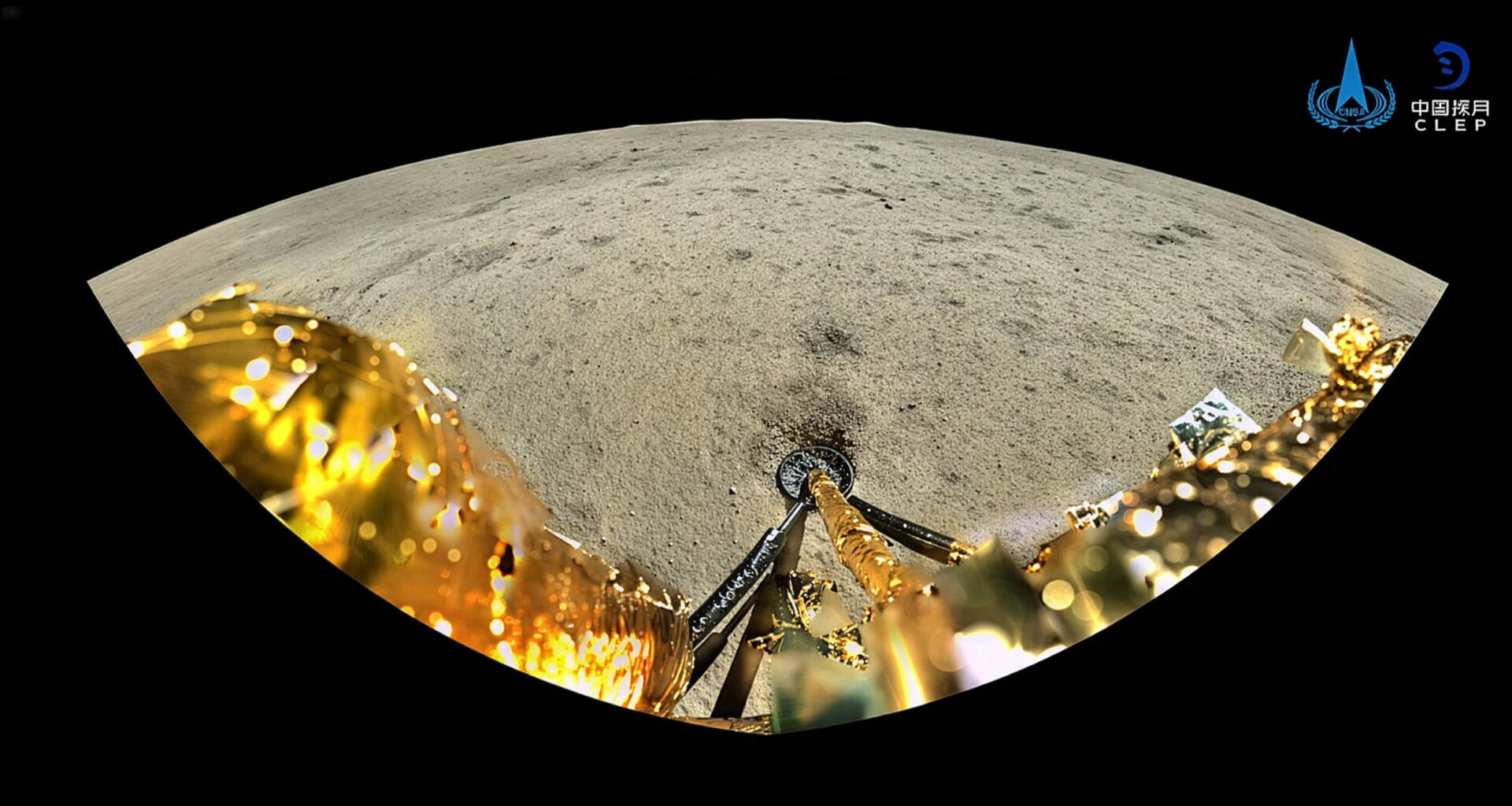
Researchers have identified a hard magnetic iron-nickel mineral inside lunar farside soil, marking the first confirmed detection of this kind of material in Moon samples.
The finding shows how repeated impacts can create minerals that lock in magnetic signals long after the Moon’s global field has disappeared.
Inside one grain

Inside a single sulfur-rich grain from the lunar farside, a tiny metallic inclusion preserved the mineral structure at the center of this discovery.
Analyzing that grain, Yang Li at the Institute of Geochemistry, Chinese Academy of Sciences (CAS), directly identified tetrataenite embedded within iron and sulfur material.
That metallic inclusion formed under conditions where nickel and iron arranged into a stable crystal capable of retaining magnetism over extremely long periods.
Such durability explains why localized magnetic patterns can persist on the Moon’s surface and sets up the need to examine how this mineral holds its magnetic signal.
Why it lasts
Unlike ordinary iron, tetrataenite, a rare iron-nickel alloy with an ordered atomic structure, resists being scrambled, so the magnetism it gains can stay put for ages.
Scientists call that remanence, magnetism left after an external field disappears and later jolts fail to erase it.
In practice, tetrataenite holds onto magnetism far longer than nearby pure iron, which magnetizes easily and loses it just as quickly.
Such a difference helps explain why one rare particle in lunar dust could matter more than a much larger patch of soft iron.
Where it formed
Nickel offered the first clue that the grain probably did not start as native lunar metal.
Nickel levels near 50 percent point to a metal that changes as it cools, forming a more stable magnetic structure along with small bits of pure iron.
That metal became trapped inside a sulfur-rich mineral common in lunar soil when impacts melted and reshaped tiny droplets on the surface.
Repeated impacts did more than scar the grain; they created the cooling conditions that let a stable magnetic alloy emerge.
A chemical nudge
During space weathering, slow surface change caused by radiation and micrometeorite hits, cooling seems to have finished the job.
Below about 660º F, atoms could slowly line up during annealing, gentle reheating that lets a crystal settle into a new order.
Phosphorus-rich spots sat beside nickel-rich zones, hinting that trace chemistry may have sped atomic motion through the cooling metal.
For now, the idea remains tentative, but it gives researchers a concrete target for later sample work and tests.
Farside magnetism puzzle
Strong magnetic patches have long appeared across the South Pole-Aitken basin, a vast impact scar on the Moon’s hidden side.
The Moon has no global field today, so those patches must come from crust that locked in older magnetism.
One leading idea held that huge impacts supplied magnetic material from outside the Moon, leaving imported debris behind.
Finding a hard magnetic carrier in returned dust finally gives that debate a real mineral specimen to inspect.
What the images showed
Inside the grain, both the alloy and nearby iron curled into tiny vortices, ringlike magnetic patterns that resist flipping.
By looping inward, each magnetic field lowers strain inside the particle instead of pointing one way.
Pure iron usually loses its record more easily, but the shape of whiskers and submicron grains helped some stability survive.
Even so, the strongest long-term memory still likely sat in tetrataenite, not in the softer iron around it.
A crowded mix
Tetrataenite did not appear alone, and that matters because lunar magnetism probably comes from several minerals acting together.
Around tetrataenite sat pure iron particles, curved whiskers, and a few scattered signals from pyrrhotite, another iron sulfide that can carry magnetism.
Each mineral responds differently to heating, cooling, and later impacts, so the final magnetic map records a messy history.
This mixed mineral assemblage may help explain why orbital surveys see isolated patches instead of one smooth blanket of magnetized crust.
Why samples count
Chang’e-6, a robotic mission that returned the first samples from the Moon’s far side, brought back about 4.27 pounds of soil from Apollo Basin, a crater inside the South Pole-Aitken basin.
The samples mix local volcanic fragments with material thrown in from past impacts, giving scientists real pieces to study instead of just maps.
Without returned material, magnetic maps stay indirect because orbiters can measure fields but cannot show which particles hold them.
This discovery gives scientists a clearer way to connect those magnetic patterns to the actual materials on the Moon’s surface.
What remains unclear
One particle cannot explain every magnetic patch on the Moon, and the authors do not claim that.
Other grains may hold different carriers, and some anomalies could still reflect ancient fields recorded before the Moon went quiet.
Future work will need broader counts, cleaner comparisons with near-side soils, and direct measurements from CAS and other labs handling returned dust.
Still, the new sample turns a long-running argument from orbital hints toward laboratory evidence under a microscope.
What changes now
A rare iron-nickel alloy in farside dust now connects impacts, cooling, chemistry, and long-lived magnetic memory in one physical story.
Future magnetic surveys and resource plans will sharpen only if more grains reveal the same pattern.
The study is published in Planet.
—–
Like what you read? Subscribe to our newsletter for engaging articles, exclusive content, and the latest updates.
Check us out on EarthSnap, a free app brought to you by Eric Ralls and Earth.com.
—–