

Tuesday, 7 April 2026, 4:41 pm
Press Release: New Zealand Defence Force
Royal New Zealand Air Force (RNZAF) No. 62 Squadron
personnel have been tracking the historic Artemis II flight
as it passes over New Zealand skies, sending four NASA
astronauts further into space than any human has ever
been.
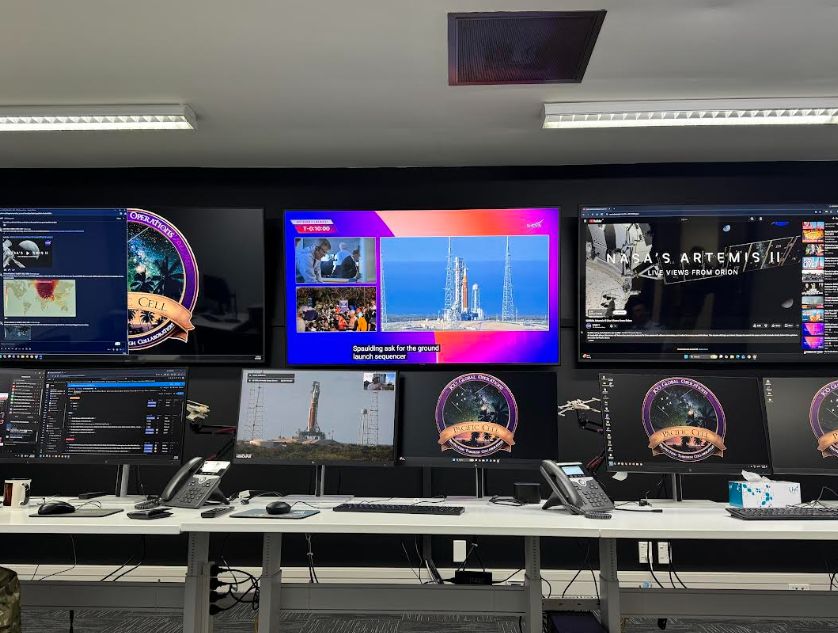 No.
No.
62 Squadron personnel at RNZAF Base Auckland monitoring the
Artemis II flight
(Photo/Supplied)
The Orion
spacecraft left Earth on Thursday and passed overhead about
midnight, on its way to slingshot around the
moon.
Today the astronauts made it to the far side of
the moon – and became the first people to travel that deep
into space.
RNZAF personnel joined dozens of other
countries in tracking the spacecraft’s progress over the
10-day mission and sending the results back to
NASA.
No. 62 Squadron Commanding Officer, Wing
Commander Matt Tristram, said they received a request from
the US Space Force Delta 5 Human Space Flight Support
Squadron which deals with human space flight, for all
partner countries to track the mission.
The flight
path was monitored using the squadron’s two telescopes,
housed at its observatory in Whangaparāoa. Images were then
sent to computers at RNZAF Base Auckland, where four of the
squadron’s staff watched the spacecraft’s progress
during the High Earth Orbit phase overnight on April
2.
 NASA
NASA
astronaut and Artemis II Commander Reid Wiseman took this
photo of Earth from the Orion spacecraft’s window on April
2, 2026, after completing the translunar injection burn
(Photo/ NASA/Reid Wiseman)
Advertisement – scroll to continue reading
It
passed over New Zealand’s sky at a height of 70,000km –
about twice the distance the squadron would normally track
objects in space.
“We worked with our partners and
the United States-led Joint Task-Force Space Defense
Commercial Operations Cell (JCO),” Wing Commander Tristram
said.
“We could use information that described the
trajectory of the crew capsule to help point the camera in
the right place. Essentially that information provided by
some of the contributors to JCO helped us cue the camera
with a telescope onto the spacecraft and be able to track
it.”
The team was hoping to track its return to
Earth next week, depending on weather conditions, Wing
Commander Tristram said.
“It’s been amazing so far
to be a small part of such a defining historic moment for
space flight. Not only to be watching it on TV with the
regular coverage, but actually contributing to monitoring it
just makes it that little bit more personal. We are all so
proud to be a part of history, even in a tiny sliver of a
way.
“It was a privilege to be asked to help. We
felt like we weren’t just observing it at arm’s length,
but were involved in the mission, which is just
amazing.”
Corporal Cicero Caramto was the first in
the squadron to be trained on using the telescopes that
tracked the flight.
One of the telescopes covers four
degrees of the night sky and the other, one
degree.
“It’s been exciting to learn about the
equipment and get outputs from it. For space domain
awareness tasking we get from partner nations and government
agencies, it’s such a cool tool to help
them.”
Using Scoop for work?
Scoop is free for personal use, but you”ll need a licence for work use. This is part of our Ethical Paywall and how we fund Scoop. Join today with plans starting from less than $3 per week, plus gain access to exclusive Pro features.
Join Pro Individual
Find out more