
The world’s fuel situation is becoming clear, and it’s beginning to feel a lot like early 2020, where an incoming crisis is looming on the horizon.
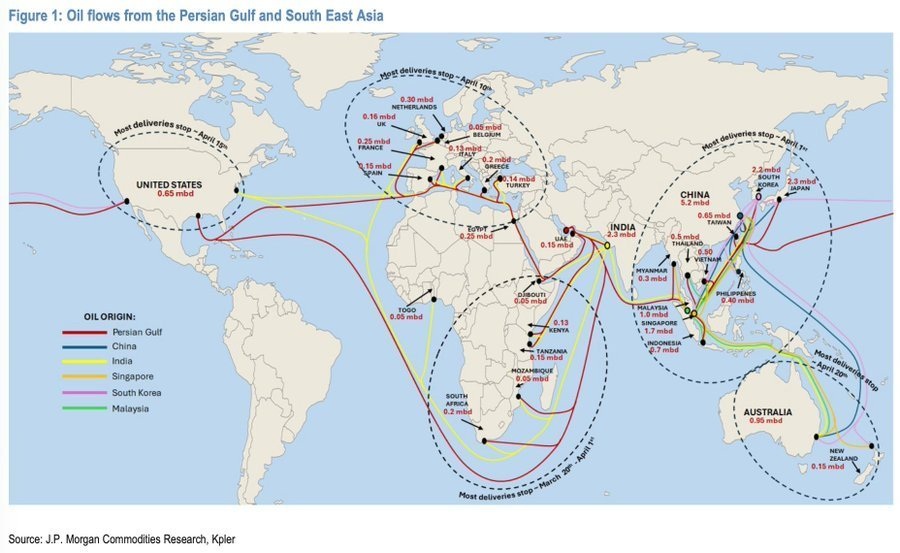
America’s war in Iran has resulted in a drastic cut in fossil fuel supply from the Middle East. And even if everything opened up tomorrow, the supply disruption is so large that the ‘air pocket’ of delivery will still hit us. It’s perhaps best demonstrated by this map of analysis done by JP Morgan, which says our currently guaranteed deliveries stop by 20 April:
Regardless of what happens with the war, significant damage to fossil-fuel infrastructure means that the disruption is going to last a lot longer – years and years.
And the time to start dealing with it is now. Not when fuel supplies start to run out, but right now.
The good news is Auckland Council already has the blueprint to reduce our fuel use in transport. It’s called the Transport Emissions Reduction Pathway.
Because, lo and behold, it turns out what is required to rapidly reduce fossil fuel use in transport, is an exact mirror of the measures needed to rapidly reduce the emissions that cause climate change.
What is the Transport Emissions Reduction Pathway?
The Transport Emissions Reduction Pathway, or TERP, is a plan of practical steps Auckland should take to rapidly reduce emissions, and therefore reduce fuel usage, of transport in our region. It was approved by Auckland Council in 2022.
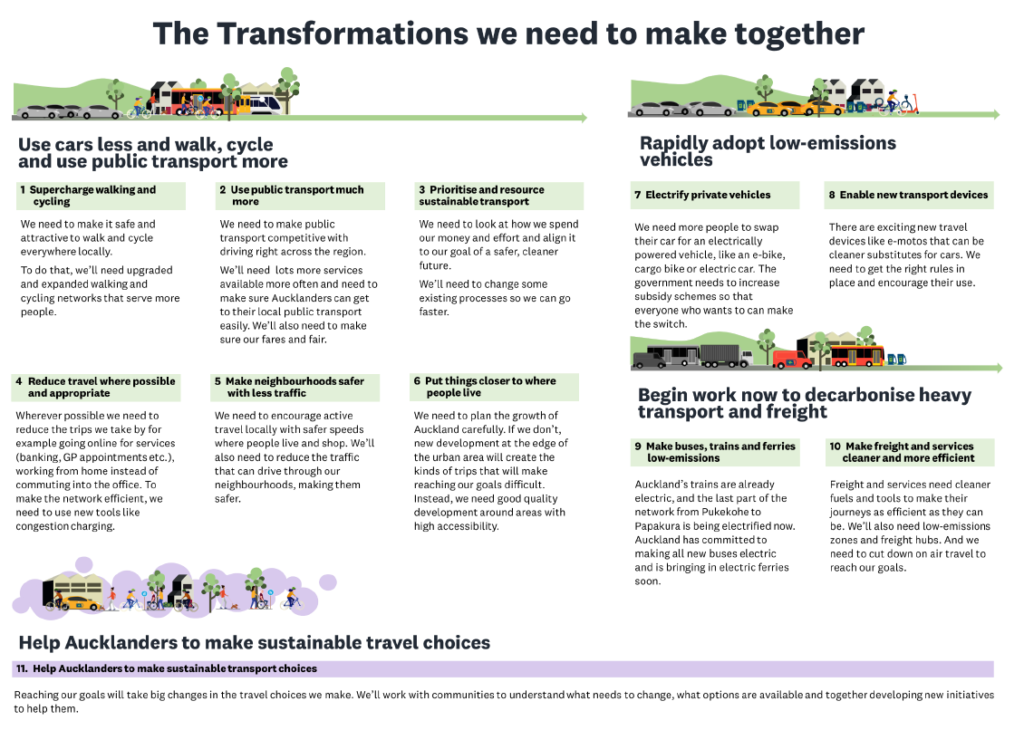
We covered it extensively here, but the thrust of the TERP is 11 key steps:
Supercharge walking and cyclingMassively increase public transport patronagePrioritise and resource sustainable transportReduce travel where possible and appropriateSafe, low-traffic neighbourhoods for peopleBuild up, not outElectrify private vehiclesEnable new transport devicesLow-emissions public transportEfficient freight and servicesEmpower Aucklanders to make sustainable transport choices
Unfortunately, in the last few years, action on the TERP has been severely inadequate.
Sounds great. So what’s stopping us?
Leadership.
Both politically, and institutionally.
Central Government, made up of National, NZ First, and ACT, has been following Simeon Brown’s extremely ideological 2024 Government Policy Statement on Land Transport, which slashed funding for walking and cycling and reduced funding for public transport, to funnel money into a few gold-plated state highways. Basically the opposite of TERP. Despite numerous opportunities to change course, including the current crisis, they have so far refused to do so.
Auckland Council, led by Mayor Wayne Brown, has a wide spectrum of political views – some excellent, some ambivalent, and some who simply do not like the idea of prioritising walking, cycling, and public transport, even to bring them up to basic parity with the investment in driving.
Auckland Transport has suffered from institutional stagnation, where a few senior decision-makers and middle managers (aka the ‘layer of clay’) have managed to ignore and/or delay well-supported strategies and plans designed to free Aucklanders from car dependency – and fossil fuels.
The thing is, in a crisis, everything can change.
No one can now claim it is too expensive, too difficult, or a ‘nice to have’ to reduce fossil fuel use in transport. Because this fuel crisis is a burning platform, and change is coming whether we like it or not.
And people already appear to be seeking out other options, and they deserve support for doing their part.
So we’re lucky we have positive options, in the form of an approved plan that lays out the way ahead.
Now’s the time where we see the mettle of our leaders. And if they refuse to take action, then we must demand it.
What needs to happen now
Many of the larger actions are beyond the power of Council to deliver rapidly. For example, electrification of the light vehicle fleet (aka cars) – we understand the demand for EVs has been so strong, many places are sold out and now waiting deliveries from overseas. But for true change, you would need central government resources and changes, such as bringing back the Clean Car Discount scheme.
So what can we, as in Council and Auckland Transport, do urgently?
The first three actions of TERP tell us.
1. Supercharge Walking and Cycling
Auckland Council and Auckland Transport can urgently initiate the delivery of “pop-up” cycleways, to complete the strategic cycleway network.
They can do this at low cost, using the same measures as many cities around the world did directly in the early COVID response. As with 2020, the trick will be to focus on the routes that provide access for essential workers, to essential services, and that create access that doesn’t currently exist. Hospitals and medical services, the food distribution network, major factories, schools.
The legal tools are there. Reshaping Streets legislation allows for ‘trials’ to pilot street changes and /or manage traffic. With four weeks notice, AT and Council can deliver significant changes that will give people safe options for replacing car trips with walking and cycling.
A lane on the Harbour Bridge, and other motorway-adjacent access, is in the hands of Waka Kotahi/ NZTA, but is something Council can absolutely advocate for. Likewise with actions to reverse the blanket speed limit increases from Simeon Browns 2024 Speed Rule, to return to safer urban 30km/h limits.
2. Massively increase public transport patronage
Auckland’s bus network has seen enormous improvements over the last few decades. We have more than enough of a foundation to significantly ramp up the frequency of bus routes across our city, so it’s as simple to catch a bus as to jump in the car.
And not just at peak times, but all day long – giving a real alternative to driving for non-commuter trips, which make up the vast majority of trips that people currently use cars for.
We need to see the frequency ramped up as soon as possible, and services expanded where gaps are found.
Cutting the current cost of fares will increase patronage, and for certain groups where cost is a big barrier such as under 25s or Community Service Card holders, it makes sense for travel to be free. (Just as it currently is for Gold Card holders off-peak. Fair’s fair!)
Auckland Transport and Auckland Council have the ability to manage this – but central government must provide the funding and resources, as it has far more capacity and ability to do so.
3. Prioritise and resource sustainable transport
To deliver both of the programmes above, sustainable transport needs to be prioritised as well as resourced.
The quickest, cheapest, and only way to realistically deliver this stuff, is to more effectively use street space that’s currently allocated to vehicles – whether as driving lanes, or for on-street parking.
What does this mean? It means bus lanes can be rolled out on all arterials and along important bus routes, and should be 24/7 to ensure reliability of services at all times.
And it means pop-up cycleways can quickly transform kerbside space into efficient lanes that can move people safely and easily without using petrol.
(Note that police have already advised people to “park strategically“, storing their cars in driveways and garages to guard against fuel theft – so this is a logical win-win.)
Bring a vision and clarity
Underpinning all of these moves, it’s time to actively Empower Aucklanders to make sustainable transport choices. This is the time for strong, clear narratives that outline and communicate the vision and the need to do this.
Quick and creative change will be needed to deal what looks to be coming our way, and communities deserve to be on board. Just as we’ve risen to the challenge in previous emergencies, we should be actively supported to do so again.
And then, as we look further ahead to the medium-to-long term, we can keep going and implement the other actions of the TERP. Electrification of our transport system will underpin our long-term resilience against fossil fuels, reduce our emissions to combat climate change, and create neighbourhoods that support us to live healthy lives no matter the global weather.
Take Action
All of this is possible, and realistic, and doable.
And necessary.
We have the plan, the means, and the smarts to deal with the crisis ahead of us.
It just requires our leaders to have courage in this moment – and if they are slow to find their voices, we must raise ours.
Because if we don’t, we’ll get the alternative – a messy, hard, damaging and unjust transition. We will all suffer, and the most vulnerable people in our society will suffer the most.
Conversely, if together we can take the steps to get off fossil fuels, not only will we get through this shock, but we will permanently reduce the cost of living, reduce our emissions to fight climate change, and create resilience to get us through the next crisis.
If you want to help, reach out to your local MP and Councillor, and ask them to push for the urgent changes we need.
So let’s get on with it. Because action inspires hope!
Greater Auckland’s work is made possible by generous donations from our readers and fans. We’re now a registered charity, so your donations are tax-deductible. If you’d like to support our work, you can join our circle of supporters here.
Share this