
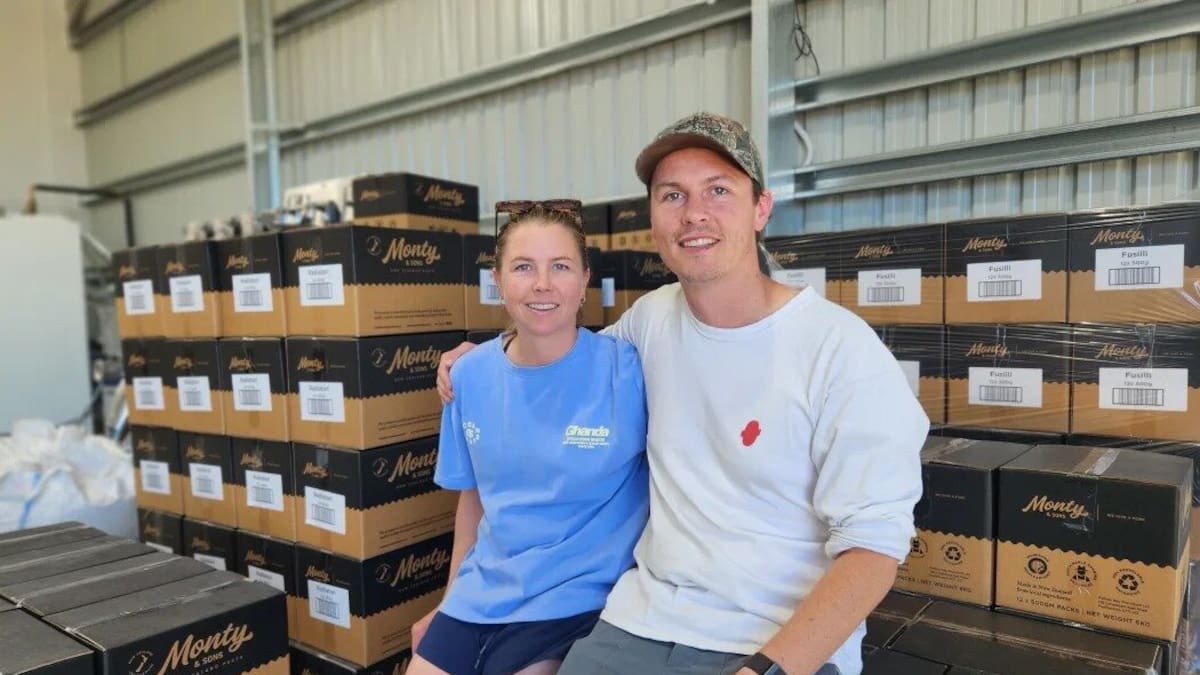
He had yet to go to Italy but had researched pasta-making methods and machines.
“The hardest part about this whole thing is getting the drying programme set right, because if it’s slightly off or the humidity is slightly wrong, you get hairline cracks and the pasta just falls to pieces.”
Now the brightly and sustainably packaged pasta is sold to about 40 outlets and online, and he’s expecting to take a good portion of the durum wheat grown by the Wairarapa Grains Collective to meet demand.
Realising that most wheat consumed in New Zealand came from Australia, discovering durum wheat – the “gold standard” for pasta-making – was being grown locally, and a desire to produce “food with provenance”, were what sparked his move from wine-making.
“We put all this prestige around wine grapes … but why do we look at, say, a paddock of wheat any differently?”
Petrie was full of praise for the four farming families making up the Grains Collective, who started growing durum wheat as a way of navigating the four-year ban on pea growing after pea weevils hit the region in 2016.
One of the farmers is Mick Williams from Ahiaruhe near Carterton.
“Durum likes a hot, dry summer, which traditionally the Wairarapa has.
“[It is] something that there was a market for, and there’s quite a lot of pasta consumed in New Zealand, and it’s all made with imported wheat, so we thought, ‘oh, well, maybe we can hop in there and collect a bit of some New Zealand-grown stuff’.”
They had grown 5ha each this year, producing 60 to 80 tonnes of flour in total.
The yield is about a third less than traditional milling-type wheat, and growers needed to be getting a premium to justify their inputs, Williams explained, but that didn’t put the growers off.
Freshly dried pasta made from durum wheat. Photo / RNZ, Sally Round
“It’s about growing a good quality product using really sound farming methods that are environmentally friendly and sustainable.
“We’ve all got a real onus on protecting the soils, so all our crops are no-tilled.
“We all have livestock within our businesses too, so there’s diversity there.”
There was a feel-good factor, too, in the links the farmers had developed with consumers.
“So many things produced on farms, in particular, they just go on a truck, and that’s it.
Mick Williams, in a field of barley with his combine harvester in the background. Photo / RNZ, Sally Round
“You don’t have any feedback from the end users, but with the durum that we’re selling to restaurants and bakers and home bakers, developing a relationship with them and getting their feedback from how much they enjoy using our product is a pretty cool new experience for us, and something we’ve all really enjoyed.”
Back at Monty and Sons, Petrie said his experience working on big broadacre cropping farms in Australia was also a factor in his support of locally grown wheat.
“We kind of just want to be part of championing the arable crop-growing sector in New Zealand because they do some pretty awesome stuff, and they are world-class farmers.”
– RNZ