
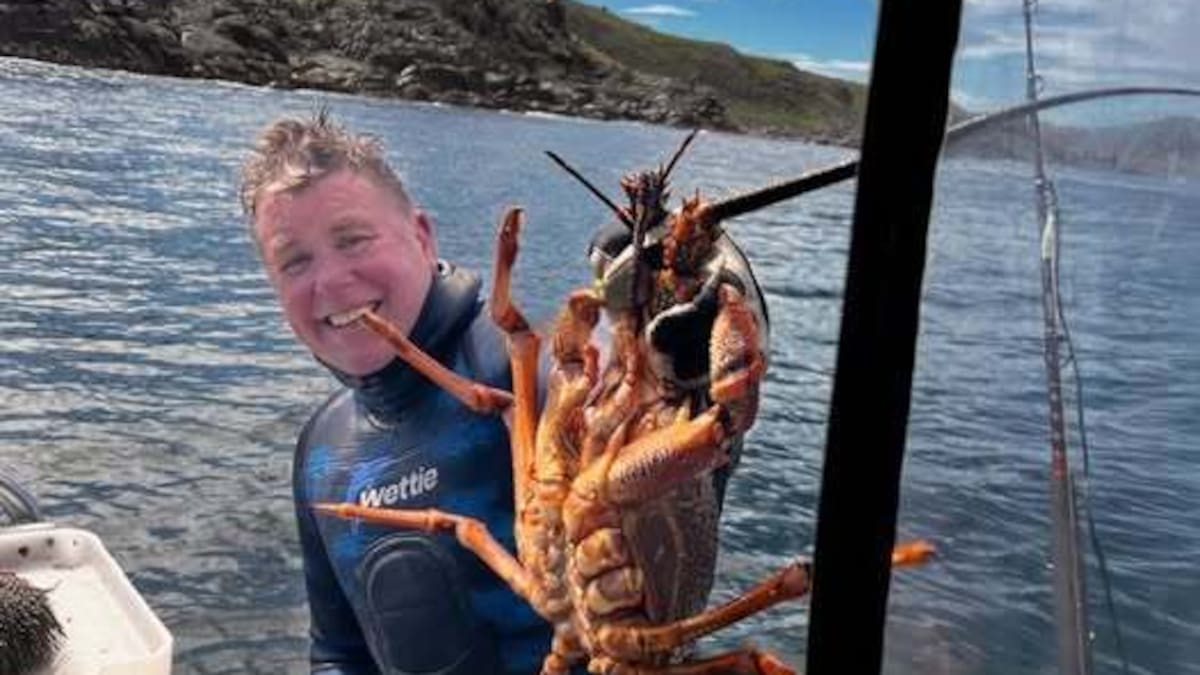
They had never previously stayed on the boat, but had done plenty of overnight trips during which they would stay in huts or similar.
At Safe Cove, the men had dinner using a Cobb Grill. They then watched a rugby game.
They had a petrol generator running to power Starlink, so they could stream the game and have phone reception.
A new diesel heater installed just two days prior was running.
When they went to bed about 10pm to 10.30pm, they turned off the diesel heater.
During the night, Murrell turned the heater back on, although it was not confirmed if he had also turned the petrol generator back on.
Rick Murrell died following a fishing accident on Lake Manapouri. Photo / Southland Business Chamber
About 7.20pm on July 20, Allison’s wife, concerned her husband had not returned that day as planned, phoned police.
She was able to provide a location to police based on her husband’s cell phone.
About 1am on July 21, a rescue helicopter found the boat in Safe Cove.
“The next thing Mr Allison remembers is a man, now known to have been from the Fiordland Marine Search and Rescue Team, banging on the boat telling him to get onto the deck,” Coroner McKenzie wrote.
Allison felt very groggy; however, he managed to get up. He tried to revive Murrell, but could not.
Confused and unwell, Allison was given medical attention before being taken by helicopter to Southland Hospital.
The boat remained in situ overnight and was taken back to Manapouri by police, where Murrell’s body was recovered.
The petrol generator used on the boat was found switched on and empty.
During the police investigation into Murrell’s death, a report from LM Safety, Occupational Hygienists, looked into how carbon monoxide (CO) and carbon-based chemicals could enter and build up in the boat’s cabin.
LM Safety set up the boat’s contents, including the diesel heater and petrol generator, to match the conditions at the time of the incident.
The tests showed that the petrol generator was the likely source of carbon monoxide, as exhaust fumes were found to enter the cabin through the wire loom access hole.
Elevated carbon monoxide readings were noted along this pathway, compared to other entry points.
The testing also revealed that the diesel heater did not significantly raise carbon monoxide levels in the cabin.
When the heater was running alone, the levels were low.
However, there was a sharp increase in carbon monoxide when the generator was turned on, indicating that exhaust fumes – not fuel vapours – were leaking into the cabin.
Maritime New Zealand advised in the report that the diesel heater could have created a vacuum that drew in air from outside the cabin to replace the internal cabin air.
This was on the basis that simultaneously running the diesel heater and the petrol generator on the deck combined to produce fatal CO levels within 3.5 hours.
Murrell was sleeping on the floor just inside the door and close to where the fumes entered.
The report outlined that if the diesel heater creates negative pressure in the cabin, outside air drawn from the deck can be contaminated by exhaust fumes from the generator.
Maritime New Zealand’s investigations also showed that the diesel heater’s exhaust had been correctly installed, with no visible signs of leakage.
An autopsy on July 23, 2025, showed the carbon monoxide level in Murrell’s system was nearing a lethal level. However, it was not quite over the fatal threshold for an otherwise healthy adult.
However, Murrell’s heart disease and the alcohol in his system would have made him more susceptible to carbon monoxide poisoning.
This would likely explain why he died at a slightly lower carbon monoxide level, the coroner’s findings say.
“These additional factors may also help explain why his friend survived and he did not, despite them both sleeping on the same boat.”
Coroner McKenzie accepted that Murrell died from carbon monoxide toxicity in the context of atherosclerotic cardiovascular disease and alcohol use.
McKenzie consulted Maritime New Zealand for any safety comments or recommendations.
Maritime New Zealand outlined that although CO detectors are not required, the absence of a detector increases the risk of undetected CO exposure.
It was noted that it is not a requirement to have a CO detector in a recreational boat.
The publication Powerboat Magazine states that marine-certified carbon monoxide detectors are available at a cost of $65 to $115.
Coroner McKenzie extended her condolences to Murrell’s family.