
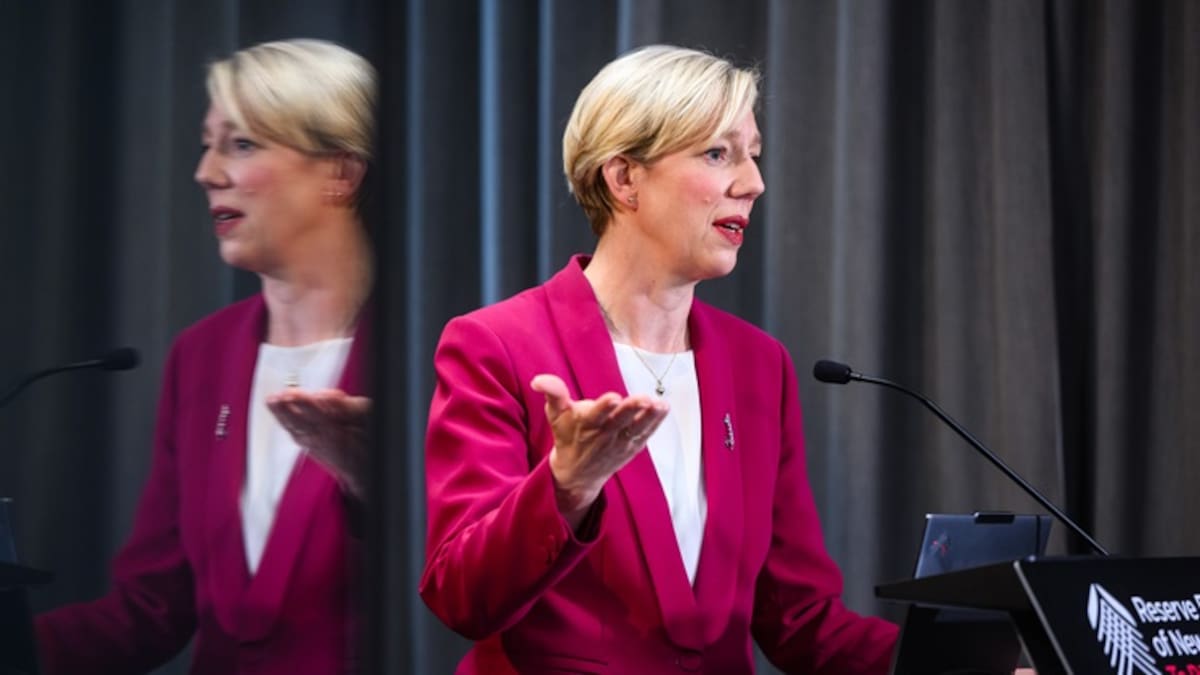
More inflation and lower growth seem to be the general expectation of most economists. But what does that mean for monetary policy?
Will the supply-side inflation be transitory? How long can the RBNZ afford to ignore an annual CPI rate of increase above 3%?
How much will higher fuel prices and worry about the uncertain outlook dampen demand and cut economic growth?
Might that actually require a cut to the Official Cash Rate if we are to avoid recession?
All these questions and more won’t be answered later this afternoon.
But tune in to the Herald for the full coverage anyway, because Breman seems to be pretty good at putting all this stuff in context, at least.
You can read our full preview of the OCR decision here.
Trans-Tasman rivalry
One bright spot, as highlighted by HSBC Australia and New Zealand head of economics Paul Bloxham, is that the RBNZ is in a sweeter spot to deal with the crisis than its counterpart across the Tasman.
“The starting point for the RBA is an uncomfortable one,” Bloxham says.
“Inflation is already too high and is about to rise further.”
The CPI inflation rate is 3.7% in Australia, compared to 3.1% here.
A tight jobs market and an economy operating beyond its capacity mean workers are more likely to be able to demand higher wages, Bloxham says.
Businesses may also be able to pass on cost increases to higher prices, and these forces could drive inflation up further, impacting inflation expectations.
“The RBNZ’s starting position is better,” he says.
“A loose jobs market means it will be harder for workers to successfully bargain for higher wages.”
The inflation shock is therefore less likely to feed into inflation expectations, or persistently high inflation, he suggests.
“With more subdued household incomes, as higher fuel costs squeeze household discretionary spending, businesses are less likely to be able to lift prices.”
I appreciate that this isn’t the most appealing bright spot for many Kiwis.
OK, so basically, he’s saying our economy has been performing so poorly that the RBNZ can afford to look through a short-term inflation spike more easily than the RBA.
But we’ll take it. In a similar vein, our less generous government support package also does the RBNZ a favour.
“In Australia, recent policy announcements to cut excise on petrol and subsidise businesses in the face of increased fuel costs already risk adding to medium-term inflationary pressures,” Bloxham says.
Paul Bloxham, HSBC chief economist for Australia and NZ. Photo / Supplied
“We see these measures as making it more likely the RBA will choose to lift its cash rate again in May.”
Bloxham, like all the local bank economists, expects the RBNZ to hold the OCR steady today and take a cautious approach as it weighs up whether the global energy shock is more of an inflation or growth concern.
“As the surge inflation is primarily a negative supply shock, it should be expected to lift short-run CPI inflation but to weaken medium-term inflation, as it also weakens growth,” Bloxham says.
“The main risk to medium-term inflation comes through the possibility of high inflation becoming more embedded in medium-term inflation expectations, which seems less likely in New Zealand than Australia given the economic starting point.”
Does the Iran conflict threaten US dollar dominance?
Q: I have seen reports that suggest that the fact that the toll Iran is demanding for passage through Hormuz is to be paid in Chinese yuan is a calculated attempt to destabilise the US$ as the reserve currency for petroleum transactions.
How likely is this to have an effect, and what are the implications for US bond rates, US debt and the wider global economy?
John O’Neill
A: Hi John, great question. I can’t claim to be an expert on all this, but it is a hot topic of discussion on financial blogs and currency trading websites right now.
A recent research note by Deutsche Bank, really grabbed headlines when it declared the Iran conflict “a perfect storm for the petrodollar”.
First, let’s start by recapping what “reserve currency” means.
Basically, the reserve currency is the preferred global currency for trade and for debt (borrowing and lending).
As such, it is the currency that central banks and financial institutions around the world tend to hold in the most significant quantities as part of their foreign exchange reserves.
As Deutsche Bank says in its recent note: “The world saves in US dollars because the world pays in US dollars.”
The greenback has been the global reserve since 1944, when the US emerged as a dominant financial, military and cultural power in the capitalist world.
Before that, it was the pound sterling, based on the dominance of the British Empire.
Things are less clear-cut before that, because we’re getting back into the 18th century.
But a case can be made for the Dutch guilder and, before that, Spanish silver. You can go right back to Roman denarii if you like.
There’s no doubt that there’s a connection between the reserve currency and financial and military might.
No challengers
So back to that perfect storm for the US dollar.
There’s no question that the US dollar is still the global reserve currency.
We see it with the strength of the greenback since the Iran conflict began. Even though the US is the one taking the risk on war, the dollar is treated as a safe haven in times of uncertainty. So it has strengthened; currencies like the New Zealand dollar have weakened.
For the past couple of decades or so, there have been questions raised about the future of the US dollar as the reserve currency.
According to the IMF, the US dollar’s share of global foreign exchange reserves has fallen from around 70% in the early 2000s to roughly 58% today.
That’s still huge but definitely represents a significant decline.
But the biggest argument against the US dollar’s demise as a reserve currency has been that there aren’t any realistic challengers.
China’s yuan is not a free-floating currency; it has state capital controls and limited convertibility.
The euro is a multi-national currency, but Europe as an institution doesn’t issue the equivalent of a US Treasury Bond, which would allow countries to hold euros without risk.
Petrodollar dominance
In her recent research note, Deutsche Bank analyst Mallika Sachdeva makes the case that US currency dominance is largely based on its dominance of the oil trade.
She traces this back to 1974 when Saudi Arabia agreed to price its oil in US dollars and invest surpluses in US assets, in exchange for security guarantees.
“Because oil is a core input to global manufacturing and transport, there is a natural incentive for global value chains to dollarise, and global surpluses to accumulate in US dollars,” Sachdeva says.
She also notes that prior to the Iran conflict US dollar dominance of the oil trade was already under pressure.
Most Middle East oil is now sold to Asia not the US, and sanctioned oil from Russia and Iran has already been trading “off dollar rails”.
What the war may change
As you identify in your question, there is a risk for the US if Iran controls the Strait of Hormuz long term and requires trade to be done in yuan.
The last oil tankers to make it out of the Strait of Hormuz before its closure appear to have docked in Singapore. Image / Getty
“Reports that the passage for ships through the Strait of Hormuz may be granted in exchange for oil payments in yuan should be closely followed,” Sasdeva writes.
“The conflict could be remembered as a key catalyst for erosion in petrodollar dominance, and the beginnings of the petroyuan.”
Why does it matter?
The problem for the US is that if countries don’t trade as much in US dollars, they don’t need to buy as many US Treasury Bonds.
It is that seemingly insatiable demand for US Treasuries that enables the US Federal Government to run such outrageous levels of debt (currently about US$39 trillion).
Without that demand, US borrowing costs would rise. The US would have to offer higher yields on its bonds to cover its debt.
That could quickly spiral into a serious debt problem and a major crash for the US economy.
It might be tempting to revel in a bit of schadenfreude about this, but, unfortunately, that kind of debt crisis would have awful ramifications for the global economy, not least our KiwiSaver balances as Wall Street stocks crashed.
Will it happen?
The extent to which this all plays out comes back to unknowable variables – like how long this war lasts and what eventually happens in the Strait of Hormuz.
I think a seismic shift is unlikely in the short term.
First of all, there’s the TACO phenomenon.
Trump Always Chickens Out, and, if there’s an insurance policy around this, it is the US bond markets, which look forward to assessing risk and would send yields on US Treasuries uncomfortably high well before we actually get to any kind of tipping point.
As we saw with his tariff policy U-turns, Trump understands the power of the bonds markets.
Secondly, China holds a lot of sway with Iran and it’s not clear the regime there is ready for reserve currency status.
It currently holds around US$780 billion in US Treasuries. If it aggressively pushed de-dollarisation to the point of crashing Treasury prices, it would destroy the value of its own reserves.
But the way the Deutsche Bank is not framed implies less of a short-term crash and more of an inflexion point that historians will one day look back on as the beginning of the end.
China will be playing the long game. Its US Treasury holdings are down from $1.3 trillion a decade ago.
Superannuation situation
Q: Recent Herald opinion pieces have been unbalanced in their statements about the affordability of NZ Superannuation, going as far as to say we are morally bankrupt “systematically transferring obligations downward while hoarding entitlements upwards”. (Jonathan Ayling March 19).
This claim ignores two large measures introduced by Michael Cullen – the NZ Super Fund and KiwiSaver.
I understand that the NZ Super Fund now is worth $80 billion, largely funded by taxpayers under the Clark and Ardern governments. The statement that the cost of superannuation will rise from 5.1% to around 8% of GDP by 2065 (39 years away) appears to take no account of the availability of the fund. Can you please advise of how and when it is likely to be used?
Current taxpayers have also contributed to incentives for contributing to KiwiSaver.
Additional changes to superannuation such as means testing may well be needed, but it is unfair to claim that nothing has been done.
A: Hi David, I won’t speak for other columnists but I think the best way to put this is that not enough has yet been done to address the affordability of Superannuation.
I’m a huge supporter of KiwiSaver and the NZ Super Fund, both of which will play a key role in funding the retirement of Kiwis as the population ages in the next 30 years or so.
But there is no getting around the fact that we need to do more.
The NZ Super Fund was never designed to cover the cost of the state pension.
It has been hugely successful, growing to nearly $90 billion in value and delivering average annual returns of 10%.
From around 2035-36, the Government will begin to withdraw money from the fund to help pay for New Zealand Superannuation.
But the fund will continue to grow until it peaks in size in the 2070s.
That all sounds good until you look at the demographics.
According to the Treasury, the number of people receiving Superannuation will grow from 928,000 today to over 1,084,000 by 2029-30.
All up the NZ Super Fund can only cover about 15% of the increased cost of delivering the pension.
Last year, the Treasury modelled what it would look like if we did nothing to address the rising cost of New Zealand Superannuation (NZS) until 2065.
“With unchanged policy, by 2065, government spending per person would nearly double – from $18,300 today to $35,900 (inflation adjusted),“ it said.
“Government revenue would rise much more slowly. These trends would result in government debt rising to around 200% of Gross Domestic Product (GDP).”
We are going to have to do something more than what we already are.
That might involve pushing KiwiSaver contribution rates up further. And then, as retirement saving rates improve, a measured increase in the age of eligibility and some means testing.
The topic is quite well covered in the pages of the Herald I reckon. Just this week, we ran a thoughtful look at the challenges by Bevan Graham, the economist at Salt Funds Management. You can read it here.
I’d also recommend Wellington Business Editor Jenée Tibshraeny‘s February interview with Secretary to the Treasury Iain Rennie.
Liam Dann is business editor-at-large for the New Zealand Herald. He is a senior writer and columnist, and also presents and produces videos and podcasts. He joined the Herald in 2003. To sign up to his weekly newsletter, click on your user profile at nzherald.co.nz and select “My newsletters”. For a step-by-step guide, click here. If you have a burning question about the quirks or intricacies of economics send it to liam.dann@nzherald.co.nz or leave a message in the comments section.
Tags:
- about
- aussie
- bank
- better
- burning
- Business
- central
- Click
- comments
- Conflict
- could
- deeper
- dive
- dollar
- dominance
- economic
- Economics
- Economy
- end
- every
- have
- here
- in
- inside
- into
- intricacies
- Iran
- leave
- leftfield
- liamdannnzheraldconz
- message
- missed
- more
- New Zealand
- News
- newsletter
- NewZealand
- NZ
- Plus
- question
- quirks
- rbnz
- section
- send
- shape
- sign
- some
- take
- than
- us
- week
- weekly
- welcome