
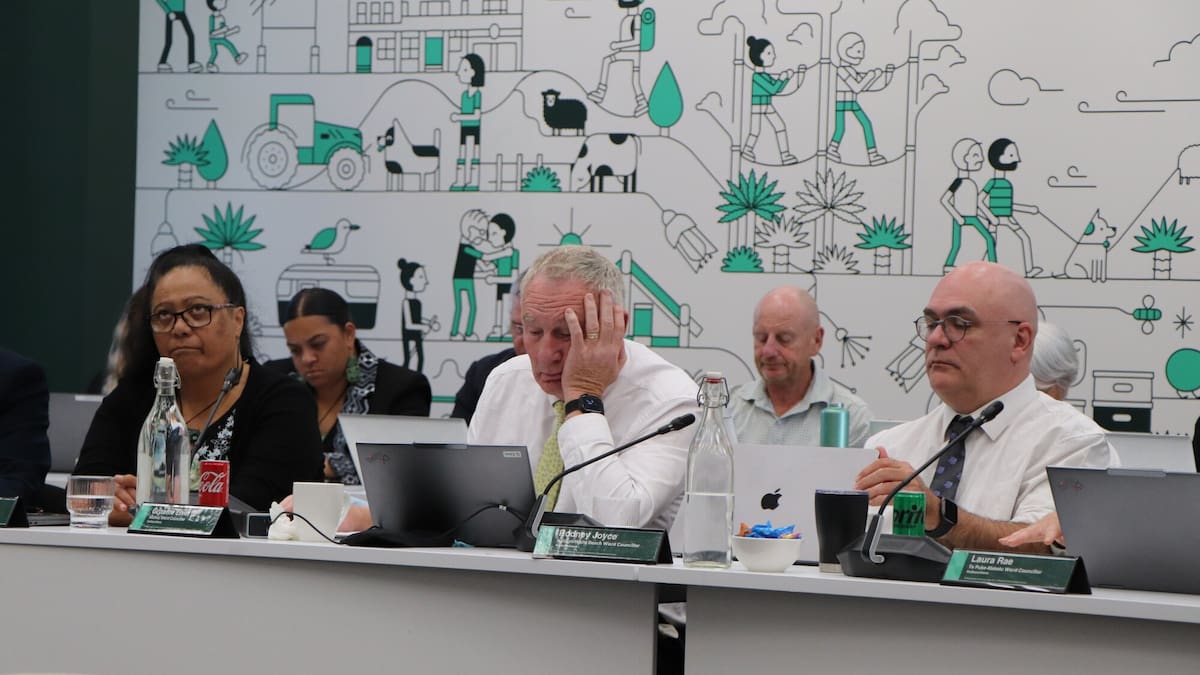
Western Bay councillors were notably reluctant to agree to the partnership during the debate on Thursday, which lasted more than five hours.
The 10 elected members of each council, plus senior staff, packed into the Western Bay of Plenty District Council chambers on Cameron Rd and held their meetings consecutively, with the hosts going first.
Western Bay of Plenty Deputy Mayor Margaret Murray-Benge. Photo / Ayla Yeoman
Western Bay Deputy Mayor Margaret Murray-Benge noted this would be the largest reform since 1989.
Several concerns around trust between the two councils were discussed, including long-running cross-boundary disputes, whether non-water issues could be used as leverage against Western Bay in the future and a belief that “off-ramps” promised earlier in the process no longer existed.
Some district councillors said they accepted the water organisation in principle, but not necessarily with Tauranga as a partner.
Western Bay of Plenty District councillors (from left) Shane Beech, Tracey Coxhead and Grant Dally. Photo / Ayla Yeoman
Maketu-Te Puke Ward councillor Shane Beech called Tauranga City Council (TCC) “dysfunctional”.
“Unfortunately, good faith and Tauranga City in the same sentence is unachievable.”
He said a CCO was financially beneficial to the ratepayers in the long-term, “but forming a CCO with the Western Bay and TCC is not in the best interest of our ratepayers”.
Katikati-Waihī Beach Ward councillor Allan Sole questioned whether they could do better, saying “probably”.
He then said the partnership was the “best deal for the ratepayer”, but added: “Do I feel comfy with this partner? No.”
Some councillors, including Maketu-Te Puke Ward councillor Laura Rae, said the decision-making process had been rushed.
Western Bay of Plenty District councillors (front, from left) Rodney Joyce, Laura Rae and Allan Sole. Photo / Ayla Yeoman
Many councillors commented that the plan was unfinished and lacked key details.
Beech said there were too many uncrossed T’s and undotted I’s.
“It shows poor governance not to have tied up all those things.”
Kaimai Ward councillor Graeme Elvin said: “We can’t blame everybody else for our own failure to be properly prepared.”
He described aspects of the city council’s conduct as “a bit unpalatable” but said there was risk in everything. “You’ve always got to consider the reward … We’ve got to get on board.”
An amendment was put forward to delay the new organisation’s start date to July 1, 2028. The vote was tied, so Western Bay of Plenty Mayor James Denyer used his casting vote to strike it down.
Waka Kai Uru Māori Ward councillor Darlene Dinsdale said iwi had been proactive in telling the councils that if they worked together in kotahitanga (unity, solidarity), they would get the results for ratepayers.
Western Bay of Plenty Mayor James Denyer. Photo / Ayla Yeoman
Denyer said the collaborative experience had been positive.
“The outcomes are demonstrably worse for our ratepayers if we choose not to join [Tauranga].
“Establishing a joint water organisation gives us the best opportunity to deliver safe, resilient and affordable water services.”
The district councillors ultimately voted 6-4 to proceed with the partnership.
Tauranga Mayor Mahé Drysdale told the meeting before the city councillors’ debate that whether there was an agreement or not, “we will go ahead with a waters organisation”.
Tauranga Mayor Mahé Drysdale. Photo / Ayla Yeoman
Drysdale said the councils were considered “big brother” and “little brother” in terms of being family.
He rejected the Western Bay councillors’ claims that this was insulting, saying the city council was the bigger party.
“We’ve given you 50% of the voting rights on this organisation, so there is nothing we can do without you guys also agreeing.
“If we wanted to pull it over you or ram it through, we would have taken out 80% of the vote and we would have made all the decisions.
“We’re trying to work together because, as you’ve pointed out, this is better for both of our ratepayers.”
Tauranga councillors voted to proceed with the organisation, with only one councillor opposed.
Tauranga councillors (from left) Rick Curach, Glen Crowther, Hautapu Baker and Marten Rozeboom. Photo / Ayla Yeoman
Matua-Ōtūmoetai Ward councillor Glen Crowther was opposed to the inclusion of stormwater in the water organisation.
“One of the absolute stoppers for me voting in favour of this … is stormwater.”
The councillors generally emphasised affordability, saying it would be in the best interest of ratepayers in the long run.
Pāpāmoa Ward councillor Steve Morris said the CCO was more affordable for people.
“We can’t jack up the water rates every time and keep hurting our people.
“This is the way to deliver value for our people.”
Te Awanui Ward councillor Hēmi Rolleston said if the councils were split in their decision, there would be bigger challenges in the future.
Tauranga councillors (from left) Rod Taylor, Kevin Schuler and Steve Morris. Photo / Ayla Yeoman
Te Papa Ward councillor Rod Taylor said he was basing his decision to establish this partnership on the future beyond a few years.
The city councillors debated whether to delay the start date to 2028, but ultimately rejected this call based on unnecessary delays and costs.
Both councils agreed that tangata whenua must be involved and current engagement arrangements should be retained or enhanced.
A formal amendment to recognise cross-boundary iwi relationships in future due diligence processes was adopted.
– LDR is local body journalism co-funded by RNZ and NZ On Air.
Ayla Yeoman is a Local Democracy Reporting journalist based in Tauranga. She holds a Bachelor of Arts majoring in communications, politics and international relations from the University of Auckland, and has been a journalist since 2022.