
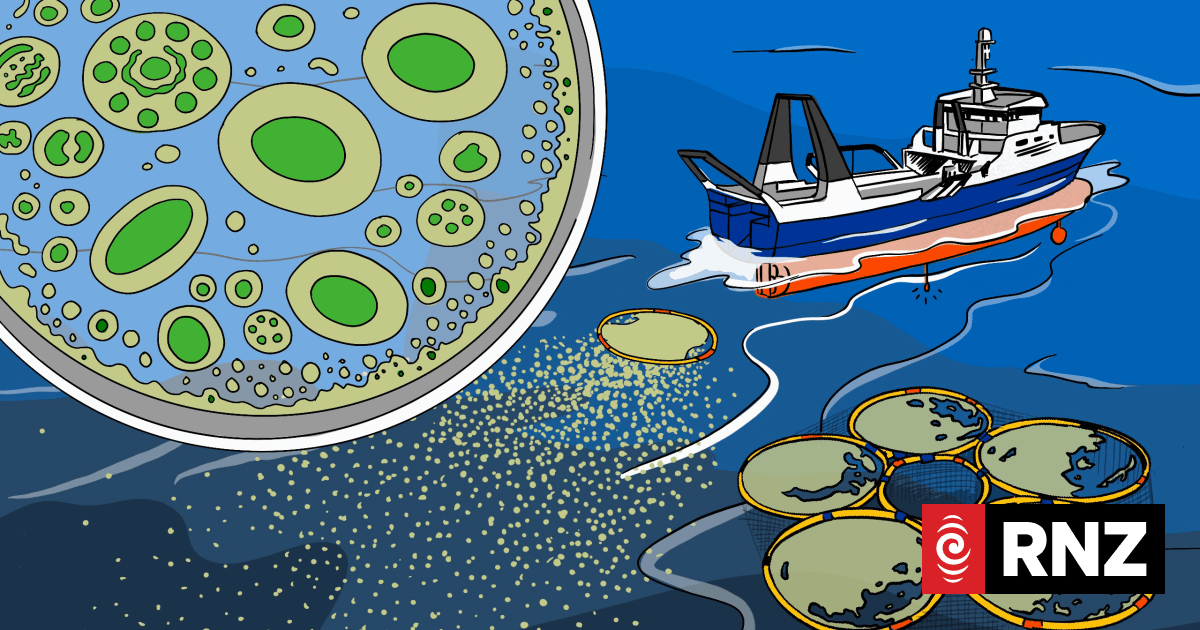
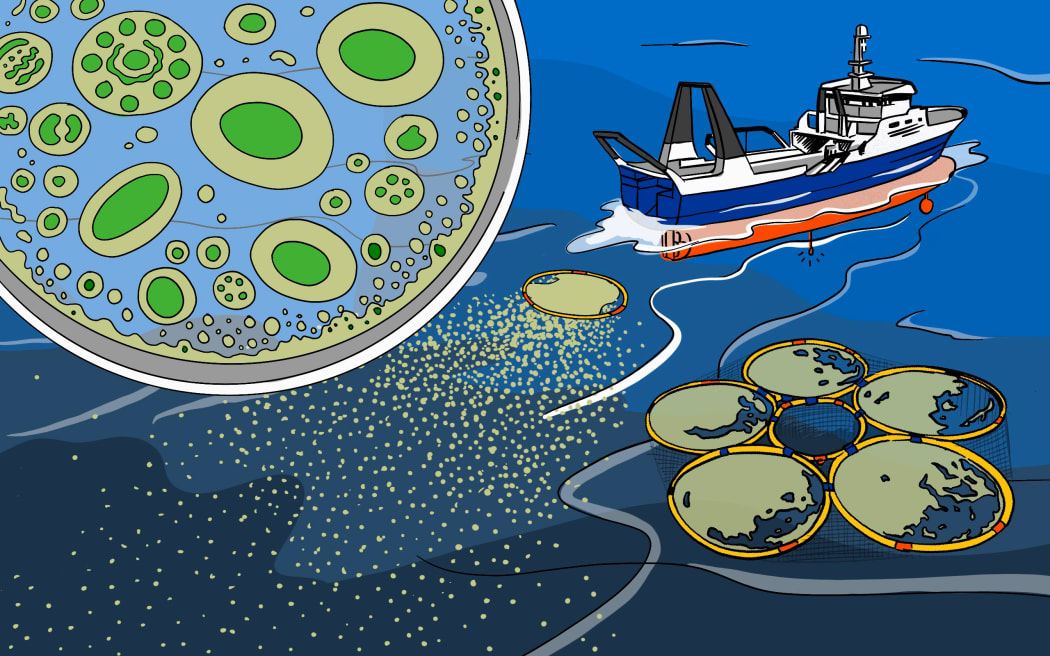
An illustration showing Gigablue’s proposed petal-like structure where carbon-capturing phytoplankton would grow.
Photo: RNZ
A company that says it has a startling solution to carbon storage wants New Zealand to make rule changes so it can forge ahead
Tonnes of little marble-sized balls of cellulose embedded with iron and manganese could be a part of ridding the planet of carbon emissions.
That’s if they work; if it can be proven that they work; and if New Zealand authorities allow an international company to run substantial experiments in our Exclusive Economic Zone.
The Environmental Protection Authority has allowed Gigablue to conduct small scale experiments but has so far balked at their plans to scale up, and the company’s requests to the Ministry for the Environment to change the regulations have gone nowhere.
Officials have also questioned whether the company’s plans are still research, or if they’ve moved to commercial activity – especially as they want to sell carbon credits from the work, in order to finance it.
RNZ climate change correspondent Kate Newton has written extensively on this issue, and ingested hundreds of pages of documents to give her a picture of what’s going on behind the scenes.
But there still wasn’t enough information there to convince scientists that the project could successfully help change the climate, without creating environmental risks. Most of the research hasn’t been published. Some of the documents that have been given up under the Official Information Act reveal doubts held by officials considering Gigablue’s requests.
Today on The Detail Newton breaks down the science in simple terms.
“There’s lots of different issues, and you can boil them down to two different categories.
“The first is, does it actually work? The second is, how do we prove it?
“There is a third category as well, which is what are the other effects it might be having on the ocean of doing all this?
“Gigablue is trying to do a type of marine carbon dioxide removal they call microalgae carbon fixation and sinking. What experts in both marine law and marine science that I have talked to have said is that what their technology appears to be is very similar to a type of carbon dioxide removal called ocean fertilisation, which has been very controversial.”
The EPA said its plans last year to deploy 1000 tonnes of particles into the ocean amounted to dumping, which is illegal.
Other schemes to use the ocean, or seaweed, to sequester carbon have met with protest and in the case of US company Running Tide, ended in total failure and the dumping of thousands of tonnes of woodchips into the sea off Iceland.
The industry and research around this is new, kicking off seriously in the last 10 years.
Newton says former climate change minister James Shaw, who has been doing some advising for Gigablue, has said that New Zealand could be a leader here.
“Because of our geographical positioning, this could actually be really good. It could create jobs, it could put us in a position where we are leading the way with this technology and able to capitalise on that.
“Both for economic benefit, but also just for the benefit of the planet itself.”
She says Shaw’s argument was that this is an urgent crisis that we’re facing, and that we need to be trying everything.
“This isn’t a silver bullet solution. It’s one tool in a toolbox. But if you don’t do the scientific research and don’t allow that scientific research programme to continue and conclude, then we’ll never know if it could have worked.”
Check out how to listen to and follow The Detail here.
You can also stay up-to-date by liking us on Facebook or following us on Twitter.
Sign up for Ngā Pitopito Kōrero, a daily newsletter curated by our editors and delivered straight to your inbox every weekday.