
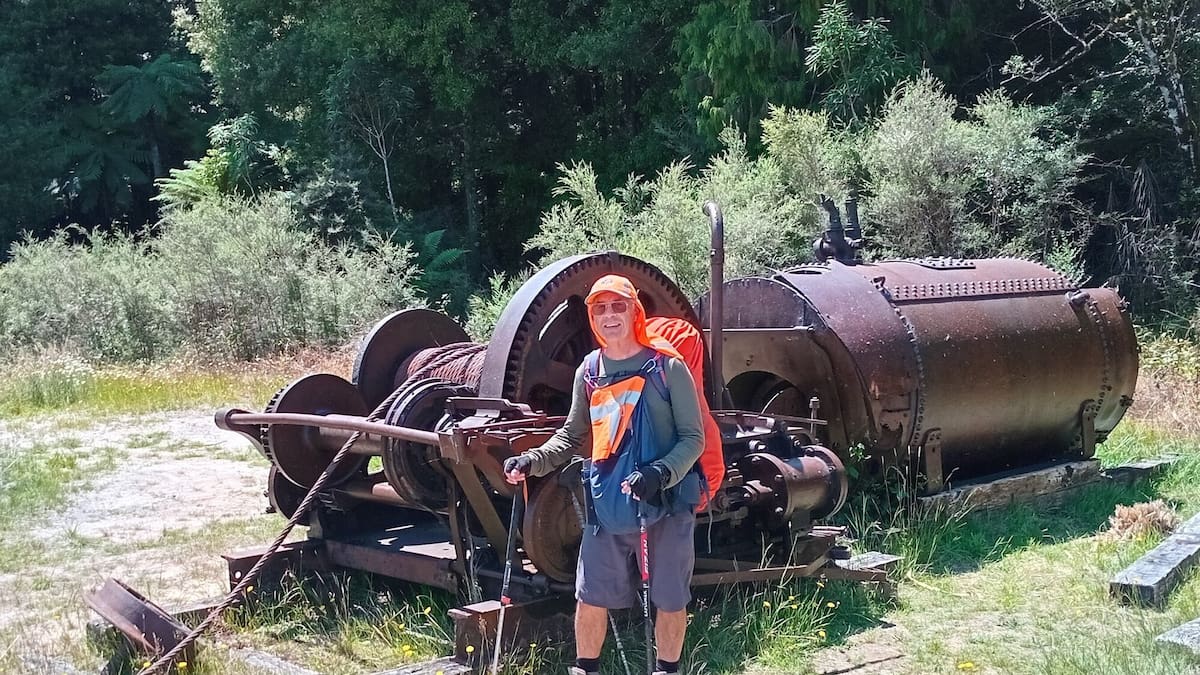
After completing the 3000km Te Araroa Trail and a South Island coast-to-coast trek “for fun”, Murphy said a friend suggested he make the next one count.
He chose to walk for Rotorua’s Plunket, The Salvation Army and Hospice – organisations that he said supported people at the beginning, middle and end of life.
The money was split evenly and presented to representatives on March 30 at a Rotorua Rotary Club meeting, of which Murphy is a member.
The retiree’s journey was unpredictable.
There were “boulder-strewn” streams, “washed away” tracks and 30m bluffs where the path had disappeared.
Terrain in Taranaki forced a change of course, adding an extra 17km.
He moved through the dark Moki and Kiwi Road tunnels in a high-vis hat, where he and a passing driver each “hugged the wall” as the car squeezed by.
There were long, quiet stretches through places like Waitaanga, Ahuahu and Matiere – communities with little traffic, abandoned houses and closed schools, with the feel of near “ghost towns”.
Murphy was joined by friend Peter Beets on the Timber Trail through the Pureora Forest, a nearly 80km route following historic logging tracks. They camped and stayed in a hut with “resident rats in the walls”.
Murphy spent five days pushing on through farmland to the edge of Kaingaroa Forest, timing his crossing for a Sunday to avoid logging trucks.
“In the hills on the eastern side of the Rangitāiki River, I listened to the sounds of kākā … and kōkako calling,” he said.
A herd of wild horses stopped him in his tracks – mares, foals and a protective stallion blocking the road from Minginui to State Highway 38. With thick gorse on either side, he edged past carefully.
That night he stayed in an abandoned house.
“The back wall and the back half of the floor of the house were missing … It took me a bit of time to tidy it up … sheep had been camping in it.”
In the ranges west of Lake Waikaremoana, Murphy was “soaked within minutes” as rain turned to hail, covering the road like “thick snow”. There was “booming” thunder and “large cracks” of lightning.
“It was a scary experience, to say the least,” he said.
With nowhere to shelter, he kept walking for more than 10 hours until he reached a campsite where hunters invited him to sit by the fire and share a cup of tea.
Beets rejoined him for the Lake Waikaremoana Great Walk before Murphy continued solo towards Wairoa.
Glen Murphy speaks at a Rotorua Rotary Club meeting about his 707km North Island walk and the funds raised for local charities. Photo / Annabel Reid
Temperatures climbed above 30C and planned water sources like the Waiau River were too muddy to drink. Murphy relied on locals, “knocking on doors” and asking them to refill his bottles.
He followed State Highway 2 to reach Māhia Peninsula after a total of 37 nights away.
Murphy said the highlight was the “interesting and incredibly generous people” he met along the way.
He was given free ice creams and drinks, meals including butter chicken and naan, and cooked breakfast.
Others handed over chocolate or a book when he ran out of reading material.
“I had people stop in their cars to offer me food, water, or a place to stay for the night,” Murphy said.
Funding to support locals at every stage of life
Murphy said the Rotorua Rotary Club played a key role in raising funds for the charities.
Rotorua Plunket clinical leader Cheryl Clark said the funding would support newly introduced local immunisation services, including equipment to make vaccinations less stressful for children.
This included a vibrating “Buzzy Bee” device with a cold pack to distract children during injections.
Clark said the funding would also strengthen before-school checks, giving nurses more consistent tools and helping better prepare children for school.
Glen Murphy (right) with representatives from Rotorua charities – Plunket, the Salvation Army and Hospice – after presenting funds from his 707km walk. Photo / Annabel Reid
Darnielle Hoods, Rotorua Salvation Army community ministries manager, said its share would go towards its community “choice model” supermarket, helping provide food to families in need.
She said limited resources meant demand was high with hundreds of families already seeking support this year. Many had to be turned away.
Most were not homeless, she said, but working families, solo parents and grandparents raising children, often turning to the Salvation Army as a last resort as living costs continued to rise.
Jess Meade, Rotorua Hospice fundraising and marketing manager, said its share would go into the Rotary Rotorua Hospice Fund, where it would be invested to support ongoing care.
Returns from the fund help cover operating costs, including keeping nurses on the road and available 24/7 to support patients and families.
She said the service remained vital, ensuring people could receive care and die with dignity, with support available whenever it was needed.
Annabel Reid is a multimedia journalist for the Bay of Plenty Times and Rotorua Daily Post, based in Rotorua. Originally from Hawke’s Bay, she has a Bachelor of Communications from the University of Canterbury.