
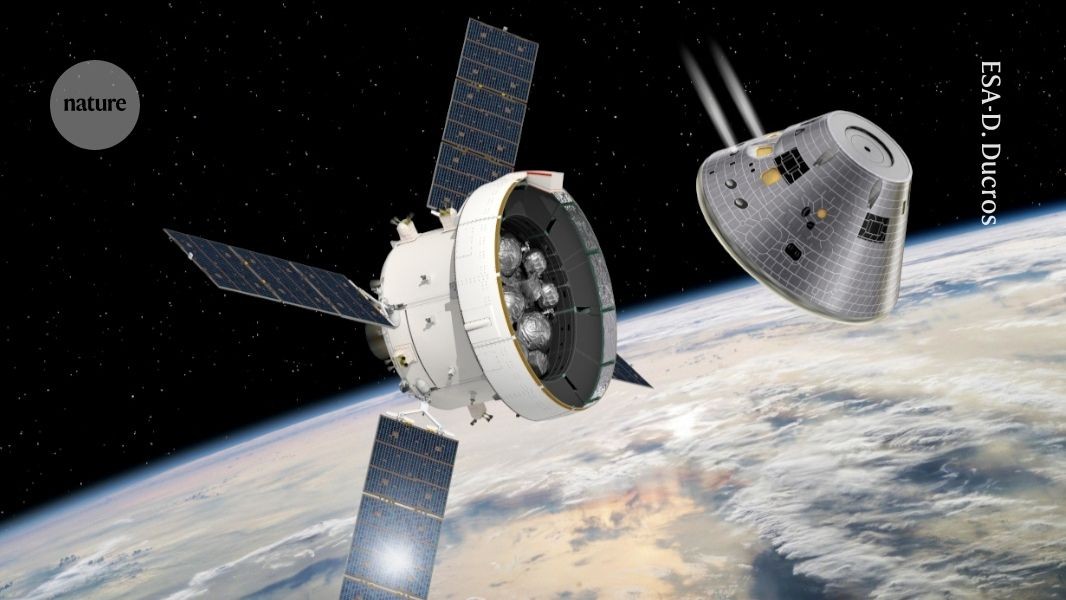
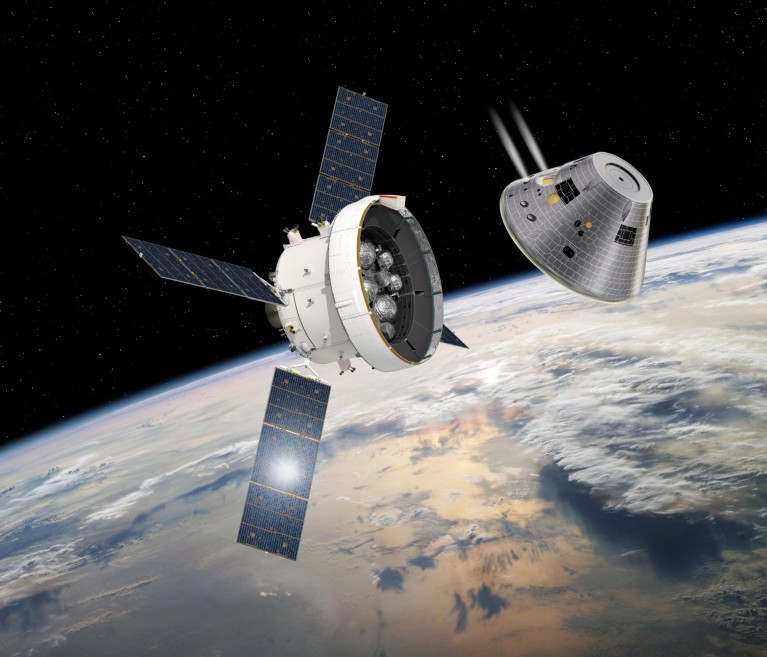
The European Service Module, depicted on the left, provides propulsion and life-support systems for the Orion spacecraft.Credit: ESA-D. Ducros
As the Orion spacecraft heads back to Earth and towards the conclusion of the Artemis II lunar fly-by journey, it is doing so with the support of European engineering.
Four astronauts — three from NASA and one from the Canadian Space Agency — are travelling inside the crew module at the top of the Orion spacecraft. The propulsion and life-support systems that are contained in its lower half were designed and built by aerospace company Airbus based in Leiden, the Netherlands, on behalf of the European Space Agency (ESA).
This European Service Module (ESM) is providing Orion’s propulsion . It also provides the crew’s life-support systems, such as water and air supplies, and maintains the module’s temperature, all of which are powered by the module’s four solar wings.
Historic Artemis II Moon fly-by: Nature’s live coverage as it happened
Didier Schmitt, who heads ESA’s future preparation team and is based in Cologne, Germany, says the module has been reported to perform flawlessly. “The ESM has performed very well,” says Jonathan McDowell, a retired astrophysicist based in London. European participation is “extremely significant”, says Schmitt. “NASA usually doesn’t want to be dependent on anybody for something so critical.”
The ESM’s role began with the 5 minutes and 50 seconds of main-engine burn that jolted the spacecraft out of its initial Earth orbit and propelled it on its way towards the Moon. That manoeuvre “happened perfectly to plan”, says Siân Cleaver, industrial engineer for the ESM at Airbus Defence and Space in Bremen, Germany. Its precision removed the need for multiple adjustments of the spacecraft’s trajectory later on, she adds.
European space objectives
Airbus has leveraged decades of European expertise in human space flight to produce the ESM. That history goes back to Spacelab — a laboratory module that flew aboard NASA’s Space Shuttle in several missions from the 1980s to the late 1990s — and continued with Airbus’s design and construction of the Columbus laboratory, the European module of the International Space Station, says Cleaver. “We couldn’t have done this without those previous projects.”
As the United States shifts away from international organizations such as the World Health Organization, NASA has retained some of its international projects, including Artemis. “The ESM is almost a holdover from a more internationalist approach,” says McDowell.
Airbus has already delivered four ESM modules, including those for the upcoming Artemis III and IV missions, and two more are under construction. Although the first race to the Moon was a competition between the United States and the Soviet Union, Cleaver says she hopes the Artemis programme will continue to be a model of international cooperation. “Going to the Moon is an opportunity for us as humanity to do things right this time.”
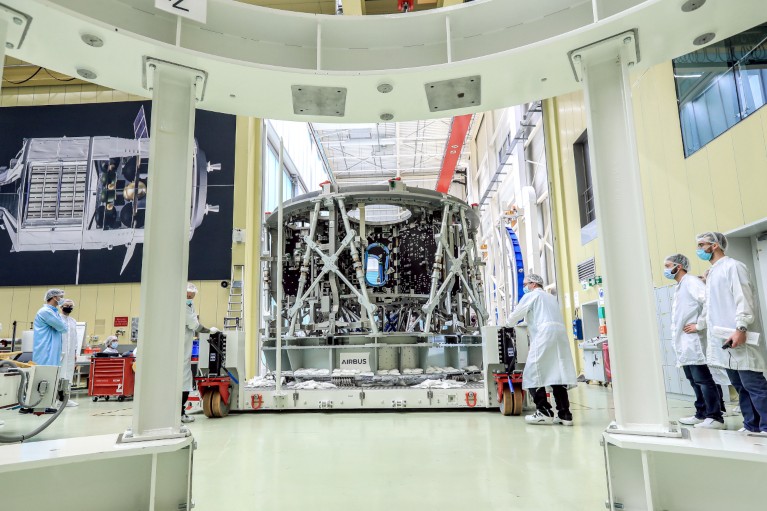
The European Service Module was built by Airbus in Bremen, Germany.Credit: Airbus
International collaboration
The Artemis programme was designed to have international and private-company components from the start, with ESA contributing to three main parts. In addition to providing the ESMs for each Artemis flight, the space agency had also agreed to build two modules for the lunar Gateway, an international space station that was intended to orbit the Moon, and send three European astronauts to it.